
Moon: What Was Its Role In Beliefs Of Ancient People?
A. Sutherland - AncientPages.com - The enigmatic moon has always fascinated humanity. Its brilliant presence in the night sky symbolized hope and enlightenment. As often as with the sun, the moon was associated with birth, death, resurrection, and fertility symbols.
The moon was believed to control water and our dreams, and its dark side was especially connected to the occult.

Credit: Public Domain
The moon's cyclical migration across the sky and its ever-changing form were, in early societies, a powerful symbol of the human life cycle. From the new moon to the full moon, each phase was assigned a special meaning, and similar was with lunar eclipses. In addition to its influence on the tide, the weather, and life in general, the moon was also said to control the fate of the people.
It was always believed that the moon's phases influenced events on earth: not only the flow and ebb of the tides but also blood-letting and haircuts were planned according to the lunar cycle.
Over the world, cultures have developed myths about solar and lunar remarks. Many believed that they were foreclosing natural disasters or the deaths of royalty. In some Asian cultures, it was believed that lunar remarks were caused by demons or dragons that swallowed the moon.
In many ancient cultures, the waxing and waning of the moon and the inevitable return of the same lunar form make a striking symbol for philosophers whose theories combined death and rebirth.

Left: Prediction of fertility with the help of the Moon's phases; Right: Lunar god Chandra, Tibet
The full moon (like the circle) was a symbol of wholeness and strength. Generally, the moon was considered "female," as the receiver of the sun's light, but also because of the similarities between the lunar month and the menstrual cycle. The Chinese associated it with the yin and the female, too. In their yin-yang system, there is maleness in the moon and femaleness in the sun as well. Thus, the moon is female in its waning and male in its waxing.
In Korea, as in China, there is a myth about an archer who shoots down unwanted heavenly bodies (one sun and one moon). Among the Khmer people, there was a belief that the moon - a protector of humans by its dimly lighting up during the night - rides a wonderful silver chariot across the sky each night.
For the Buddhists, the moon represents spiritual strength. The harvest month (full moon near the autumn equinox) symbolizes the fertility of the fields.
The Chumash Indians of the California Coast saw the moon, a female god in charge of human health. Among the ancient Egyptians, the Moon was either Thoth, the god of wisdom and writing, or Khonsu, a healer and protector and an enigmatic figure with his dark side.
The ancient Greeks had a lunar deity, Selene, who was associated with the word selas’, which also means ‘light’, and Artemis, goddess of the Moon and the twin sister of Apollo.
The Maya believed in the goddess Ixchel, who was associated with the moon, medicine, childbirth, and weaving. Ixchel was the mother of the Bacabs, four brothers who were believed to be the four Atlantean gods – the giants. Among the Mayans, the moon had a powerful influence on terrestrial events. A waxing moon had the attributes of the beautiful, ideal woman, while a waning moon was considered to be an old divine woman who governed over childbirth.
The ancient Aztecs believed that daily movements of the moon and sun movements symbolized the struggle. Their moon goddess was Coyolxauhqui, who was also the sister of the Sun god, Huitzilopochtli. It is said that she appeared in the sky when her brother cut off her head and threw it into the sky to form the Moon.
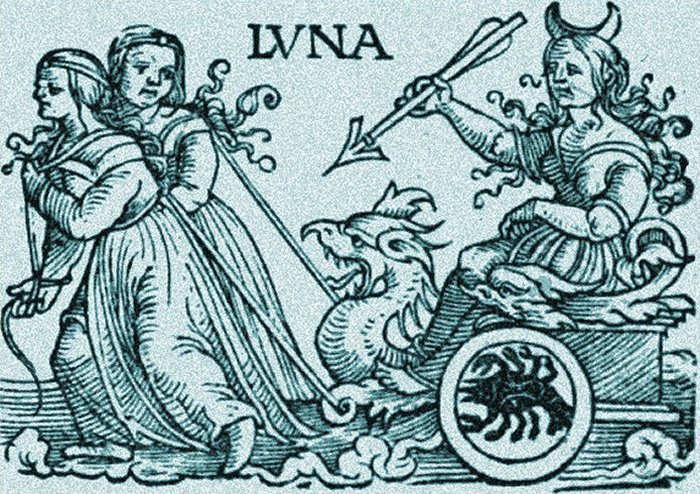
An ancient moon Goddess, the namesake for the Latin word luna meaning 'moon'. Her name also forms the root of the English words 'lunar' and 'lunatic'.
Interestingly, in 1978, a carved, circular Aztec stone depicting the mythical being Coyolxauhqui dismembered and decapitated was accidentally discovered in the ruins of the Templo Mayor of Tenochtitlan, now in Mexico City.
In ancient traditions of Peru, the worship of the moon was subordinated to that of the sun, wrote the Inca chronicler and writer, Garcilaso de la Vega (1539-1616). He named the moon "the wife of the sun" and described that walls inside the lunar temple were covered with silver "so that their whiteness might immediately proclaim this the chamber of the moon.” The moon was the sister and the wife of the sun as well as the mother of the King and the entire race and thus was called 'Mamaquilla’ (or 'Mother Moon’ - Mama Killa). In Inca mythology, she was the third power and goddess of the moon.
The chronicler also mentioned, there were no sacrifices to the moon like those to the sun. “On either side of the figure representing the moon were the bodies of the deceased queens of the Incas, arranged in order of age and royal succession."
Updated on September 18, 2024
Written by – A. Sutherland - AncientPages.com Senior Staff Writer
Copyright © AncientPages.com All rights reserved. This material may not be published, broadcast, rewritten or redistributed in whole or part without the express written permission of AncientPages.com
More From Ancient Pages
-
 Mystery Of The Ancient Sitovo Inscription: Undeciphered Script Or Just A Natural Rock Formation?
-
 Star-Shaped Magnetic Anomaly At Hidden Stone Circle In The Outer Hebrides Gives New Insight Into Ancient Beliefs
-
 Illuminati: Facts And History About The Secret Society
-
 Asenath And The Golden Tablet That Changed Her Destiny
-
 Hidden Mega-Monument Discovered At Laona, An Ancient Burial Mound In Cyprus
-
 Lacrosse Was Invented By Native American Indians
-
 Roman Naval Base of Haltern in Germany Was Rebuilt Four Times 2,000 Years Ago
-
 Lake Huron Was Home To A 9,000-Year-Old Civilization – Underwater Structures And Artifacts Reveal
-
 Merneith: Mysterious Queen In The Land Of The Pharaohs Could Be Earliest Attested Female Ruler
-
 Armenia: Old Land Where Myths, Legends And Long History Meet
-
 World’s Oldest Shoe Is 5,000-Year-Old
-
 On This Day In History: Cyrus The Great And His Army Took Babylon – On Oct 12, 539 BC
-
 The Ruins Of Pennard Castle And The Tale Of Faeries’ Curse
-
 Abric Romaní Cave: New evidence indicates Neanderthals used to heat water some 60,000 years ago
-
 4,000-Year-Old Tomb Altóir Na Gréine Rediscovered By Folklorist In County Kerry, Ireland
-
 Oldest Fossil Human Footprints In North America Confirmed
-
 Outstanding Unfinished Ancient Marble Carving Of A Lion’s Head Found Near Selinunte, Sicily
-
 The Untold History Of The Horse In The American Plains Revealed
-
 Neanderthals Had Capacity To Speak And Understand Language Like Humans
-
 Unraveling Pharaohs’ True Knowledge Of Hieroglyphs – Could All Pharaohs Read And Write?

