
Sobekneferu: First Female Pharaoh In Ancient Egypt
A. Sutherland - AncientPages.com - A number of rulers in ancient Egypt were named in honor of Sobek, an important ancient Egyptian deity of the 12th Dynasty, who was associated with the Nile crocodile or the West African crocodile.
One of such rulers was Sobekneferu (her name means "the beauty of Sobek") . She was the sister (or the sister-wife) of the last king, Amenemhet IV, the last ruler of the 12th Dynasty. Unquestionably, Sobekneferu, also known as Neferusobek was the first female pharaoh of Egypt. Her name was included in the Saqqara King List, probably dated to the reign of Ramses II (1290-1224 BC).
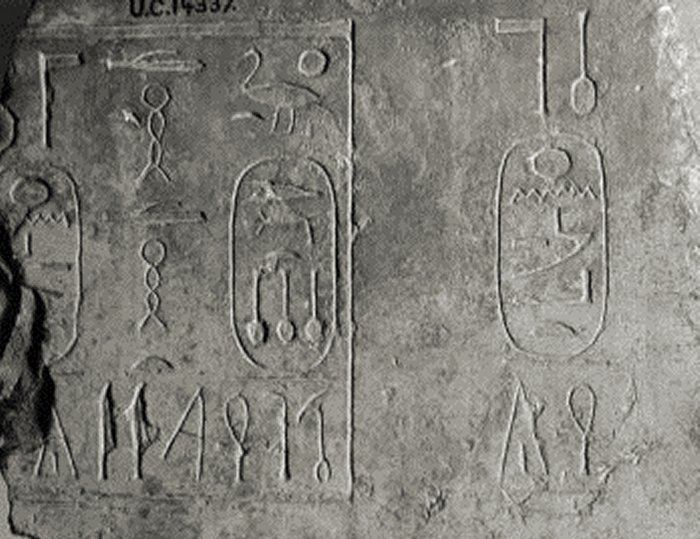
Attestation in the Petrie Museum: relief fragment found at Hawara. Image source
She took the throne after the death of her brother Amenemhat IV, a peaceful ruler who focused his ruling years on expeditions in the Sinai for turquoise, in Upper Egypt for amethyst, and to the Land of Punt.
Queen Sobekneferu was the royal daughter of Amenemhat III, whose reign is considered to be the golden age of the Middle Kingdom. Sobeknefeu was associated with Amenemhat III rather than her brother Amenemhat IV.
Sobekneferu ruled from 1806 to 1802 BC but according to the Turin Canon, an ancient Egyptian papyrus probably dated to the reign of Pharaoh Ramesses II, Sobekneferu ruled exactly three years, ten months, and twenty-four days. It is evident that she was the last pharaoh of the Twelfth Dynasty but not much can be said about the period of her reign.

Left: Bust of Sobekneferu (Louvre). Source; Right: Drawing by Flinders Petrie of the cylinder seal of Sobekneferu in the British Museum
It is known, however, that according to Egyptian tradition, Sobekneferu ruled independently and did not have a successor to claim the throne.
See also:
Shishak (Sheshonq I): Egyptian King Who Invaded Judah And United Egypt
Harem Conspiracy – Plot To Murder Ramesses III, The Last Great Warrior Pharaoh
Ankhesenamun – Mysterious Death Of Tutankhamun’s Wife Ended The True Amarna Bloodline
According to the Danish Egyptologist, Kim Ryholt, the contemporary sources from the time of her reign show that Sobekneferu never adopted the title of King's Sister-only "King's Daughter". Sobekneferu was never as popular as Pharaoh Hatshepsut and other ruling queens of ancient Egypt because she contributed with fewer monuments.
Death Of Pharaoh Sobekneferu
The death of Queen Sobekneferu marked the end of the Middle Kingdom. After her, a number of kings, mentioned in the Turin Canon papyrus, claimed their rights to the throne but ruled only for a shorter period of time.
These kings initiated the 13th Dynasty of rulers in ancient Egypt.
Legacy And Statues Of Sobekneferu
There have been unearthed statues related to Pharaoh Sobekneferu in places such Fayoum and Tell el-Daba, an archaeological site in the Nile delta region of Egypt where Avaris, the capital city of the Hyksos, was once located.
Inscription on the nilometer at Nubian Semna informs about only three years of her rule. An inscription from Hawara also mentions her name.
She is also credited for additions to the funerary complex of her father, Amenemhat III at Hawara (called a labyrinth by Herodotus), and also ordered the construction of structures at Heracleopolis Magna.
She is believed to have built a pyramid at Mazghuna, near Dahshur, on the west bank of the Nile about 40 kilometers (25 mi) south of Cairo. The Mazghuna structure was excavated by Flinders Petrie, an English Egyptologist in 1911. The pyramid has not been completed and never used.
Written by – A. Sutherland - AncientPages.com Senior Staff Writer
Copyright © AncientPages.com All rights reserved. This material may not be published, broadcast, rewritten or redistributed in whole or part without the express written permission of AncientPages.com
Expand for referencesMore From Ancient Pages
-
 Ancient Symbol Hamsa: It’s Meaning And History Explained
-
 Fascinating Ancient And Unexplained Mysteries Of Arizona – Strange, Unknown Creatures, Baffling Vanishings And Anomalies – Part 2
-
 Aegir – Jotun Lord Of The Stormy Seas Revered And Feared By Norsemen
-
 Uplistsikhe Devastated By Genghis-Khan Hordes But Once City-Fortress Of Queen Tamar
-
 Neanderthals Buried Their Dead And Developed Spirituals Beliefs – Did Neanderthals Practice Religion?
-
 When And Why Did Humans Start Using Tombstones?
-
 The Knap Of Howar: One Of The Oldest And Well-Preserved Neolithic Complexes Orkney, Scotland
-
 Major Earthquake Struck The Atacama Desert 3,800 Years Ago, Forcing Hunter-Gatherers To Move Inland
-
 Astonishing Lunar And Solar Calendars Created 30,000 B.C.
-
 Gilded Coffin Of Nedjemankh, Priest Of Ram-God Heryshef Recovered By Egyptian Authorities
-
 Master Kong Confucius: Great Philosopher And ‘Teacher Of All Teachers’ Ahead Of His Time
-
 11 Ancient Sacred Indian Symbols Explained
-
 Elk Tooth Rattlers And People’s Dance 8,000 Years Ago
-
 Secrets Of Maxims Of Ptahhotep – Ancient Egyptian Wisdom Is Still Relevant Today
-
 Enigma Of The Mysterious Ancient Shining Twins – Were They With Humans From The Beginning Of History? Part 1
-
 Rare Well-Preserved 2,500-Year-Old Dagger Linked To The Keeladi Civilization Discovered In Tamil Nadu, India
-
 Evidence Scots And Irish Settled Iceland A Century Before The Vikings?
-
 Rare Discovery Of 8,500-Year-Old Human Teeth Used As Jewelry
-
 Hoard Of Roman Bronze Coins Turns Out To Be Offering For Safe Crossing
-
 On This Day In History: Captain James Cook Spotted The East Coast Of Australia – On Apr 19, 1770

