
Truly Bizarre And Most Fearsome Ancient Helmets Ever Seen
AncientPage.com - Going to war in ancient times involved more than just great military strategy and excellent warrior skill. To conquer your enemy, it was assumed the warriors must look as fearsome as possible.

We have previously seen that Aztec Eagle Warriors and Jaguar Warriors who were without doubt some of the most skilled and feared fighting forces of the ancient world wore special armor and headdresses. Eagle Warriors were adorned in eagle feathers and wore headgear with an eagle head on it, their faces looking out from an open beak. Jaguars wore suits made from the pelts of pumas (jaguars) and associated themselves with their god of night.
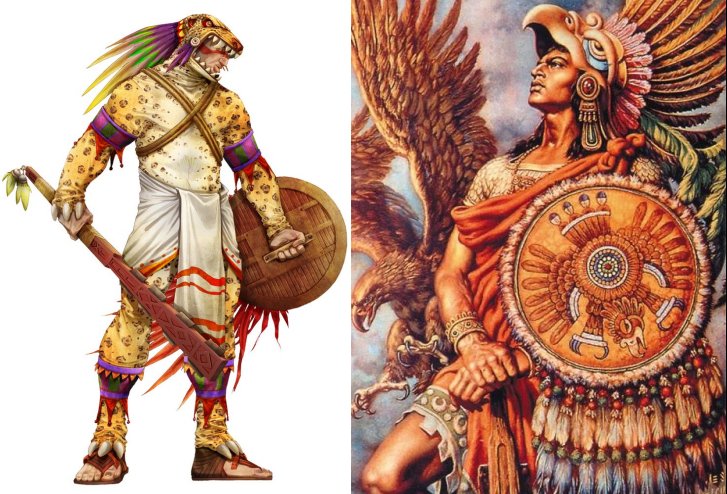
Aztec Jaguar and Eagle Warrior
It is believe that Vikings filed their teeth to frighten opponents in battle or to show their status as a great fighter.
The Winged Hussars were one of the most effective military forces in the world. The Winged Hussars were known for the wings with long feathers worn on their backs or attached to the saddles of their horses, which during a charge uttered a sound of vibrating feathers that frightened enemy infantry.

Winged Hussars
King Henry VIII is today often remembered for his many marriages. He also played a critical role in the English Reformation, turning his country into a Protestant nation. King Henry VIII also had an unusual taste in weapons and armour.
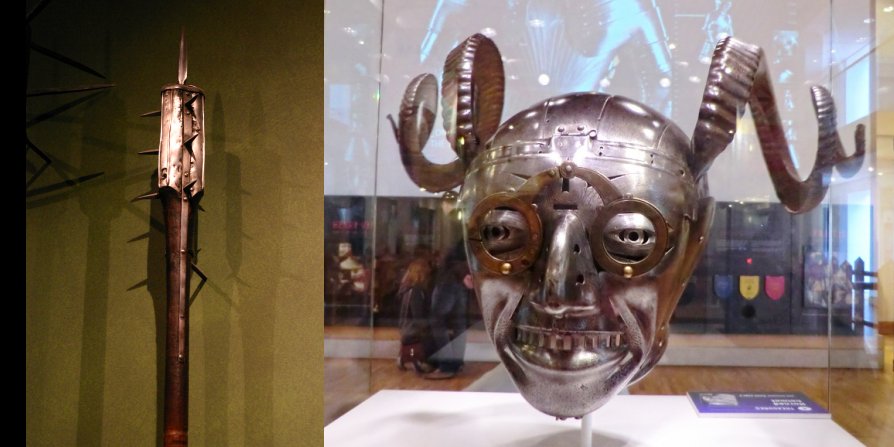
King Henry's Walking Staff and Horned Helmet
Helmets fitted with mask-like visors were a popular German and Austrian fashion about 1510 to 1540. With their visors forged and embossed as humorous or grotesque human masks, such helmets were often worn in tournaments held during the exuberant pre-Lenten (Shrovetide) festivals, celebrations somewhat akin to the modern Mardi Gras.

Grotesque human mask-like visors were really popular in Germany and Austria in the early 16th century.
Other ancient helmets were made in the likeness of frightening animals or strange objects.

Kolman Helmschmid, Helmet (Burgonet) of Emperor Charles V, c. 1530, Patrimonio Nacional, Real Armería, Madrid
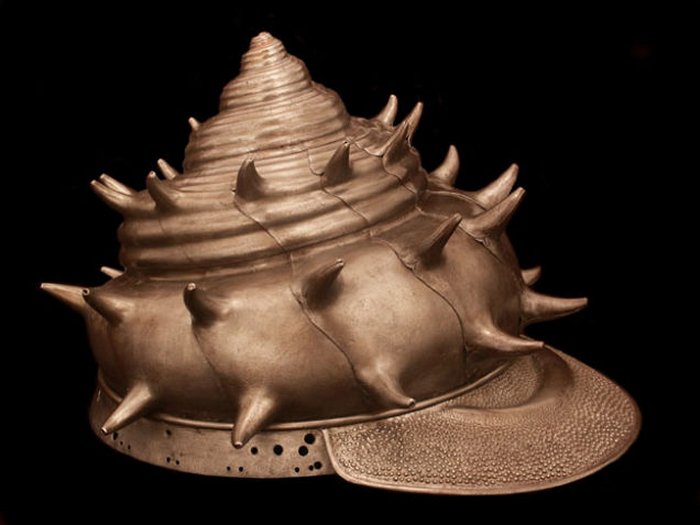
Helmet in the form of a sea conch shell, 1618, Japan

The ceremonial and parade helmets of Charles V
Desiderius Helmschmid, c. 1540
Impressive helmet masks abound in the region spanning the present-day national borders of Côte d'Ivoire, Mali, and Burkina Faso. Sculptors carve works intended to incite fear by making visual references to powerful animals, including crocodiles, warthogs, and antelopes.
See also:
Winged Hussars: Facts And History About The Polish Warriors, Their Armor And Military Tactics
Fearsome Aztec Eagle Warriors And Jaguar Warriors Of Mesoamerica
King Henry VIII’s Walking Staff And Other Unusual Weapons
The aggressive imagery artists create in helmet masks like this one contrasts with their more delicate handling of kpeliye'e face masks. Not associated with any single animal, kponyugo helmet masks foster spectators' uncertainty and apprehension.
The aggressive imagery artists create in helmet masks like this one contrasts with their more delicate handling of kpeliye'e face masks. Not associated with any single animal, kponyugo helmet masks foster spectators' uncertainty and apprehension.
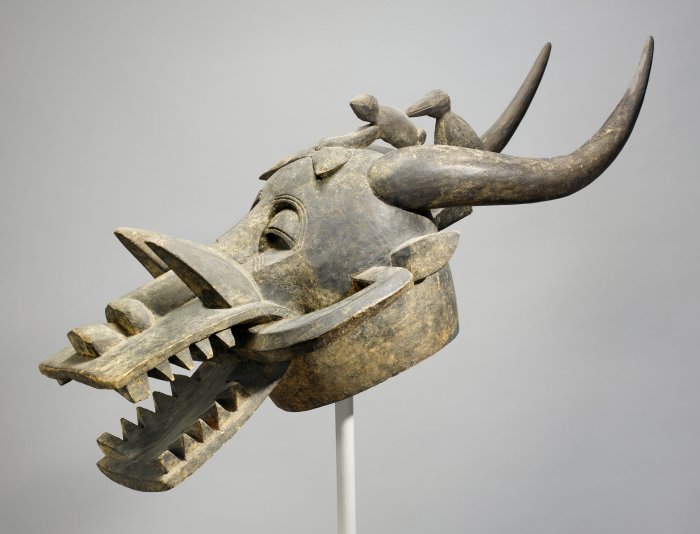
Helmet Mask (Kponyugo)
The mask's open jaws and sharp teeth appear ready to devour its prey and thus visually underscore its ferocity. Members of poro and other fraternal associations in the region don composite helmet masks and full-body outfits during funerals and on other occasions to punish human lawbreakers and deter malevolent spirits.
Due to the aggressive and combative nature of the helmet masks and their performances, women and children are enjoined to avoid seeing them, a stricture honored due to the costly consequences that transgressions precipitate.

Roman Cavalry Helmet, 100-250 A.D.
The most vulnerable part of the soldier in battle was his head, so the search for protection by some form of helmet goes back to the earliest times. The technology of armor was constantly evolving and different armies during different periods favored special shapes for their helmet.
Helmets were purpose-built to protect the wearer against the specific weapons he faced, but as we have just seen, the helmets were often also especially designed and modified to frighten the enemy.
Copyright © AncientPages.com All rights reserved. This material may not be published, broadcast, rewritten or redistributed in whole or part without the express written permission of AncientPages.com
More From Ancient Pages
-
 Large Collection Of 2,200-Year-Old Tombs With Boat Coffins Made Of Nanmu Wood, Unearthed In SW China
-
 Amazing Tomb Of Yuya And Tjuyu Filled With Ancient Treasures In The Valley Of The Kings
-
 The Legend Of Little Deer – Interesting Cherokee Tale Of How Disease And Medicine Began, And Why The Native Americans Respect All Life
-
 Declining Fertility Rates May Explain Neanderthal Extinction
-
 Mada’in Saleh: Magnificent Timeless Rock-Cut Tombs And Monuments In The Desert
-
 Last Fragment Of Early Christian Christogram Found In Ancient City Of Parthicopolis, Bulgaria
-
 Evidence Of The Moon-Eyed People – Strange Runic Tablet And A Curious Discovery In North Dakota – Part 1
-
 What Fossils Reveal About Hybridization Of Early Humans – History Of Humankind Is More Complex Than Previously Thought
-
 Are Bones Of Apostle Peter Hidden Inside A 1000-Year-Old Roman Church?
-
 11,000-Year-Old Human Remains Found At Heaning Wood Bone Cave In Britain
-
 15 New Archaeological Finds Unearthed In Pre-Inca Ruins Of Tiwanaku, Bolivia
-
 On This Day In History: ‘The Wars Of The Roses’ – Fighting For The Throne Of England At Tewkesbury – On May 4, 1471
-
 Modern Humans Traveled Across The Eurasian Steppe 45,000 Years Ago
-
 Extraordinary Kite-Shaped Pictish Ring Found At Moray Fort In Scotland
-
 Tarkhan Dress – The World’s Oldest Woven Garment
-
 Humans Survived A Covid-19-Like Pandemic 25,000 Years Ago
-
 Gilded Coffin Of Nedjemankh, Priest Of Ram-God Heryshef Recovered By Egyptian Authorities
-
 Tiglath Pileser III: Neo-Assyria’s Strong King Who Built A Mighty Empire
-
 Rare Rock Panel Sheds New Light On Ancient Egyptian History
-
 Chankillo: A 2300-Year-Old Solar Observatory in Peru

