
Prehistoric Hi-Tech Nanospirals Barely Visible To The Naked Eye: Still Remain An Unsolved Mystery
A.Sutherland - AncientPages.com - Strange microscopically small nanospirals within the material that had to be at least 100,000 years old have been detected in several places, during a routine investigation of mineral deposits in the Ural Mountains in 1992.
The origin of these extraordinary and strange artifacts that the human eye can barely see - is still not explained.

There were many speculations regarding the nanospirals. Some said they are forgery, but alternative history researchers think the artifacts offer proof of advanced ancient high-tech knowledge.

However, the discovery of these prehistoric artifacts is very interesting, because the sophisticated technology required to make this kind of product - only goes back to the 1970s.
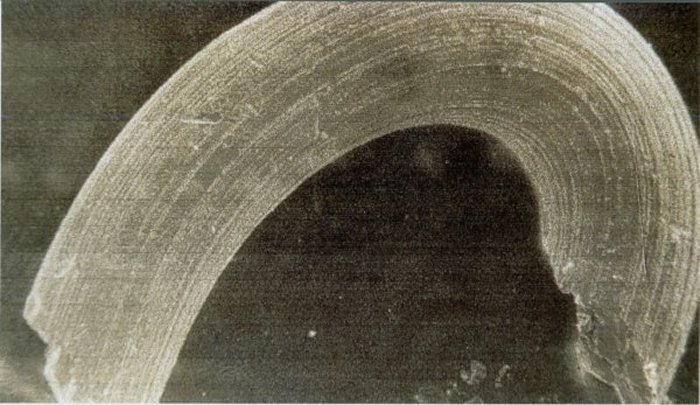
The spirals range between 3 cm and 0.0003 mm in size. Their remarkable regularity in structure and smooth surfaces, perforated in places, are only visible under an electron microscope.

The nanospirals are of copper, tungsten or molybdenum. The latter two metals along with others are used in electronics and rocket technology.
The nanospirals are mainly made of tungsten and their cores are tungsten or molybdenum. Ones discovered at a later date were also made of copper.
Fascinating is the spirals' proportion due to their surprising regularity, which indicates that they could only have been manufactured by mechanical means. So one can say their construction is artificial.
Their date of origin is estimated between 300,000 and 100,000 BC.
Written by – A. Sutherland - AncientPages.com Senior Staff Writer
More From Ancient Pages
-
 Ruins Of The Ancient City Of Palmyra Documented – What Remains After The Fall Of The Assad Regime
-
 Mysterious El Caracol At Chichen Itza: What Did Maya Astronomer-Priests Observe In The Sky?
-
 Rock-Cut Tombs Of Beni Hasan With Spells, Prayers To Osiris And Anubis And Map To Underworld
-
 2,000-Year-Old Stela And ‘Laboratory’ Of Early Maya Writing Found In Guatemala
-
 Tides And Hurricane Activity Impacted The Maya Civilization – What Can This Tell About Modern Climate Change?
-
 Tomte – A Beloved Scandinavian Christmas Gnome
-
 New Insights Into The Dawn Of The Indo-European Languages
-
 Lamplighters In London: An Important Job In The Victorian Era
-
 Huginn and Muninn: Powerful Ravens Of Odin, Supreme God In Asgard In Norse Mythology
-
 Mysterious Gold-Colored Chariot Washes Ashore In India – But Where Did It Come From?
-
 3.6 Million-Year-Old Rare Skeleton Of Human Ancestor Revealed By Researchers In South Africa
-
 Huge Untouched Vassal King Tomb From The Ming Dynasty Discovered In Xinfu District, China
-
 Aegir – Jotun Lord Of The Stormy Seas Revered And Feared By Norsemen
-
 Secrets About ‘Tennessee’s Ancient Egyptian Temple’ Revealed
-
 Karakorum – Genghis Khan’s Headquarters And Important City In History Of Silk Road
-
 Discovery Of Chromosomes Offers Evidence Of Ancient Humans Living In South America Over 18,000 Years Ago
-
 Strange 1,200-Year-Old Anglo-Saxon Artifact Used For Unknown Purpose Found In Norfolk, UK
-
 Controversial 5,500-Year-Old Sumerian Star Map Of Ancient Nineveh Reveals Observation Of Köfels’ Impact Event
-
 Tooth Analysis Reveal Nebraska Resembled A Dry Savanna 18 Million Years Ago
-
 Medieval Wooden Stave Churches In Norway Are Older Than Previously Believed

