
Genghis Khan Has 16 Million Relatives – You Could Be One Of Them
Ellen Lloyd - AncientPages.com - Legendary Mongol leader Genghis Khan (1162-1227) is today famous for establishing the largest empire in history. He was a ruthless killer, but also a brilliant military innovator who practiced the ‘surrender or die’ policy.
Genghis Khan massacred millions of Asian and Eastern European people. However, he also practiced religious and racial tolerance, and his Mongolian Empire valued the leadership of women.
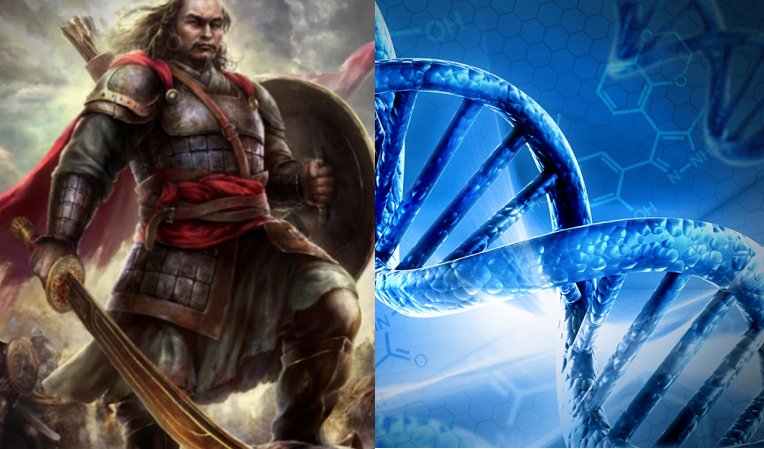
Genghis Khan married at age 16, but had many wives during his lifetime and naturally plenty of children.
He and his sons vanquished peoples from the Adriatic to the Pacific, reaching modern Austria, Finland, Croatia, Hungary, Poland, Vietnam, Burma, Japan and Indonesia. At their peak, the Mongols controlled between 11 and 12 million contiguous square miles, an area about the size of Africa.
Modern developments in DNA testing have revealed a vast number of people may, in fact, be directly related to Mongolian warrior king Genghis Khan.
A 2003 groundbreaking historical genetics study revealed that close to 8 % of men living in the former Mongol Empire carry identical Y-chromosomes. That 8% is 0.5 percent of the male worldwide population, which translates to a staggering 16 million descendants alive today.
Scientists have traced this lineage back to around 1,000 years ago, and the very special set of circumstances required for such a vast spread of DNA point to one man – a certain Genghis Khan.
“We have identified a Y-chromosomal lineage with several unusual features. It was found in 16 populations throughout a large region of Asia, stretching from the Pacific to the Caspian Sea, and was present at high frequency: ∼8% of the men in this region carry it, and it thus makes up ∼0.5% of the world total.
The pattern of variation within the lineage suggested that it originated in Mongolia ∼1,000 years ago. Such a rapid spread cannot have occurred by chance; it must have been a result of selection.
The lineage is carried by likely male-line descendants of Genghis Khan, and we, therefore, propose that it has spread by a novel form of social selection resulting from their behavior,” researchers of the American Society of Human Genetics state.
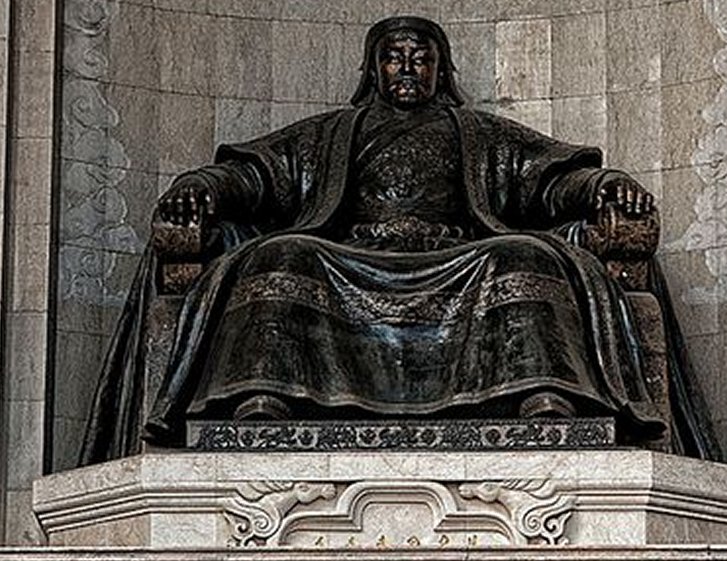
We mustn’t forget that Genghis Khan and his sons were well-known for their brutality and rapes. The number of offspring his own sons boasted was staggering. His oldest son had 40 sons and numerous daughters. One of his grandsons had 22 legitimate sons. If we add to this, his other sons and their children, we get a good idea of how it’s really possible so many people are descendants of Genghis Khan.
Although this theory is impossible to ascertain without a sample of Khan’s own DNA and we have no access to his body, it does seem likely that these identical chromosomes are linked in some way to Genghis Khan.
Genghis Khan died on August 18, 1227, during the siege of Ningxia. The cause of his death remains unknown and has been attributed to being slain in battle, illness, falling from a horse.
His final resting place remains unknown. There are suspicions the tomb of Genghis Khan is hidden in the Khentii Mountains. It is allegedly protected because people fear it’s cursed, but these are only rumors and solid evidence is missing.
Written by Ellen Lloyd – AncientPages.com
Copyright © AncientPages.com All rights reserved. This material may not be published, broadcast, rewritten or redistributed in whole or part without the express written permission of AncientPages.com
Expand for referencesMore From Ancient Pages
-
 More Anglo-Saxon Burials And Artifacts Found In Lincolnshire, UK
-
 Ancient Secrets Of Polish Ciemna Cave Inhabited By Humans 120,000 Years Ago
-
 Bizarre Ancient Lie Detector – The Mouth Of Truth – Bocca della Verità
-
 Neanderthals Are Not The Only Species Whose Dentition Is Characterized By The Possession Of Thin Enamel
-
 Unusual 260,000-Year-Old Modern-Shaped Florisbad Skull Challenges The Theory Of Evolution
-
 Evidence Humans Walked The Great Plains 18,000 Years Ago May Have Been Found – Archaeologists Say
-
 Evidence For Milk, Meat, And Plants In Prehistoric Kenya And Tanzania
-
 Fascinating Millennia Old Natufian Culture: Funerals With Flowers, Food And Pounding Sound Of Mortars
-
 Colossus of Ramesess II At Karnak Temples Is Undergoing Restoration
-
 On This Day In History: American General Benedict Arnold Commits Treason – On Sep 21, 1780
-
 On This Day In History: Joan Of Arc Was Captured By The Burgundians – On May 23, 1430
-
 Knowledge Of Divine Alien Beings And High-Tech In Ancient Egypt Described In Sacred Books And Papyrus – The God Who Spoke About Time Dilation – Part 1
-
 Socrates: Great Philosopher And Brave Man Who Still Inspires Many People
-
 First Known Depiction Of The Biblical Heroines Deborah And Jael Unearthed On 1,600-Year-Old Mosaics
-
 Amazing Prehistoric Forest Submerged Under Water Thousands Of Years Ago Re-Emerges On Welsh Beach
-
 Ancient Mammoth Ivory Carving Technology Of Master Craftsmen – Reconstructed
-
 65,000-Year-Old ‘Stone Swiss Army Knives’ Show Early Humans Had Long-Distance Social Networks
-
 North America’s First Languages Originate From Siberia
-
 Focus On Unique And Spectacular Gallery Grave In Ancient City Of Dara, Mardin
-
 On This Day In History: Explorer Of The New World Amerigo Vespucci Born – On Mar 9, 1451

