
Khonsu: Enigmatic Egyptian Moon God, Healer, Protector And His Dark Side
A. Sutherland - AncientPages.com - In Upper Egypt, Khonsu (the 'wanderer' or “he who comes and goes”) was part of the Theban Triad, where his father was the god Amon (Amun), and the mother was the goddess Mut.
In the Lower part of Egypt, he was believed to be the child of Ptah and Sekhmet.
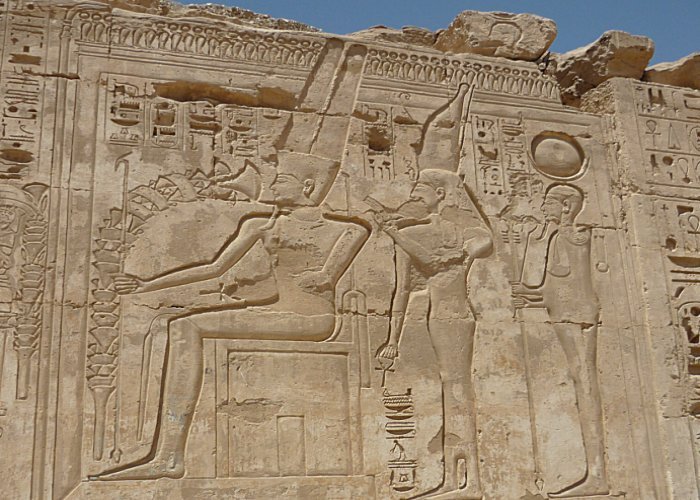
The Theban Triad is depicted at Medinet Habu. From left to right: Amun, Mut and Khonsu. Source
Appearance And Many Attributes Of Khonsu
In human form, Khonsu is usually portrayed as a youth wrapped in mummy bandages. As a divine child of Mut and Amun, his head is often decorated with the side-lock (symbol of childhood). In his hands, he holds a flail and a crook (associated with Horus and Osiris) and a waas-sceptre.
See also: 12 Ancient Egyptian Symbols Explained
Similar to Ptah, he wears a menat-necklace and is known to wear his lunar symbol in the form of the lunar disk placed in a crescent new moon upon his head. These attributes indicate he is a lunar deity and as such, Khonsu has only one rival - the god Thoth, a lunar god worshipped in the form of an ibis or a baboon.
As the god of the moon, Khonsu takes over many of Thoth's attributes and helps him reckon time.
Later, during the New Kingdom (c. 1570 - c.1069 BC) he was also an important god of healing and a national deity. As the deity representing the cyclical nature of the moon, he was connected with the inception of pregnancy, fertility and childbirth. Generally, he plays an important role in the creation of new life in all living creatures.
‘Pathfinder’ And ‘Protector’ That Guards Travelers
Some titles were frequently attributed to him, such as "Khonsu, the decider of the life span", "Khonsu the Provider", "Khonsu the Child". Khonsu is sometimes associated with the 'dark side of the moon'.
In Egyptian beliefs, as the god of the moon, Khonsu was a "Pathfinder" and "Protector" that guards travelers by protecting them against wild animals. He gives the brightness at night and thus, makes traveling easier and safer.
Khonsu Was A Long-Lasting Healer
During the Ptolemaic dynasty (305–30 BC), Khonsu was highly respected as a healing god. He was reported to have healed King Ptolemy Philopator (244-204 BC), the fourth line of Macedonian Greeks who ruled Egypt as the Ptolemaic Dynasty. Ptolemy Philopator was very ill, however, he did not appeal to Greek gods but the god Khonsu of Thebes.
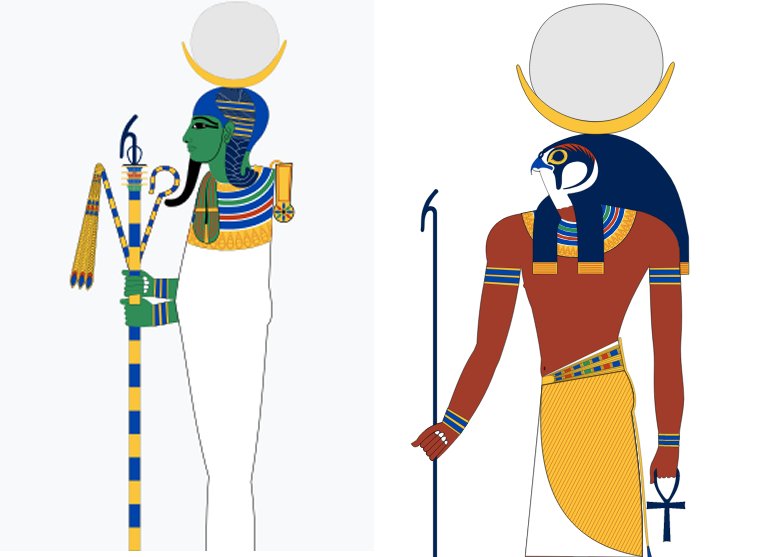
Left: Khonsu, an ancient Egyptian god depicted as a mummified child with a moon disk on his head. Source: Right: Khonsu, the ancient Egyptian moon-god, was depicted either as a falcon wearing the moon-disk on his head. Source:
It helped somehow and the ruler was cured, and from this on he called himself ‘Beloved of Khonsu who protects His Majesty and drives away evil spirits’. Khonsu's fame as a healing deity is recorded on a stele discovered in his temple and now is in the Louvre Museum in Paris.
Khonsu And The Apocrypha Of The Old Testament
The name of the Egyptian god Khonsu occurs in the Apocrypha Of The Old Testament (3 Macc 6:38) as part of the Egyptian name of the ninth month of the year and the first month of the summer season: ‘Pachon’ (He of Khonsu)…”
Khonsu And His Darker Side
Khonsu of the Old Kingdom (c. 2613-2181 BC) is not the same figure as in the New Kingdom.
In the "Cannibal hymn" of the Pyramid Texts, Khonsu is described as a bloodthirsty and cruel figure. He assists the deceased ruler in catching, killing, and eating other lesser gods, to get the necessary strength. In the Coffin Texts, he is “Khonsu who lives on hearts" that most probably refers to his connection with the afterlife.
Later in the New Kingdom, his nature changes much, and is worshiped as the son of Amun and Mut, who protects fertility, childbirth, and pregnancy.
Khonsu Worshiped Across Egypt
Khonsu had his main temple in Karnak and he was honored during the feast of Opet, an ancient Egyptian festival celebrated annually in Thebes and dedicated to the Theban Triad (Amun, Mut, and their child, Khonsu). His Karnak temple was constructed during the 20th Dynasty (12th -11th century BC).
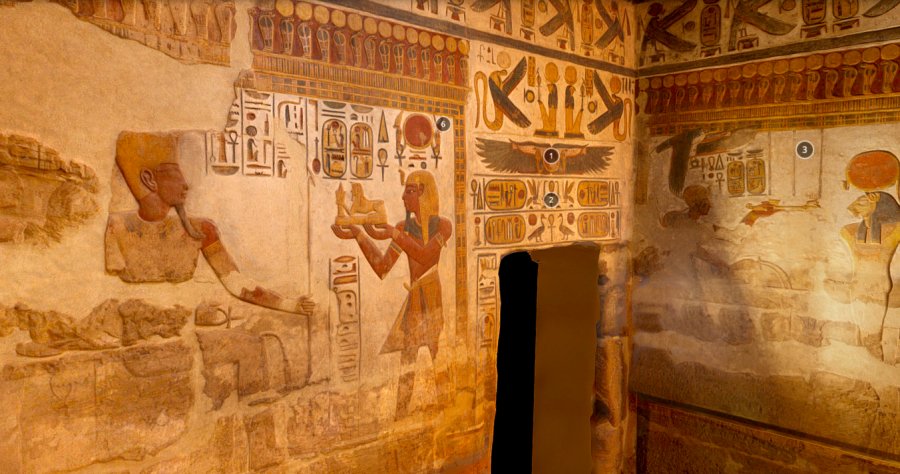
Credit: American Research Center In Egypt
His temple is still well-preserved and its walls are covered with a text describing Khonsu as the great snake that fertilizes the cosmic egg. The god had other cult sites, located in Memphis, Hibis, and Edfu, and some other smaller temples dedicated to him were built across Egypt.
Written by – A. Sutherland - AncientPages.com Senior Staff Writer
Copyright © AncientPages.com All rights reserved. This material may not be published, broadcast, rewritten or redistributed in whole or part without the express written permission of AncientPages.com
Expand for referencesReferences:
Bard A. K. Encyclopedia of the Archaeology of Ancient Egypt
Parker B. The Serpent The Eagle The Lion & The Disk
van der Toorn K, Becking B, van der Horst P. W. Dictionary of Deities and Demons in the Bible
More From Ancient Pages
-
 Selinunte: Latest Excavations Bring To Light A New Small Temple – What Ritualistic Practices Will Be Revealed One Day?
-
 Source Of Ancient Roman Silver Was The Iberian Peninsula
-
 Ancient History Of Chinese Swords
-
 Noppera-bo: Odd Intimidating Human-Like Faceless Yokai In Japanese Folklore
-
 Pompey The Great: One Of Roman Empire’s Most Successful Military Commanders
-
 Pictograms: First Written Accounts Of Earthquakes In Pre-Hispanic Mexico
-
 500-Hundred-Year-Old Mystery Of Aztecs’ Death May Have Been Solved – New Study
-
 On This Day In History: Independence Of Lower Canada – Today Quebec – Proclaimed On Feb 28, 1838
-
 Legendary Lost Island Of Gold Of The Mysteriously Vanished Srivijaya Civilization Found Underwater
-
 Byzantine Granary With 11 Pithoi Found In Byzantine City Of Amorium In Central Turkey
-
 Mysterious Shasu – Bandit Canaanites Or Israelites?
-
 Kalaripayattu – 3,000-Year-Old Indian Martial Art From Which Kung Fu And Karate Emerged
-
 Ancient Roman Women Wore Bikini In 1400 B.C.
-
 Tiny Paper Scraps From ‘Queen Anne’s Revenge’ Shed Light On Reading Habits Of Blackbeard’s Pirates
-
 Exceptional Discovery Of Ancient Fresco Depicting Mythological Scenes In Peru
-
 Ancient Highways Unearthed In Arabia
-
 Insects Played An Important Role In The Biblical Exodus
-
 Many Samurai Had Swords With Secret Crucifixes And Hidden Christian Symbols To Avoid Persecution
-
 Makara – Legendary Sea-Creature With Many Incarnations In Hindu Mythology
-
 Will The Oven Bricks Of The Tudor Warship The Mary Rose Be Preserved Before It’s Too Late?

