
Mag Mell: Irish Tradition Of Otherworldly Paradise That Could Be Reached Through Death And Glory
A. Sutherland - AncientPages.com - In the mythology of the Irish people, Mag Mell was a mythical, paradise-like realm with everlasting spring and sunshine. It was a place where all the trees were always full of magical fruit, flowers, and divine mead that could never be emptied.
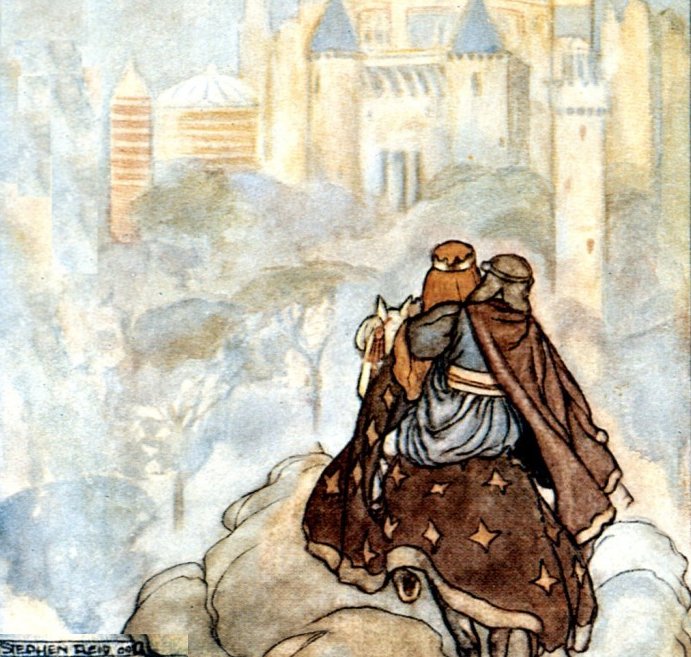
The fairy Otherworld; a beautiful land of everlasting spring and sunshine, the Land of Youth (Tir na n-Og) or Mag Mell. Illustration by Stephen Reid in T. W. Rolleston's The High Deeds of Finn (1910) via Wikipedia
In Mag Mell lived gods accompanied by immortal heroes who were able to reach this place through death and glory.
All of them enjoyed endless happiness and harmony. Neither disease nor death or any other discomforts was known to them.
Mag Mell reminds us of god Odin’s Valhalla, the hall of the fallen Viking Warriors. Valhalla was the Viking warriors’ dream destination and Mag Mell was reserved for the Celtic heroes who died honorably.
In several Irish tales, Mag Mell was the Otherworld in the form of a floating island and the realm of the sea god Manannan Mac Lir. According to the Irish “Book of Invasions”, a sea god and king of the Fomorians, Tethra became a ruler of Mag Mell, after his death in the first battle of Mag Tuired, when the Tuatha De Danann took Ireland from the Fir Bolg, one of the four groups, who then inhabited the island.
Tradition has it that this ancient sea god never lived on land but made his home somewhere in the ocean, on an island with different names: Mag Mell (“plain of honey” or “the plain of delights”) or sometimes Emain Ablach (“island of apples”) and Tir Tairngiri (“land of promise”).
The ancient Irish imagined Mag Mell to be located in the south or south-west of Ireland or beneath the ocean. It was also considered a possible refuge for the Tuatha De Danann.
Mag Mell Is Unlike The Underworld In Other Mythologies
Mag Mell was accessible only to those who really deserved it. It was not a place similar to other realms of the dead like Hel’s dark dwelling place for the dead in Norse myths or a gloomy abode of Yama, the god of the underworld, who rules the hell and judges the dead, in Hindu texts.
This supernatural Celtic realm of everlasting youth, beauty, health, abundance, and joy, was never associated with a typical afterlife destination.
Mag Mell was believed to be an earthly paradise, accessible to divine beings and some earthly visitors, who became the chosen ones such as Cuchulainn or Tethra, Fionn mac Cumhaill, and others.
According to ancient Irish beliefs, time passes much slower in the Otherworld. As previously discussed on Ancient Pages, the Celtic Tree of Life served as a portal to invisible worlds and a source of sacred knowledge, guarded by the most enlightened ones.
This could explain why ancient Celts believed there were gateways leading from the material into the spiritual world, and why times passed slower in this mysterious realm, invisible to the naked eye. The nature and reality of the Celtic Otherworld sound almost like the modern concept of parallel universes.
Updated on February 21, 2024
Written by – A. Sutherland - AncientPages.com Senior Staff Writer
Copyright © AncientPages.com All rights reserved. This material may not be published, broadcast, rewritten or redistributed in whole or part without the express written permission of AncientPages.com
Expand for referencesMore From Ancient Pages
-
 Orang Bunian: Mysterious Invisible Whistle People Living In Forests In Malay Folklore
-
 Aboriginal Art And Knowledge Unlocks Mystery Of Fairy Circles
-
 Is The Tomb Of Genghis Khan Hidden And Protected In The Khentii Mountains Because Some Fear It’s Cursed?
-
 Large 4,000-Year-Old Sumerian Port Discovered In The Desert In Iraq
-
 Mystery Of Sacred Groves Of Oshogbo And Its Remarkable Ancient Figures
-
 Striking Ancient Stone Idols: The Forgotten Polovtsian Statues Of Eastern Europe
-
 Intriguing Discovery Could Offer Proof Of The Tabernacle – Has The Dwelling Place Of God Been Located?
-
 Yayoi People (Korea) Interbred With Jomon People (Japan) Giving Birth To Ancestral Group Of Modern Japanese People
-
 Immigrants In Prehispanic Cancun Were Treated Just Like Maya Locals
-
 7th Century Old Cistern Among Recent Finds In Medieval City Of Beçin, Turkey
-
 One Of The Biggest Bronze Age Settlements On Orkney – Discovered
-
 2,000-Year-Old Measuring Table With Stone Weights Unearthed In Jerusalem
-
 Mysterious And Unexplained Encounter With Unusual Tiny Beings In Italy – The Thing – Part 1
-
 Mysterious And Unexplained Encounter With Unusual Tiny Beings In Italy – A Strange Connection – Part 2
-
 Ancient Ingapirca: Largest And Best Preserved Inca Ruins In Ecuador
-
 Ancient Temple Dedicated To Aztec God Xipe Totec Discovered In Mexico Reveals A Gruesome Story
-
 Connection Between Alpha Draconis And Egyptians Pyramids Revealed
-
 Sandstone Head Of A Bodhisattva Discovered Near Ta Nei Temple
-
 New Interpretation Of A 4,000-Year-Old Cemetery In Present-Day Slovakia
-
 Asenath And The Golden Tablet That Changed Her Destiny

