
Biblical Prophet Jeremiah Whose Prophecies Disappointed People
David Tee - AncientPages.com - Archaeology can do many things. It can unearth buildings, long lost artifacts, and even discover civilizations lost to history. The Hittites are one prime example of the last as their empire was lost for 1800 years. It wasn’t until the 19th century AD that archaeology unearthed that nation.
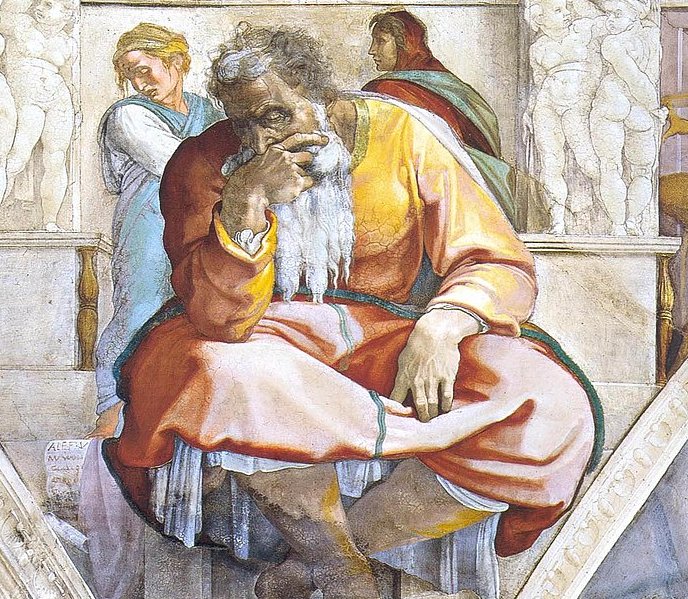
Jeremiah, as depicted by Michelangelo from the Sistine Chapel ceiling. Image credit: Vatican Museums via Wikipedia
But can archaeology prove someone’s existence? This is a difficult question to answer as even modern people’s existence can be called into question. With lots of legal identification and paperwork in their possession, their existence can be refuted. Let’s see what archaeology can do for the Biblical prophet Jeremiah.
Who Was Prophet Jeremiah?
The meaning of his name is unknown or under heavy debate, but one thing is for sure because of his prophecies, he was known as the weeping prophet. He was called the weeping prophet because he knew what was going to happen and cried tears of sadness. He was also very sad because people didn't want to listen to him.
Jeremiah was born into the priestly family of Hilkiah.
His hometown was Anathoth which gives him a connection to Abiathar, a priest during King Solomon’s reign. Jeremiah never married as he obeyed God’s instruction to avoid marriage due to the upcoming problems Israel was going to endure.
Zephaniah was a prophet who came just before Jeremiah and Habakkuk, Obadiah and Ezekiel were contemporaries at some point in his life. Jeremiah prophetic ministry took place between 626 and 586 BC.
There is no information about his death.
What Did Jeremiah Prophecy?
The prophet was not noted for saying anything good for Israel, Jerusalem or its rulers. Jehoiakim was so incensed at hearing some of the words Jeremiah had written that he cut the scroll up into pieces and burned it in the fire (Jer. 36:21).
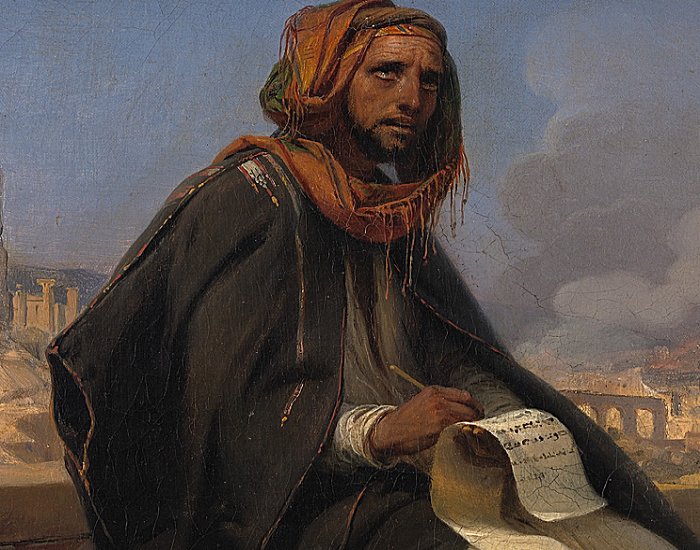
Jeremiah on the ruins of Jerusalem. 1844. Source
Jehoiachin and Zedekiah also did not fare well in some of Jeremiah’s prophecies. The prophet made calls for Jerusalem’s and all of Israel’s repentance and return to the laws of God. He also spoke of the upcoming Babylonian captivity. Foreign nations were not left out of his doom and gloom-type prophecies.
Jeremiah did, however, provide a little hope. He did prophecy that the people of Israel and Jerusalem would be restored to their land eventually.
Archaeology Uncovers Evidence Of Prophet Jeremiah
Archaeologists have made some rather startling discoveries over the years. Some pertain to the prophet Jeremiah in an indirect way. One discovery contained 250 bulla or clay seals. A few of these seals had names of people included in the book of Jeremiah.
A bulla is a little clump of clay that has an impression stamped on it. Fire does not destroy bulla but helps preserve them forever.
- Jerucal ben [son of] Shelemiah ben [son of] Shevi- mentioned in Jer. 37:3 and 38:1
- Berekhyahu son of Neriyahu the scribe- he was Baruch, Jeremiah’s scribe and he was mentioned in Jer. 36:1-4
- Elishama' servant of the king- Jer. 36:10-12
- Yerahme'el, son of the king- son of Jehoiakim Jer. 36:26
- Gedalyahu ben Pashur & Yehukual ben Shelemyahu- they sought the death of the prophet & mentioned in Jer. 38
Jeremiah 32 (the thirty-second chapter of the Book of Jeremiah) talks about how a relative came to the prophet to have the latter redeem a field in their hometown. Jeremiah had Baruch place the deeds in two clay jars. Similar jars were unearthed in the area where the 250 bullae were discovered.
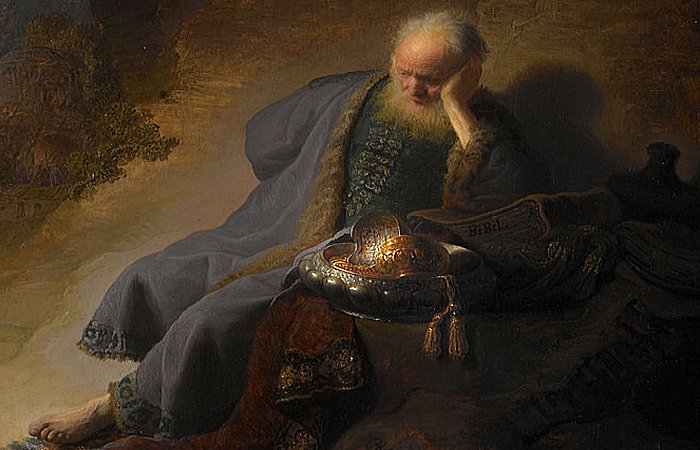
Jeremiah Lamenting the Destruction of Jerusalem, Rembrandt van Rijn, c. 1630. Source
Then an inscribed clay tablet was uncovered held in storage at the British Museum, some dating back 5,000 years. On this clay, tablet was a name. It was a name of great importance. Jeremiah wrote that Nebo-Sarsekim was an important officer to Nebuchadnezzar II.
He was also the one charged by Nebuchadnezzar to look after Jeremiah.
Archaeology has illuminated much of the Old Testament. Archaeologists have spent their lives looking for physical evidence to support and prove the biblical record. These discoveries have gone a long way in showing that Jeremiah actually existed.
But they do more than that. They also show the veracity and accuracy of the biblical book. Nebo-Sarsekim may have been an important officer to Nebuchadnezzar II but to history, he was very insignificant.
Since this little unimportant passage has been shown to be correct, what does it say about the book’s author and the major events? It means that Jeremiah was real and was a prophet of God.
Written by – David Tee - AncientPages.com Staff Writer
Copyright © AncientPages.com All rights reserved. This material may not be published, broadcast, rewritten or redistributed in whole or part without the express written permission of AncientPages.com
More From Ancient Pages
-
 Patara’s 2,400-Year-Old Ancient Kitchen And ‘Women’s Room’ Unearthed
-
 Heyoka – Sacred Clown Who By Doing The Opposite Helps And Guides In Daily Life
-
 Homo Longi: Extinct Human Species That May Replace Neanderthals As Our Closest Relatives
-
 Cartography Shows That The Isthmus Of Tehuantepec Was Used As An Inter-Oceanic Passage In The 16th Century
-
 Gold Earring Found In Ruins Of Ancient Roman Colony Deultum In Bulgaria
-
 Mystery In Abydos: Carved Rock Chambers Discovered Inside Sacred Mountain
-
 Peculiar Neolithic Anomaly Investigated In Scotland
-
 Face Of Egyptian Man Who Lived 35,000 Years Ago Reconstructed
-
 Extraordinary Discovery Of First Viking Tower In Viborg, Denmark Re-Writes Viking History
-
 Another Franklin Expedition Crew Member Identified
-
 On This Day In History: Precious Rosetta Stone Found By Napoleonic Expedition To Egypt – On July 15, 1799
-
 Did Neanderthals And Modern Humans Meet In The Czech Republic 50,000 Years Ago?
-
 What Ancient Civilization Discovered Metallurgy?
-
 Excavations At Oylum Höyük In Southeast Anatolia Near Syrian Border – Resumed
-
 Never-Ending Battles Between God Ra And Indestructible Apophis In Ancient Egyptian Beliefs
-
 Earliest Ochre Crayon Used By Our Ancestors 10,000 Years Ago Found In Yorkshire, Northern England
-
 Baroque-Period Marble Skull Analyzed With Standard Forensic Anthropological Techniques
-
 Fragments Of 6,500-Year-Old Figurine Of ‘Venus of Egerszeg’ – Unearthed
-
 Bronze Age Scandinavians Crossed The Sea Before The Vikings – New Computer Model Reveals
-
 Unicorns In Southern Africa: The Fascinating Story Behind One-Horned Creatures In Rock Art

