
Mystery Of Egyptian Tomb 10A And The Mummy’s Head – A 4,000-Year-Old Crime
Ellen Lloyd - AncientPages.com - All ancient Egyptian tombs are unique, but some pose a greater mystery than others.
In 1905, archaeologists excavating in the Egyptian necropolis of Deir el-Bersha discovered a hidden tomb that contained something unexpected. After 33 days of digging a 30-foot shaft, the archaeological team, led by archaeologists George Reisner and Hanford Lyman Story from the Harvard University-Boston Museum of Fine Arts Expedition, entered the 4,000-year-old Egyptian tomb, but they were unprepared for the frightening sight that awaited them. Inside the cramped limestone chamber was a beautifully painted cedar coffin, and on top of it was a mummy's severed head.
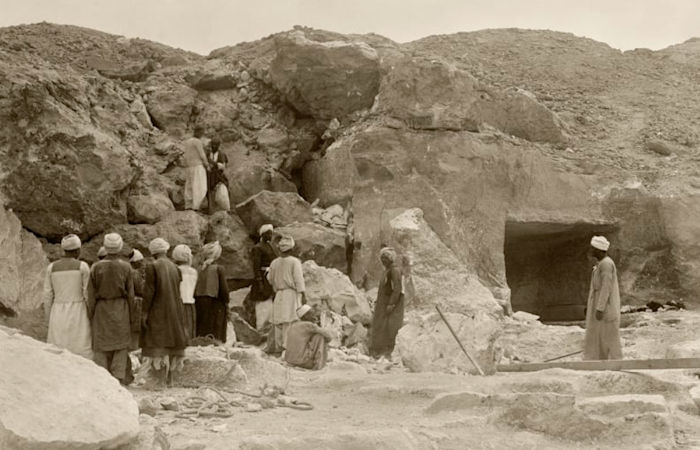
Riddle Of The Decapitated Egyptian Mummy
Where was the rest of the mummy? Why was only the head there? Who and why had beheaded the deceased? Decapitation was not an ancient Egyptian burial practice anyone was familiar with at the time. The researchers had encountered a mystery, and it would take 104 years before modern forensic experts could shed some light on this peculiar story.
As archaeologists continued exploring the hidden tomb's secrets, they realized this was no ordinary burial site.
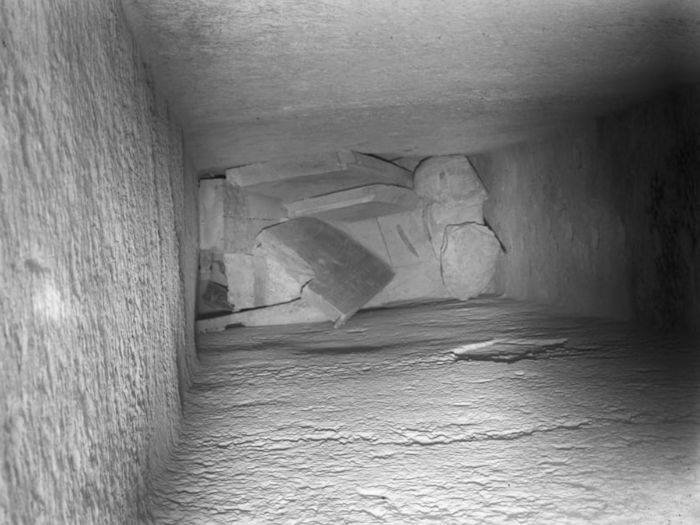
Djehutynakht's tomb was discovered at the bottom of a 30ft pit. It had been plundered in antiquity, and the corpses damaged. Most of the valuable jewels were stolen, but a number of objects were left behind, making it one of the largest burial assemblages of the Middle Kingdom ever discovered.
Tomb 10A was the largest burial assemblage of the Middle Kingdom (2040-1640 B.C.) ever discovered. Scientists found magnificent cedarwood coffins, personal items such as jewelry, written religious chants, and an astounding flotilla of reassembled model boats inside the chamber. As the investigation of tomb 10A continued, researchers eventually determined this was the final resting place for a governor named Djehutynakh and his wife.
"At some point during the couple's 4,000-year-long slumber, grave robbers ransacked their burial chamber and plundered its gold and jewels. The looters tossed a headless, limbless mummified torso into a corner before attempting to set the room on fire to cover their tracks." 1
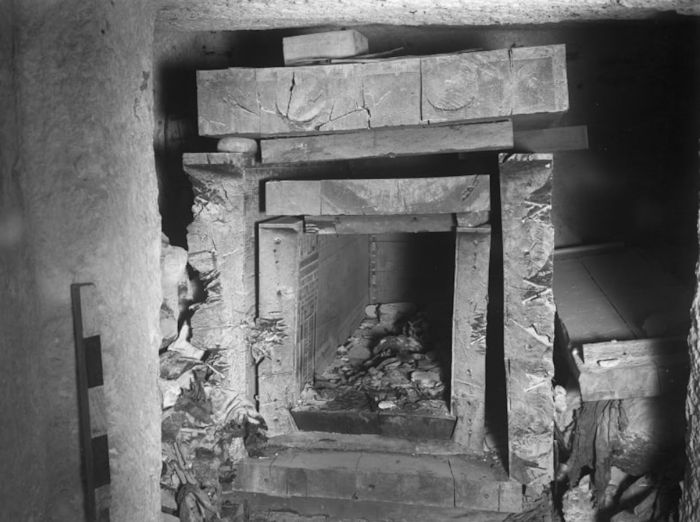
The tomb contained four painted coffins, an inner and outer one for both the governor and his wife. They were made of massive planks of imported cedar.
The archaeologists felt lucky because they could recover many magnificent ancient objects that had survived the raid and sent them to the Museum of Fine Arts, Boston, in 1921.
According to the Museum of Fine Arts, Boston, tomb 10 A "contained four beautifully painted coffins, one of which (detail, shown above), the famous "Bersha coffin" (the outer coffin of the governor), is arguably the finest painted coffin Egypt produced and a masterpiece of panel painting. The tomb also included Djehutynakht's walking sticks, pottery, canopic jar, and miniature wooden models that were made for the burial but reflect life on Djehutynakht's estate, including some 58 model boats and nearly three dozen models of daily life such as individual shops for carpenters, weavers, brick-makers, bakers, and brewers. Of these, the best known is the exquisitely carved "Bersha procession" of a male priest leading female offering bearers." 2
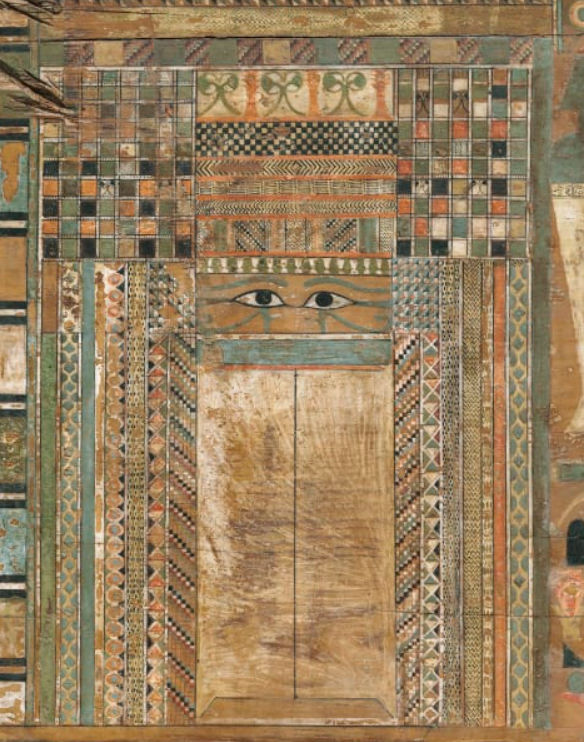
The outer coffin of Djehutynakht, known as the "Bersha coffin" is famous for its intricate and beautiful panel painting. The paintings and inscribed funerary texts were intended to facilitate Djehutynakht's passage to the afterlife.
The transportation of these ancient items was dramatic because the ship caught fire. Still, fortunately, the crew had the situation under control, and the precious ancient Egyptian artifacts suffered only slight water damage.
After arriving in Boston, the Museum put the Deir el-Bersha coffin and procession on view in the galleries, but most of the other objects were not revealed to the public.
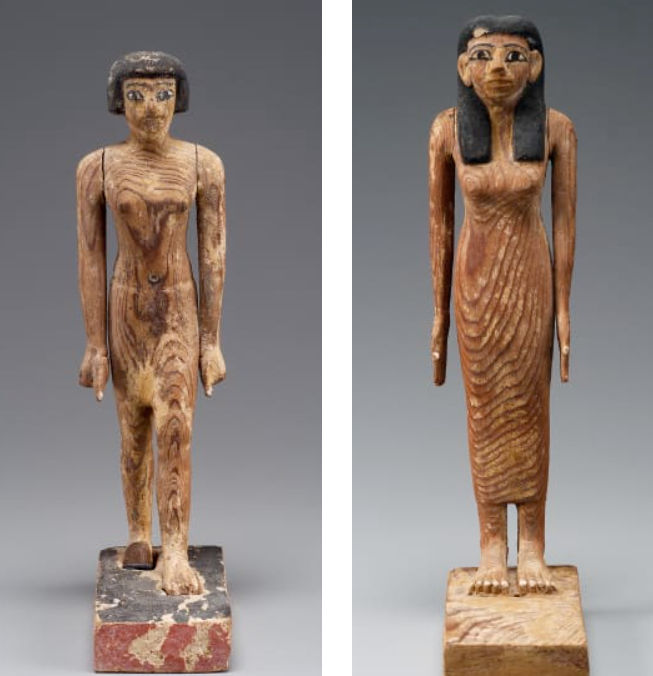
Statuettes were found within the tomb. Right: This wooden figure of a striding man is thought to be Governor Djehutynakht.
In 2009, the Museum of Boston decided to put the stored artifacts on display, but the staff encountered a rather embarring problem. "Though the torso remained in Egypt, the decapitated head became the star of the showcase. With its painted-on eyebrows, somber expression, and wavy brown hair peeking through its tattered bandages, the mummy's noggin brought viewers face-to-face with a mystery." 1
Whose Head Was It And Why Was It Missing Cheek Bones?
Suddenly, the Museum realized no one knew whether the mummified head belonged to Djehutynakh or his wife. Only a DNA analysis could answer this question, but extracting DNA from a 4,000-year-old mummy is easier said than done.
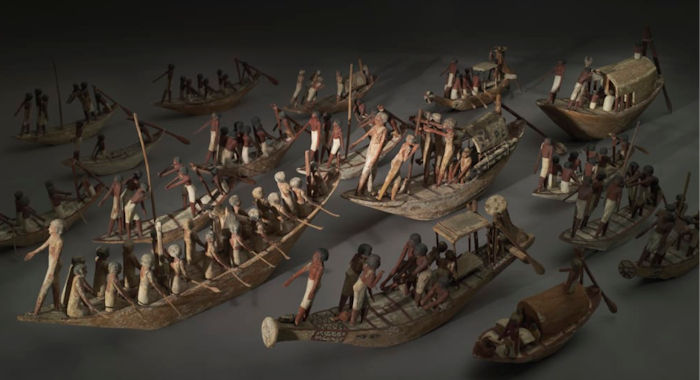
The tomb included some 58 model boats, as well as models of carpenters, weavers, brick-makers, bakers and brewers.
The Boston Museum contacted the Federal Bureau of Investigation (F.B.I.), asking for help solving this ancient mystery.
While examining the head, scientists discovered something puzzling. The mummified head was missing cheekbones and part of its jaw hinge. How could the missing facial bones be explained?
According to Dr. Rajiv Gupta, a neuroradiologist at Massachusetts General, "all the muscles that are involved in chewing and closing the mouth, the attachment sites of those muscles had been taken out."
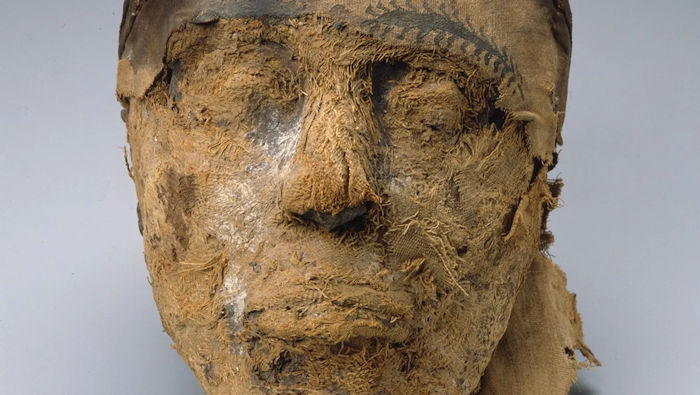
For years, archaeologists had puzzled over whether the mummy's head belonged to husband or wife. The Boston Museum of Fine Arts, in possession of the entire contents of the tomb, sent it out for analysis. In 2009, doctors from the Massachusetts General Hospital extracted a tooth from the mummified head.
This had been caused by the opening of the mouth ceremony, an ancient Egyptian ritual described in funerary texts such as the Pyramid Texts. "The Opening of the Mouth Ceremony allowed statues of deities and the dead to regain their senses, to see thereby into the realm of the living." 3
However, the ritual was also performed so the deceased could eat, drink and breathe in the afterlife.
By extracting the mummy's molar and studying the genetic material, F.B.I specialists could determine the mummified severed head belonged to Governor Djehutynakht.
What is still unknown and may never be solved is why Governor Djehutynakht had been decapitated and by whom. Had the ancient Egyptian governor been a hated man? Did looters deliberately cut off his head to prevent him from entering the afterlife, or did workers destroy his body before the tomb was sealed?
Updated on September 2, 2023
Written by Ellen Lloyd – AncientPages.com
Copyright © AncientPages.com All rights reserved. This material may not be published, broadcast, rewritten or redistributed in whole or part without the express written permission of AncientPages.com
Expand for references- Nicholas St. Fleur - The F.B.I. and the Mystery of the Mummy's Head, The New York Times
- Museum of Fine Arts, Boston - The Secrets of Tomb 10A Egypt 2000 BC
- Carolyn Graves- Brown - Daemons and Spirits in Ancient Egypt
More From Ancient Pages
-
 Huginn and Muninn: Powerful Ravens Of Odin, Supreme God In Asgard In Norse Mythology
-
 Small Figurine Reveals How A Viking’s Hair And Beard May Have Looked
-
 Megalithic Cemetery With 49-50M Long Tombs Was Accidentally Found In Poland
-
 How Did Sargon Become The Most Powerful Ruler Of Mesopotamia?
-
 On This Day In History: Columbus Reached Honduras With His Ships – On July 30, 1502
-
 Hybrid Camels Revealed In Ancient Arab Temple Art At Hatra, Northern Iraq
-
 Hulagu Khan Destroyed Thousands Of Priceless Ancient Books Kept In The House Of Wisdom In Baghdad
-
 The Untold Story Of The Inca – Fire In The Sky – Part 1
-
 Golden Figurine From Yozgat Depicts Unknown Hittite God
-
 Ancient Maya Astronomers Predicted Meteor Showers 2 Millennia Ago – Mayan Hieroglyphic Inscriptions Reveal
-
 Ancient Roman Coffin Found In Leeds Revealed To The Public For The First Time
-
 Secrets Of Namibia’s Fairy Circles Solved – Self-Organizing Plants Are The Creators – New Theory
-
 Disbelief In Human Evolution Is Linked To Prejudice And Racism – Scientists Say
-
 Comet Explosion 13,000 Years Ago Wiped Out Megafauna And The Clovis Culture In North America
-
 Ancient Secrets Of The Amazon Jungle – Dangerous Expeditions And Hidden Treasures – Part 1
-
 Why Napoleon’s Invasion Of Russia Was A Fiasco
-
 Neanderthals Are Not The Only Species Whose Dentition Is Characterized By The Possession Of Thin Enamel
-
 Sacred And Mysterious Lake Titicaca Still Holds Many Ancient Secrets
-
 Nicholas Owen ‘Little John’ Who Paid Highest Price For His Ingenious, Camouflaged Places To Hide
-
 Oklahoma’s Ancient Mosaic Floor With Mysterious ‘Post Holes’ Could Re-Write History Of North America

