
Mysterious Death Of Cambyses II – Natural, Suicide Or Assassination By Darius I The Great?
Ellen Lloyd - AncientPages.com - As the eldest son of Cyrus the Great, Cambyses II had an obligation to expand the Achaemenid Empire founded by his father. It was a duty he gladly undertook and successfully carried out. Nevertheless, at the end of his life, history shows Cambyses II’s power for glory and military success most likely led to his ultimate downfall.

Cambyses II died under mysterious circumstances, and historians are uncertain whether his death was an accident, suicide, or assassination by Darius I the Great.
Cambyses II Rose From Governor Of Babylon To King Of The Achaemenid Persian Empire
Before Cambyses II became King of the Achaemenid Persian Empire, he was a governor in Babylonia. He was also performing the ritual duties of a Babylonian king at the Akitu Festival, the Babylonian New Year festival celebrated in spring to honor “honor the rebirth of the natural world.
During the Akitu festival, “statues of the gods were paraded through the city streets, and rites were enacted to symbolize their victory over the forces of chaos. Through these rituals, the Babylonians believed the world was symbolically cleansed and recreated by the gods in preparation for the New Year and the return of spring.” 1
When Cyrus the Great died in 530 B.C., Cambyses II ascended the throne, and the new Persian King focused his attention on the conquest of Egypt.
Being the ruler of the Achaemenid Empire, the world’s largest empire of the ancient world must have made Cambyses II proud, but also worried as much was expected from him. Looking back at his reign, it is obvious he had reason to be satisfied with some of his achievements, but he certainly never gained his father's prominence.
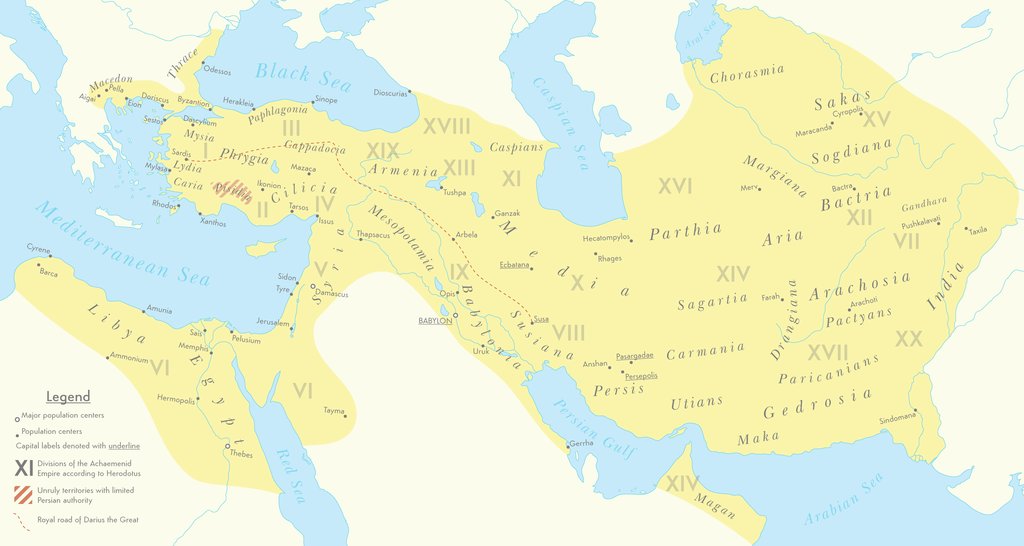
The Achaemenid Empire at its greatest territorial extent, under the rule of Darius I (522 BC to 486 BC). Credit: Cattette - CC BY 4.0
After gaining support from Polycrates of Samos, the Cambyses II attack on Egypt was not a very demanding military operation. The Greek general in the Egyptian army provided Cambyses II with vital strategic information, and the Persian army could proceed into the land of the Pharaohs.
Pharaoh Psamtik III “did all he could to resist Cambyses II’s invasion, but his Egyptian army was no match for the Persians, who had already conquered Babylon, Assyria, and other Egyptian former allies.” 2
After Cambyses II had won the Battle of Pelusium, his army could successfully capture Heliopolis and Memphis.
A humiliated Psamtik III was captured and executed by the Persian King Cambyses II. The death of Pharaoh Psamtik III ended the 26th dynasty of Egypt.
Was Cambyses II A Madman?
According to the ancient Greek historian Herodotus, the King of the Achaemenid Empire was a cruel madman who abused his power in ancient Egypt.
“The narrative of Cambyses’ abortive campaigns falls between the report of two outrageous actions the king perpetrated while in newly conquered Egypt: the brutalization of the body of Amasis (pharaoh Psamtik III) and the murder of the bull-god Apis.” 3
Herodotus relates that Cambyses II not only executed the Pharaoh but tortured and mutilated his body.

Cambyses II invaded Egypt and captured Pharaoh Psamtik III.
Cambyses was accused by Herodotus to have been guilty of “a set of bizarre and violent tortures, the motives for which are not stated: flagellation, plucking of hair, sticking the body with pins. Cambyses’ final solution of throwing the stiff embalmed corpse into the fire is concluded by two summarizing clauses with intervening explanatory gloss:
“… commanding impious things. For the Persians believe that fire is a god. Thus to burn the dead is absolutely not in the custom of either, of the Persians for the reason mentioned, since they say it is not just to offer to a god the corpse of a man. The Egyptians, on the other hand, believe that fire is a living beast, that it devours everything it seizes, and that filled with nourishment, it dies together with the thing devoured. Thus it is absolutely not in their custom to give corpses to beasts; and for this reason they practice embalming, lest the body lying (in the earth) be eaten by worms. Consequently, Cambyses commanded to do things not in the custom of either.” 3
Once Psamtik III was dead, Cambyses II was the true ruler of Egypt. Following the traditional Egyptian royal custom, he took the titles of "king of Upper and Lower Egypt" and descendant of the gods Ra, Horus, Osiris, used by the previous Egyptian Pharaohs: He was crowned in the temple of the goddess Neith.
The conquest of Egypt was his most outstanding achievement, and whether he was mad is still debated among historians.
Cambyses II would not be much of a warrior if he were satisfied with only conquering the land of the Pharaohs. While being in Egypt, he made new military plans and now had his eyes on Ethiopia, and Carthage, founded by Queen Dido.
The Persian King prepared his army and set out against Ethiopia, but his planned invasion became a fiasco because he ran out of supplies and had to return. He never attempted to attack Cartage, and whether he knew it or not, his end was approaching.
The Strange Death Of Cambyses II
Darius I the Great, who left an account of his rise to the Persian throne on his Behistun inscription, stated that Cambyses II murdered his brother Bardiya.
“Smerdis is the real name of the younger brother of Cambyses but he is sometimes known as Bardiya.” 4
Soon after that, something strange happened. While Cambyses II was traveling through Syria on his way back to Persia, he suddenly died. The cause of his death is still a historical riddle. Cambyses II received a wound to the thigh and died three weeks later, in July 522 B.C., of a severe bacterial infection.
Cambyses II had a close relationship with Darius I the Great. Also, Cyrus the Great's daughter, Atossa would marry Darius the Great and ultimately give birth to Xerxes I.
At the time of his death, Darius was Cambyses' lance-bearer. Darius claimed Cambyses II understood success was impossible and stabbed himself deliberately. Herodotus, on the other hand stated Cambyses II’s was accidental.

Relief of Darius I the Great in Persepolis, the ceremonial capital of the Achaemenid Empire (c. 550–330 BC). Credit: Adobe Stock - Sergey
“Exactly what happened in connection with the death of King Cambyses II and Darius I’s subsequent accession to the throne in 522 B.C.E. has troubled historians. It is certain that Darius I was not a descendant of Cambyses II. However, the (obscure) legitimacy of Darius’s claim to the throne is treated in the lengthy inscription that Darius made on the rock face of Bisitun, visible from the main road between Susa, one of the traditional principal cities of Elam, and Ecbatana in Media, shortly after he had consolidated the power.” 5
Whether Darius I the Great assassinated Cambyses II remains a historical riddle.
“After Cambyses died, supposedly a fake Smerdis rebelled and claimed the throne for himself. This takeover and crowning of the new king are seen in old letters from Babylon and these letters declared he was officially declared King on July 1st.
Darius killed this fraud in about September of the same year in Sikayauvati. The Behistun inscription records all of this and states that Darius killed a man, a Magian from Mede, called Gaumâta.
But there are complications to this story.
It seems that the real Smerdis had a wife. For the fake Smerdis to succeed in his plans he would have to have some interaction with her and fool her completely. This is a tall order and hints at three possible scenarios. One, the Smerdis that was killed by Darius was the real Smerdis who was not killed by his brother Cambyses.
Two, the wife was a completely clueless person and was fooled by this fraud. Then, three, it is possible that the wife was in on the ruse and helped the fake gain power. Unfortunately, there are no extant records telling us the full story of what truly happened.” 4
Darius I the Great eventually gained control of the Persian Empire, but this was not without problems. The story of the fake Smerdis and the impostor is a true ancient detective story.
Updated on January 3, 2023
Written by Ellen Lloyd - AncientPages.com
Copyright © AncientPages.com All rights reserved. This material may not be published, broadcast, rewritten or redistributed in whole or part without the express written permission of AncientPages.com
Expand for references3. Munson, Rosalia Vignolo. “The Madness of Cambyses (Herodotus 3.16-38)." Arethusa 24, no. 1 (1991): 43-65.
5. Granerød, Gard. “‘By the Favour of Ahuramazda I Am King’: On the Promulgation of a Persian Propaganda Text among Babylonians and Judaeans.” Journal for the Study of Judaism in the Persian, Hellenistic, and Roman Period, vol. 44, no. 4/5, 2013, pp. 455–480.
6. Schiena, Simonetta. "The False Smerdis: A Detective Story of Ancient Times: The Reconstruction by Ilya Gershevitch." East and West 58, no. 1/4 (2008): 87-106
More From Ancient Pages
-
 Riddle How Human’s Uniquely DNA Evolved Solved By Scientists
-
 Ancient Egyptians Had A Different Definition Of ‘Foreigners’
-
 Strange Cave Drawings Of Unknown Beings And Animals In Japan Puzzle Historians
-
 Roman-Germanic Mythical Kneeling Figure With A Human Head And Snake’s Body Unearthed At Stuttgart’s Excavation Site
-
 Mystery Of The Man Whose Supernatural Abilities Still Captivate Scientists
-
 Legendary ‘Orichalcum Metal’ Related To Atlantis Found In 2,600-Year-Old Shipwreck
-
 Did The Viking Blood Eagle Ritual Ever Happen Or Was It A Misunderstood Story?
-
 Mystery Of The Neanderthals – Search For Traces Of Neanderthals’ Lives And Hints Of Their Demise
-
 Yggdrasil: Eternal And Sacred Tree Of Life In Norse Mythology
-
 Remarkably Well-Preserved Afragola Village After The Vesuvio Eruption 4,000-Years Ago
-
 Ancient Sound Of Stones – Acoustics At Stonehenge Tested By Scientists
-
 Use Of Tobacco Pipes By Hopewell People Tells A New Story
-
 Oklahoma’s Mysterious Hollow Hill – The Unexpected – Part 2
-
 New Clues About The Fascinating Ancient Roman City Falerii Novi Revealed By Scientists
-
 Surprising Discovery – Decline Of Classic Maya Cities Is A More Complicated Story Than Previously Thought – Researchers Say
-
 Ancient Jericho – City Of Giants And Home Of The Mighty Gibborim
-
 Remains Of Colonnaded Hall Of 26th Dynasty Found At Ancient Buto Temple, Northern Nile Delta
-
 1,900-Year-Old Child’s Nightgown Found In Judean Cave Of Letters
-
 Giant Balor Of The Evil Eye – Terrifying Fomorian King And Grandfather Of Celtic God Lugh
-
 Thousands Of Ancient Tools From A South African Cave Reveal Prehistoric Human Connections

