
Goddess Xi Wangmu (Xiwangmu) Who Controlled Life, Death, Creation And Talked Directly To Humans In Chinese Mythology
A. Sutherland - AncientPages.com - One of our earlier articles we devoted to the sacred Kunlun Mountains believed to be a Taoist paradise and the central pillar of the world that supported the heavens.
In Chinese mythology, it was to be the sacred place where the earthly world was connected with the world of the gods.
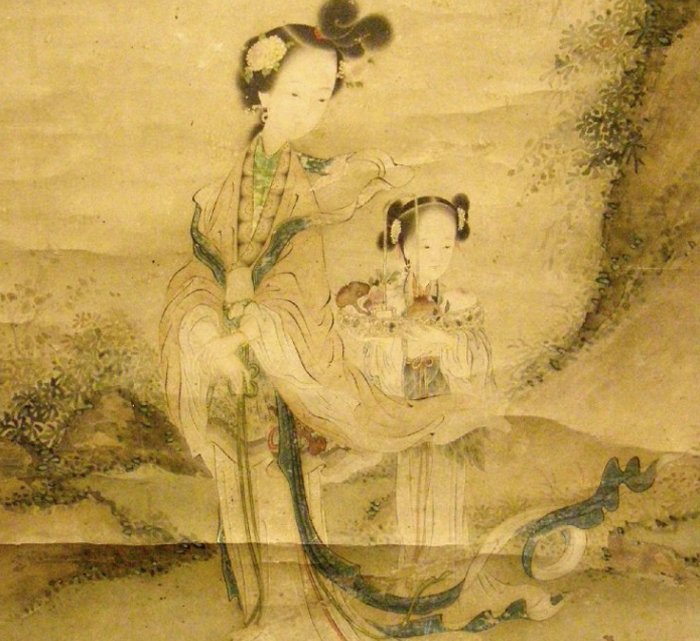 This powerful Chinese goddess was also known as the 'Queen of the West' or 'Queen Mother of the West. Source
Kunlun was the sacred place associated with the goddess Xiwangmu (Xi Wangmu), as her place of residence, and as some tales say, there lived the divine siblings – Nuwa (Nüwa) and Fuxi lived. It was after the world was just created, and they were the only survivors of a great flood.
The Kunlun Mountains have been seen as the origin of the Chinese civilization, and a place where wonderful trees grew, producing precious stones instead of fruit, and cinnabar streams had magnificent properties. 'Those who drank from those streams escaped death.' 1
For the Hindu and other eastern religions, the sacred Mount Meru was of very similar importance.
Queen Mother Of The West And Great Instructor
This powerful goddess, also called the 'Queen of the West' or 'Queen Mother of the West lived in the Jade palace (or silver palace), where the herbs of immortality and long-lived fish grew. Blue magical birds were her messengers, and she traveled alone on a white crane.
See also:
Jade Emperor – Supreme Ruler Of Heaven In Chinese Mythology
Legendary Erlang Shen And His Third Seeing Eye That Could Distinguish Between Truth And Lie
Legendary Mount Penglai Where The Eight Immortals Reside
Xiwangmu possessed an elixir of immortality made from beautiful peaches that were cultivated during 6,000 years in an orchard on Kunlun Mountain. These wondrous fruits assured longevity or immortality and were served by Xiwangmu to the immortals who attended her great feast. The goddess' palace was believed to be a perfect paradise, where it was used as a gathering place for the divinities and a cosmic pillar where communications between deities and humans were possible.
In an ancient Chinese text Zhuangzi, Xiwangmu was the instructor of the ways of the Dao and immortality for the Yellow Emperor, who received instructions from Xiwangmu on how to civilize the world of humans, She also instructed other Chinese sage kings.
Goddess Of Destruction Or Vampire Sucking Yang Energy
Myths and legends usually vary much, and Xiwangmu's status and attributes have changed as well. In one legend, she was the Chinese goddess of disaster and destruction, who had tiger teeth and a leopard tail, or was a kind of vampire who sucked vitality yang out of men to strengthen her own yin. It is said she an excellent practitioner of Yin and Yang.
 Blue magical birds were Xiwangmu's messengers, and she traveled alone on a white crane. source
Xiwangmu was occasionally considered the 'mysterious woman of the nine heavens,' each one in charge of the immortals of her sex.
Xiwangmu And The Heavenly Archer Yi (Hou Yi)
The Heavenly Archer Yi was a husband of the famous Chinese lunar goddess Chang'e ('the Lunar Toad'), which is the subject of many Chinese myths that date back to the Tang Dynasty (AD. 618 – 906).
Yi was the mythical hero who was capable of shooting down nine of the suns with his arrow. One day, for his impressive achievements, Yi was granted the herb of immortality by Xiwangmu. It was Yi who managed to build a jade palace for her, and as a reward, he received a pill made of longevity peaches. However, he was to eat it only after a year's fast, during which he could only feed on the scent of flowers.
Houyi decided to fast and hid a strong light-emitting pill on the roof of his home. Unfortunately, his curious wife Chang'e found the pill; she swallowed it and suddenly began to float in the air until it finally landed on the moon and turned into a three-toed toad.
Interestingly, on the historic Mawangdui funeral banner, the goddess Xiwangmu is accompanied by a toad tripod and a hare that prepares an elixir potion of life under the moon cassia tree that possesses seeds with magical powers.
During the spring festival of fertility, the Chinese offered Xiwangmu gifts on the sacrificial altar.
Written by – A. Sutherland - AncientPages.com Senior Staff Writer
Copyright © AncientPages.com All rights reserved. This material may not be published, broadcast, rewritten or redistributed in whole or part without the express written permission of AncientPages.com
Expand for referencesReferences:
Walters D., Chinese Mythology
James, Jean M. "An Iconographic Study of Xiwangmu during the Han Dynasty." Artibus Asiae 55, no. 1/2 (1995): 17-41.
More From Ancient Pages
-
 Why Is The Oseberg Ship Burial A Great Viking Mystery?
-
 Vahanas – Sacred Animal Vehicles Of Hindu Gods And Goddesses
-
 Hidden Carving Of Stonemason Never Meant To Be Seen Discovered In Cathedral Santiago De Compostela
-
 Curse Tablets With Messages To The Gods Of The Underworld Found In 2,500-Year-Old Well
-
 Secret Underground Chambers Of Caynton Caves And The Knights Templar Connection
-
 Reconstructed – Incredibly Well-Preserved 1,700-Year-Old Lendbreen Tunic – Norway’s Oldest Piece Of Clothing
-
 Large Bronze Age Stone May Be Europe’s Oldest 3D Map
-
 Our Ancestors Collected Shells 100,000 Years Ago To Create Personal Identity
-
 Map May Confirm The Legend Of The Mysterious Lost Sunken Welsh Kingdom Of Cantre’r Gwaelod In The Black Book Of Carmarthen
-
 Neanderthals: The Oldest Art In The World Wasn’t Made By Humans
-
 Pre-Columbian Americans Mastered Electricity – Ancient Inscription And Document Reveal Proof Of Advanced Ancient Technology
-
 Iraq’s Ancient Kish City Survived The Great Flood – Today It’s Neglected And Lies Buried In Sand
-
 Māori Connections To Antarctica May Go As Far Back As 7th Century
-
 On This Day In History: Grote Reber, Great Amateur Astronomer And Ham Radio Operator Born – On Dec 22, 1911
-
 Mysterious And Frightening Sculptor’s Cave Of The Picts Reconstructed In 3D Model
-
 Deception And Hidden Truth – Ancient Struggle Of The Eagle And Serpent – Part 2
-
 Huge, Cylindrical Pre-Incan Chullpas Of Sillustani, Peru Were Used As Graves For Colla Nobles
-
 Why Are Statues Of Mythical Yeti Dividing People In The Himalayas?
-
 On This Day In History: Emperor Romulus Augustus Deposed – On September 4, 476
-
 On This Day In History: First Battle Of Reading Took Place – On Jan 4, 871 AD

