
Rakshasas: Night Wandering Race Of Demons And Warriors Fuelled By Kundalini In Hindu Beliefs
A.Sutherland - AncientPages.com - In Hindu beliefs, the rakshasas were a terrible danger to all living creatures, and especially to their enemies.

Sculptures of Rakshasa in Thailand. Credit: Stock Photo
As master magicians, the rakshasa warriors were equipped with psychic and magical abilities fueled by divine and powerful energy known as kundalini.
One story tells that when the rakshasas die, they are judged by their great king, Ravana. Those among the rakshasas with extraordinary magic powers and cunning are reborn as even more powerful creatures.
Their greatest rakshasa - Ravana, will also someday return because, as Ravana foretold before his last battle, he would be reborn one more time into the world.
His task will be to enslave the world forever. However, it will be difficult as his ancient nemesis - an arch-enemy - will also return one day with a flaming sword mounted on a white horse.
Who Are The Rakshasas?
The rakshasas dwelled in abandoned trees, forgotten caves, and distant mountain slopes.
The rakshasas were believed to be part animal and part human. However, their appearance varies widely, which deepens on sources. Based on the Hindu religious texts, they had five legs and a hideous body covered with blood. Later depictions show them having copper-colored faces with fire-colored red hair, long tongues, and protruding fangs. Some had long arms, some were fat, and others were lean.
They were given many different names, such as cannibals, biters, night-stalkers, vampires, dark-faces, and many more.
Their look was considered intimidating, as were the awful sounds they made. Their cannibalistic nature and killing of animals and people by ripping their bodies in a very unusual, gruesome way spread fear.
As skilled shapeshifters capable of changing their look at their will at any moment, the rakshasas were masters of deception. These hideous demons could even look beautiful (predominantly female rakshasas, called rakshasis, could shapeshift into beautiful women) to satisfy their plans of deceiving humans.
Rakshasas Symbolize Tamas - The Dark Nature
According to Hindu beliefs, the Rakshasas symbolize the dark nature of tamas that include many negative qualities, including hatred, domination, aggressiveness, vengeance, self-destruction, and ignorance.
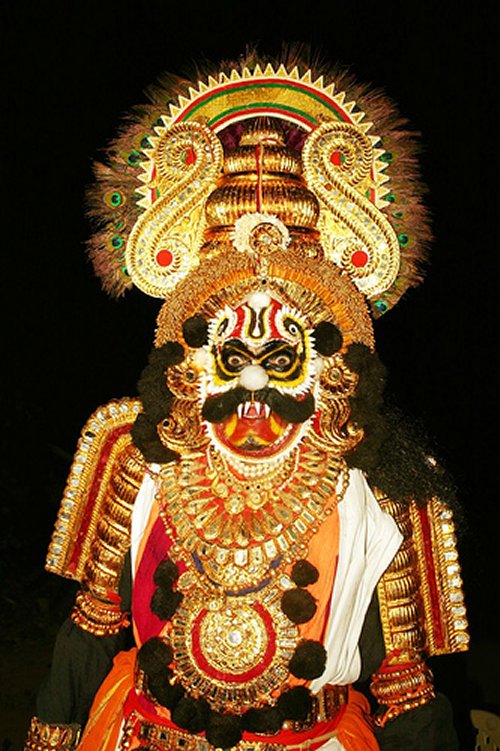
Rakshasa as depicted in Yakshagana, an art form of coastal Karnataka. Credit: Manohara Upadhya, CC BY-SA 3.0
'Rakshasas' (Demons) are associated with tamas – one of three the so-called Gunas (qualities). Two others are Sattva and Rajas, according to Hindu Philosophy.
These three qualities (gunas) are the primary energies from which the universe evolved. The qualities attributed to the Devas (Gods) are identified with Sattva, those of Manushya (Humans) with Rajas, and those of Rakshasas (Demons) with Tamas.
Tamas inflicts wounds and indescribable suffering, which is incompatible with dharma, an old and very complex concept with multiple meanings in Indian religions, such as Hinduism, Buddhism, Jainism, Sikhism, and others.
Perhaps the most straightforward meaning of 'Dharma' is "right way of living" and "path of rightness."
Rakshasas Once Served Brahma
In Hindu beliefs, the rakshasas formerly served Brahma, the creator god and one of the Hindu Trimurti, as guardians of the precious primeval waters of the earth. These terrible creatures were Brahma's creation to protect the ocean from those who tried to steal the elixir of immortality, the amrita, from the depths of the cosmic ocean.
With time, they changed, became real monsters, and turned their backs on him.
As a result of their degeneration, they began to demonstrate their cannibalistic and evil nature, raping women, drinking their blood, interrupting sacrificial ceremonies, and harming humans and animals. Their favorite time of activity was night.
The most famous representative of the rakshasas was the King of Lanka, Ravana, who kidnapped Sita, wife of King Rama, the seventh avatar of the god Vishnu, one of his most popular incarnations along with Krishna and Gautama Buddha, as narrated in Ramayana, a famous epic of ancient India.,
The history of Ravana only emphasizes all the negative qualities of the Rakshasas as evil demons that can also incarnate in human bodies. Among many Hindus, it is strictly forbidden to utter the name 'rakshasa' because it may provoke an evil spirit.
Is There A Way to Kill The Rakshasa Demon?
It is believed that an exorcism, a complex and dangerous part of magic, can kill the rakshasas; extended exposure to sunlight and burning the creature to ash can be another effective way to get rid of it.
Written by – A. Sutherland - AncientPages.com Senior Staff Writer
Updated on February 22, 2024
Copyright © AncientPages.com All rights reserved. This material may not be published, broadcast, rewritten or redistributed in whole or part without the express written permission of AncientPages.com
Expand for referencesThe Essence of the Bhagavad Gita, explained by P K. Jaya Shekhar,
Hyatt V. The Book of Demons
Jaya Shekhar, The Best Bet: Forming the Right Relationships and Making the Most of Your Relationships
More From Ancient Pages
-
 1,500-Year-Old Roman Settlement Destroyed By The Goths Discovered In Bulgaria
-
 Gordian Knot And How Alexander The Great Managed To Outmaneuver The Problem
-
 Nammu: Sumerian Goddess Who Got The Idea To Create Mankind In The Image Of Gods
-
 Beautiful Legend Of La Befana – Witch Who Delivers Gifts To Children In Italy On Epiphany – Twelve Days After Christmas
-
 Secret Hidden Freemasonic Messages Concealed In Ancient Egyptian Artifacts And Roman Works – Curious Stellar Symbol – Part 2
-
 Mysterious Jade Cong – Perplexing Ancient Chinese Artifact
-
 Does A Baffling Artifact Offer Evidence Of Ancient Extraterrestrial Visitation In New Zealand? – Experts Investigate – Part 2
-
 Almost Unknown Ancient Greek Text Rewrites History Of Poetry And Song
-
 ‘Impossible’ Ancient Traces Of Humans – No, We Are Not The First
-
 Teotihuacan’s Puzzling Red Glyphs Could Be Unknown Ancient Writing
-
 Hayk – Legendary Patriarch And Founder Of Armenia Who Defeated King Bel Of Babylon
-
 How Did Vikings Celebrate Yule – The Winter Solstice?
-
 Rocket Launch Into Space At Sibiu, Romania Took Place In 1555 – Sibiu Manuscript
-
 1,200-Year-Old Rock-Cut Temple Found On Banks Of Arjuna River,Tamil Nadu, India
-
 Relics Dated To Byzantine And Late Period Unearthed In Meir Necropolis In Assiut, Upper Egypt
-
 Child Finds Impressive 1,800-Year-Old Ring Engraved With Goddess Minerva On Mount Carmel, Israel
-
 Abric Romaní Cave: New evidence indicates Neanderthals used to heat water some 60,000 years ago
-
 Chocolate Was Invented In Mesoamerica 1900 B.C.
-
 A 5,000-Year-Old Anatolian Sword Identified In Armenian Monastery In Venice
-
 Unexplained Mystery Of The Ship Of Horror – An Unsettling Story

