
Serket: Scorpion Goddess Who Could Heal Poisonous Bites And Sting Evildoers
A. Sutherland - AncientPages.com - In ancient Egyptian beliefs, Serket (Serqet, Selkis) controlled the breath of life, protected righteous deeds, healed deadly bites of snakes and scorpions, and punished evildoers.

Serket and her scorpion. Edfu Temple. Image credit: - CC BY-SA 3.0
The scorpion is a symbol that appeared on the earliest Egyptian artifacts related to the earliest human settlements to the beginning of the Early Dynastic Period around 3100 BC. Serket was depicted as a scorpion with the head and torso of a woman or a woman with a scorpion on her head.
In a strong association with the scorpion, which is famous for protecting its young, also Serket symbolizes the robust protection of motherhood and nurturing of children. In this aspect, she was often compared to the Egyptian goddess Isis, who protected Horus from Seth, the god of chaos, and during the child's infancy.
Generally viewed as a benevolent and protective deity, Serket was given different and beautiful titles. Some of them are: "Lady of Heaven," "Mistress of the Sacred Land," "Lady of the Beautiful Tent," and "The Mistress of the Beautiful House," but this goddess could also punish if necessary when she disapproved of something or someone.
Ancient Egyptians believed that Serket had power over snakes, scorpions, and their poisonous and deadly bites. Thus, she could sting evildoers and cure others who suffered from scorpion stings and snake bites.
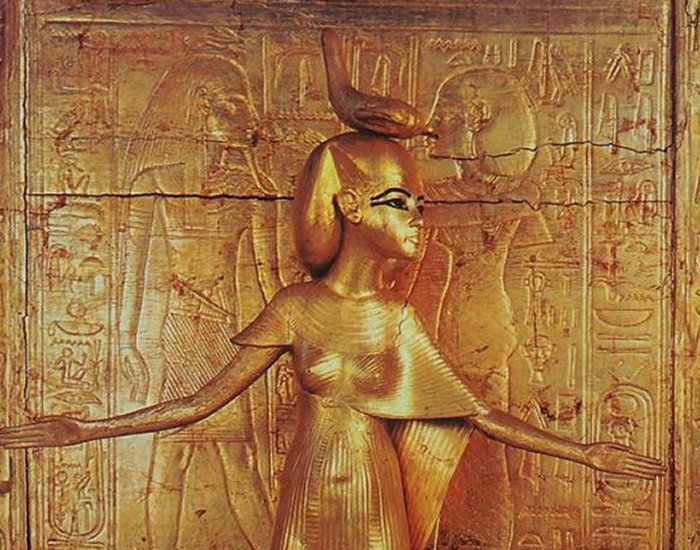
Serket protecting the shrine for the canopic vases of the Tomb of Tutankhamon. Image credit: National Museum, Cairo, Egypt.
Because Serket could cure snake bites, she was sometimes known as the protector from Apep (or Apophis), a demon in snake figure in ancient Egypt's beliefs, widely known as the evil snake god.
Serket also plays a role in the fight against the serpent.
In Coffin Texts spell 752, the deceased says: "I am skilled in the craft of Serket-Hetyt; therefore I will drive off Apophis, ferrying across the firmament."
The goddess's protective role (alone and in the company of other deities) is attested in the Pyramid Texts when the deceased king says: "My mother is Isis, my nurse is Nephthys… Neith is behind me and Serket is before me…" (PT 1375).
Together with three other goddesses (Nephthys, Isis, Neith), Serket protected the body and vital organs of the deceased.
The organs were traditionally stored in the canopic jars and guarded by four minor deities called the 'Four Sons of Horus.'
One of them was the baboon-headed Hapy, who guarded the lungs (protected by Nephthys). Another was the human-headed Imsety, who guarded the liver (and who was himself guarded by Isis). The third was the jackal-headed Duamutef, who defended the stomach (often protected by Neith), and the falcon-headed Qebesenuef, guardian of the intestines (often protected by Serket).
The jars were identified with the four protective goddesses Isis, Nephtys, Neith, and Serket.
This deity did not have many temples raised in her honor, but she had a large number of priests in many communities. She was initially worshiped in the Delta, but her popularity spread throughout the land, and cult centers were established at Djeba (Edfu) and Per-Serqet (Pselkis, el Dakka).
Ancient Egyptians believed that they could save themselves from all venomous creatures by venerating the scorpion goddess.
The goddess was associated with magic, and many magical spells confirm her role as a patroness of practitioners of magical medicine dealing with poisonous bites of scorpions and snakes.
Written by – A. Sutherland - AncientPages.com Senior Staff Writer
Copyright © AncientPages.com All rights reserved. This material may not be published, broadcast, rewritten or redistributed in whole or part without the express written permission of AncientPages.com
Expand for referencesReferences:
Hart, G. A Dictionary of Egyptian Gods and Goddesses
Jackson, Roy. Egypt
More From Ancient Pages
-
 Ancient Egyptian Knowledge Of The Cosmic Engine And Unseen God Of The Universe
-
 Ancient DNA From Medieval Germany Reveals The True Story Of Ashkenazi Jews
-
 350-Year-Old Remains Unearthed In A Stone Age Site In Portugal
-
 Reconstrucion Of The 19-Meter-Long Gjellestad Viking Ship In Progress
-
 Inghirami Tomb – Spectacular Etruscan Burial With 53 Alabaster Urns In Ancient City Of Volterra, Italy
-
 New Light On Appearance Of Scythians In Northern Black Sea Region
-
 Exceptionally Rare 1,300-Year-Old Golden Pommel Found In Blairdrummond, Scotland
-
 Confucius: Philosopher, Educationist And Great Intellect With A Noble Morality
-
 Ancient Roman Portable Toilets Studied By Scientists
-
 On This Day In History: The Gregorian Calendar Implemented – On Oct 5, 1582
-
 Bog Body Of The Elling Woman: Was She Sacrificed To The Gods Because Of Climate Change?
-
 Ancient Mosaic Floor Decorated With Colorful Floral Designs Re-Uncovered After 40 Years
-
 Pyramid Texts Of Ancient Egypt That Charted Journey Of Pharaohs Into Afterlife
-
 Mysterious Gold-Colored Chariot Washes Ashore In India – But Where Did It Come From?
-
 Mysterious 11,000 – Year-Old Tower Of Jericho: Was World’s First Skycraper A Symbol Of Power Or An Ancient Time-Keeping Device?
-
 On This Day In History: Charlemagne Became The King Of The Franks – On Dec 5, 771
-
 Unique Sword Discovered In Mysterious Pre-Viking Tomb In Uppsala, Sweden
-
 Ogdoad Of Hermopolis – Ancient Egyptian Concept Of Eternal And Primeval Forces
-
 Ancient Bizarre Experiments Conducted In Mysterious Underground Temple
-
 1,500-Year-Old Christian Reliquary Found In An Unknown Church In Irschen, Austria

