
Samurai Swords: Katana And Wakizashi And Their Long Tradition
Rafael - AncientPages.com - There are thousands of weapons that have been crafted by man but only a few have acquired the attention and interest of individuals all over the world.
The Samurai swords and especially the Katana are considered the favored weapons of all times. Since the appearance of Japanese swords in popular movies, more people have grown interested in these works of art. Although there were many types of Samurai swords, there were two main blades that were carried by the Samurai, the Katana and the Wakizashi.
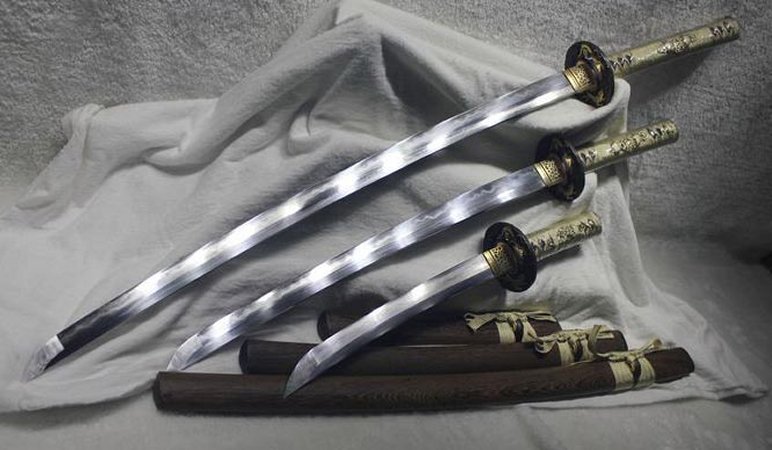
Katana swords are very sharp and tough. Image credit: Katanas For Sale
Wearing both swords together is referred to as “Daisho” and the only individuals that were allowed to do so were the Samurai. These Samurai swords symbolized the Samurai social status.
Katana Served In Life And Protected In Afterlife
The Katana was considered a vital part of a Samurai life and many Samurai regarded their sword as an extension of their soul. When a young Samurai was born, a sword would be brought into the bedroom before the birth and this would be his very first Samurai sword.
Also, when the time came for an old Samurai to pass, the blade would be set by his side so he can carry it to the afterlife. Even after death, the Daimyo (a powerful Japanese feudal lord) believed that he could still rely on the Samurai warriors who had served him in life to follow him and protect him in the afterlife.
The Katana sword is described as a single-edged curved blade that features a unique profile, mostly due to the swordsmith and his method of crafting the sword. To qualify as Katana, the blade should be at least 60.6 centimeters (2 Shaku), while the handle should have enough room to accommodate both hands when wielding.
The Wakizashi blade is shorter than the Katana and its blade usually measures 30.3-60.6cm (1-2 Shaku). The Wakizashi was considered very close to the Samurai soul. It was used as a backup sword, when in close quarters and to behead honored enemies after defeating them. Another famous use for the Wakizashi was the ritualistic suicide called seppuku.
The Samurai Katana dates all the way back to the 14th century, yet the most significant period of the Samurai weapons was categorized into four important phases: the Koto, Shinto, Gendai, and the Shinsaku period.
The very first Samurai sword featured a straight, single-edged blade and was called the Chokuto. This sword was based on weapons coming from China; yet by the end of the tenth century, the Japanese developed their own swords with their own special methods.

This resulted in the appearance of military warriors who protected society and eventually became the very first Samurai of Japan.
There were only a few pieces of evidence that exhibited the evolution of the Samurai swords. However, based on numerous Japanese myths, Amakuni is considered as the Father of the Samurai.
The Kamakura And Muromachi Era
The Kamakura (1185-1333) and Muromachi (1336-1573) periods were considered as the most vital eras of the history of Samurai swords. During this time, a large number of invasions occurred in Japan which required a great need for an effective Samurai sword to fend off the invaders and defending the country successfully.
When engaged in battles, the Japanese Samurai realized the difficulty of drawing a straight blade from its scabbard while on a horseback.

Daisho - Only a Samurai was allowed to wear the Katana and Wakizashi. Image credit: Katanas For Sale
Some swordsmiths began crafting arched Samurai blades which were effectively used by cavalry and those were called the Tachi. Due to the design and the efficiency of the sword cutting angles, the Samurai could draw their swords from the scabbard and attack successfully with one hand, even while riding a horse.
Right after the Muromachi period, there were lesser occurrences of invasions and wars in Japan, which greatly diminished the demand for Samurai swords. Other superior weaponry such as guns was also introduced, thus, forcing almost all of the swordsmiths to abandon their work.
The Edo Period
As time passed, the Samurai sword rose to popularity once more when the great emperor Hideyoshi Toyotomi allowed the Samurai class to wield the Samurai swords again. Eventually, there came four hundred years of peace and the Samurai sword eventually became a quality piece of art that represented the long history of the Japanese.
Samurai blades that were crafted during the period were primarily utilized for decorative purposes.
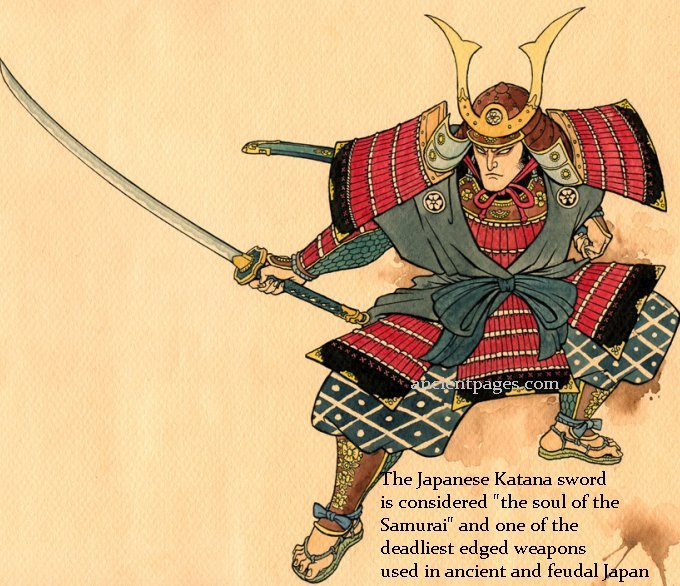
The Edo period (1603 and 1868) also known as Tokugawa period, was also the time when rulers of Japan attempted to regulate the different versions of Samurai swords, as well as the social groups that were allowed to carry these; additionally, it was also the time when the lengths of these Samurai swords were officially set.
End Of The Samurai Era
The year 1876 was the beginning of Japan’s civilization and the samurai warriors and citizens were completely prohibited from carrying swords. This was considered as a dark period especially for remaining swordsmiths since they had to abandon and close down their business.
The Japanese army also had to stop utilizing the Samurai swords and adopted the use of contemporary weapons that came from the West such as the Western-style cavalry blades. After The Second World War, only a few swordsmiths in and outside the country were allowed to produce Samurai swords.
Modern-Day Samurai Swords
Even in this day and age, the Samurai Katana is highly respected and considered as one of the finest swords; yet it is extremely rare to find a smith that can craft a Samurai sword with the passion, heart, and skill of the early swordsmiths.
Katana swords are still adorned by martial arts practitioners and sword collectors. There are various martial arts that make use of the Katana sword, like Iaido and Kenjutsu. The Katana sword continues to carry a strong ceremonial and historical significance.
Written by – Rafael - AncientPages.com Contributor
Copyright © AncientPages.com All rights reserved. This material may not be published, broadcast, rewritten or redistributed in whole or part without the express written permission of AncientPages.com
Expand for referencesMore From Ancient Pages
-
 Chonchon ‘Tue Tue’ Bird With Human Head Brought Bad Omens To Places It Haunted In Beliefs Of Mapuche Indians
-
 Remarkable 5,000-Year-Old Crystal Dagger Discovered In Megalithic Tomb Of Montelirio Tholos
-
 Mayan Maize God And Ancient City Of El Mirador
-
 Corsica: ‘The Island Of Statue-Menhirs’ – Where Humans Lived At Least 7,000 BC
-
 Evidence Of Frightening Rituals Practiced By Ancient Steppe Nomads In Siberia – Discovered
-
 220 Million-Year-Old Dinosaur Footprint Found On Wales Beach By Girl
-
 Secret High-Tech Knowledge Hidden In Ancient Manuscripts And The Mysterious Seven Sky Kings
-
 Secret Kumari Kandam Continent And Links To Lemurians
-
 On This Day In History: Fascinating Prague Astronomical Clock Mentioned For The First Time – On Oct 9, 1410
-
 One-Eyed Giant Polyphemus – Most Famous Of The Cyclops In Greek Mythology
-
 Champa’s Megalithic City My Son And The Nagas Inscription That Could Re-Write History
-
 Food And Clothing Of Middle Class Of The Sumerian Society
-
 Ancient Bizarre Experiments Conducted In Mysterious Underground Temple
-
 Long-Lost Anglo-Saxon Monastery Ruled By Queen Cynethryth Of Mercia Discovered By Archaeologists
-
 Ancient Irish Practiced Special Burial Rituals Such As Dismemberment Of Bodies
-
 Oldest Golden Jewel In The Caucasus Unearthed In Azerbaijan
-
 Ireland’s Population Was In Decline When Vikings Arrived To Settle
-
 Mnemosyne: Powerful Greek Goddess Of Memory, Bridge Between The Past And The Future
-
 Artifacts And Remnants Of 3,000-Year-Old City Unearthed Near Great Zab River In Iraqi Kurdistan
-
 Scientists Question Whether Meat Eating Really Changed Human Evolution

