
The Mixtec – Mysterious Very Advanced Culture Of The Foremost Goldsmiths Of Mesoamerica
A. Sutherland - AncientPages.com - The Mixtec people called themselves the Ñuu Savi - "People of the Rain" and lived in three mountainous areas of present-day Oaxaca in Southwestern Mexico.
Their homeland was the Mixteca.
The Mixtec never built large cities similar to Tula or Teotihuacan, but instead lived and worked in smaller settlements in neighboring valleys.

From left: Mixtec Codex, (Latin American Studied.org); Turquoise mosaic mask. Mixtec-Aztec, 1400-1521 AD/British Museum; Plate 37 of the Codex Vindobonensis. The central scene supposedly depicts the origin of the Mixtecs as a people whose ancestors sprang from a tree; Mixtec Rain God (Wikipedia)
Much about the pre-history of these people is unknown but archaeological evidence shows that the culture flourished between 940 and 1500AD. Around 1350 AD, the Mixtecs took over control of the sacred, ceremonial site of Monte Alban, near the present-day city of Oaxaca, from the Zapotecs, who ruled Monte Alban for some about 12 centuries.
Later, archaeological evidence revealed that Monte Alban’s interior, especially Tomb No.7, contained lavish burial treasures of gold, silver, pearls and turquoise.
They were a complex society, which unlike other cultures had a continuous history that goes from the Preclassic (from at least 1500 BC), until the end of the Postclassic (900 AD and the Spanish arrival in 1519).

Interior of the Mixtec tomb, archaeological site at Zaachila, Oaxaca, Mexico. Image credit: El Agora/Wikipedia
In the 10th century, several Mixtec kingdoms were established, in which lived classes of nobles, artisans and peasants. Later, during 500-750 AD, the Mixtec created urban centers and developed a calendar, monumental architecture, terrace agriculture, impressive irrigation systems, and glyphic writing. Their most important and one of the oldest settlements in Oaxaca, was Tilantongo and the Mixtec picture codices tell stories about its kings.
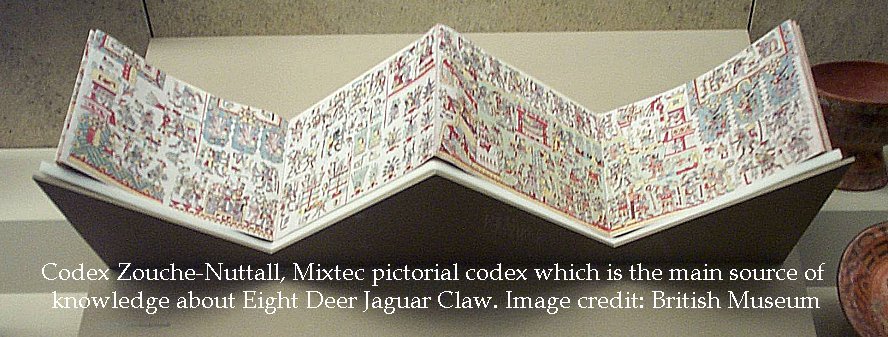
Much place is devoted to one of the greatest of the Mixtec dynasties, the Tilantongo dynasty, established upon the marriage of two nobles in the holy Mixtec city of Tilantongo in 990 AD and Lord 8 Deer (also known as Eight Deer Jaguar Claw), a powerful Mixtec ruler 11th century Oaxaca referred to several Mixtec manuscripts, especially, the 15th-century deerskin manuscript "Codex Zouche-Nuttall"
However, only eight of the original Mixtec historic documents survived until today.

The chest plate (or chimalli) was made by Mixtec craftsmen using components such as gold and turquoise. The Mixtecs were masters in making gold and metal objects.
The Mixtecs’ legacy includes many more amazing achievements. For example, these people were considered the foremost goldsmiths of Mesoamerica," who mastered the ‘lost-wax casting’ of gold and its alloys, which resulted in remarkable gold work and the art of jewelry (necklaces, pectorals, rings, earmuffs and nose rings). The art of designing with feathers is also included in their rich legacy.
Another Mixtec achievement is a writing system of written signs and pictures that influenced other Mesoamerican cultures. The system was used to record (on deerskin) historical and cultural events such as the births, marriages and deaths of nobles, wars and victories, and other important events that affected the Mixtec society.
See also:
Mystery Of Monte Albán – Ancient City ‘At The Foot Of The Heavens’ Built By The Zapotecs
Aztecs: Facts And History About The Ancient And Powerful Mesoamerican Civilization From Aztlán
Dresden Codex – The Oldest And Best Preserved Book Of The Maya
Aztec Empire: ‘Tlatoani’ – The Ruler With The Ultimate Power In The Land
Aztecs: Facts And History About The Ancient And Powerful Mesoamerican Civilization From Aztlán
During their large expansion, the Aztecs conquered many lands in Mexico and Mesoamerica through wars.
The Mixtec were one of them; many died in sacrifices and some of the most skilled craftsmen moved to the Aztec capital, Tenochtitlan, to create new wonders in gold for their new rulers. The Mixtec nobles – as the other conquered lands - were obliged to pay tribute to the rulers in Tenochtitlan.
Today, they are considered the fourth largest group of native peoples of Mexico, after Nahua, Mayan and Zapotec - among the most numerous Indian towns of Mexico.
Written by – A. Sutherland AncientPages.com Staff Writer
Copyright © AncientPages.com All rights reserved. This material may not be published, broadcast, rewritten or redistributed in whole or part without the express written permission of AncientPages.com
Expand for referencesReferences:
Spores R. Sr., Balkansky A. K. The Mixtecs of Oaxaca
More From Ancient Pages
-
 Who Was The The Mysterious Lady Of Bietikow And What Had She In Common With Ötzi Iceman?
-
 UK’s Oldest Human DNA Reveals Two Genetically Distinct Human Groups Migrated To Britain At The End Of Last Ice Age
-
 Ancient City Of Uxmal And Magnificent Pyramid Of The Magician
-
 Surprising Discovery Reveals Ancient Tibetan Bowl Shows Alexander The Great – The Jewish Version And Not The Homer’s Iliad
-
 Skull Reveals Little Foot Was Capable Of Different Head Movements Than Modern Humans
-
 Unusual Fog, Mysterious Forest Disappearances, And Unexplained Lights In Finland – What Is The Connection?
-
 Mystery Of Vangchhia Ancient Site: Water Pavilion And Ingenious Idea Of Water Harvesting
-
 Mystery Of Biblical Noah’s Strange Connection With Red-Skinned Giants And The Watchers – Not-Of-This-World Emergence – Part 1
-
 DNA Study Reveals How Europe’s Hunter-Gatherers Adapted To A New Way Of Life – Farming
-
 On This Day In History: Gottfried Wilhelm von Leibniz – Famous Philosopher, Scientist And Mathematician Died – On Nov 14, 1716
-
 Easter Island May Offer Proof Of An Alien Apocalypse
-
 Ancient People In The Tibetan Plateau Had More Cultural Exchanges Than Previously Thought
-
 New Discovery: Unknown Use Of Yellow Colors In Ancient Egypt – Revealed
-
 Intact 2,600-Year-Old Etruscan Tomb Opened In Vulci- Exceptionally Rare Artifacts Found Inside
-
 What Did Bronze Age People Do With All That Bronze?
-
 Radar Reveals ‘Ghost’ Footprints From Pleistocene Era
-
 Evidence Of The Moon-Eyed People – More Clues – Part 2
-
 Aoife: Beautiful Female Warrior, Lover Of Cuchulainn And Mother Of His Only Son In Irish Beliefs
-
 Three 3,500-Year-Old Painted Wooden Coffins Discovered In Luxor, Egypt
-
 525-Million-Year-Old Fossil Defies Textbook Explanation For Brain Evolution

