
Death Of Norse God Balder And Loki’s Mischief That Led To Destruction In Ragnarok
A. Sutherland - AncientPages.com - The death of Balder (Baldr or Balðr) - a favorite of both gods of Aesir - is probably the most famous of all the Norse myths.
Most we know today about him comes from the ‘Prose Edda’ of Snorri Sturluson and the work of Saxo Grammaticus ( c. 1150 – c. 1220), a Danish historian, theologian and author.
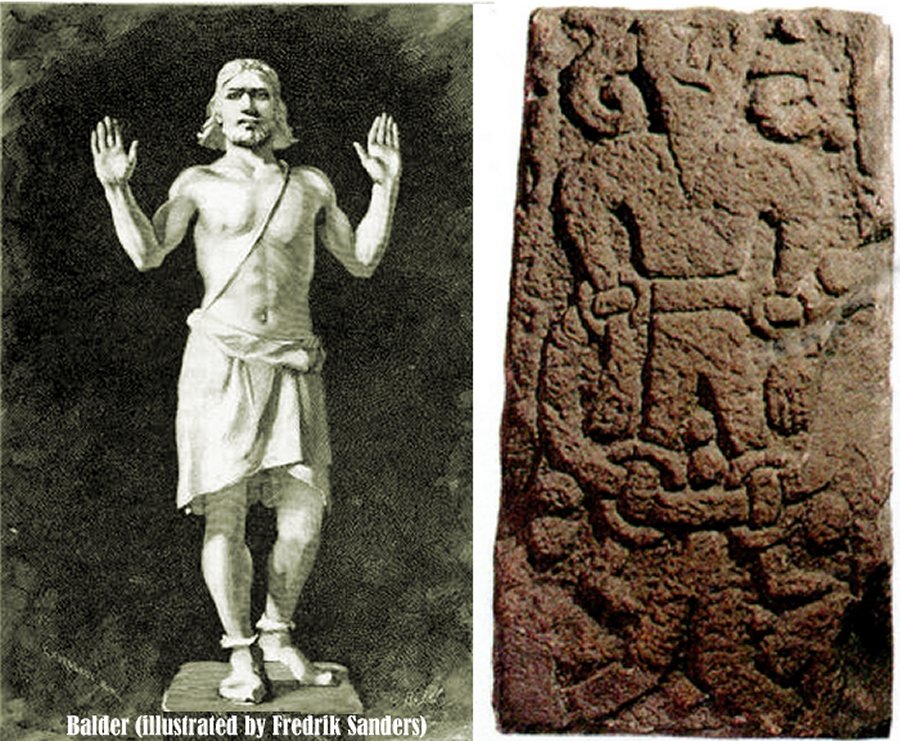
Balder. Image via Wikimedia commons. Right: The gods were determined to punish Loki for death of Balder. He was bound with his own son’s entrails. (stone cross, Cumbria, England
It is the myth about the mortality of the gods and the limits of their power. Even powerful Odin who possessed magical runes and knew about their abilities, was unable to prevent the death of his son, Balder, the beautiful, the pride of all the gods.
Balder - the god of the sun and light - was the son of Odin and Frigg and Hod (Höd) was his blind brother. He dwelled in a palace called Breidablik in Asgard.
Balder is considered Scandinavian equivalent of Apollo, but according to Danish tradition, he was not as a god but as a warrior fighting on earth. He was also compared to the Middle East’s fertility gods such as Adonis-Dionysos, Attis, Osiris and others.

Balder’s brother Hermod took Odin’s horse Sleipnir and rode to Hel, goddess of the dead, in Niflheim and he begged her to let Balder to return with him.
When Balder became plagued by evil dreams about his destruction, his mother Frigg asked all created beings along with plants, trees, and all objects of metal, wood and stone, to swear never to cause Balder harm.
See also:
Goddess Idun And The Golden Apple Myth In Norse Mythology
Ragnarok In Norse Mythology – The Doom Of The Gods And Apocalyptic Record Of The Coming Comet
The Realms Of Jötunheimr – The Home Of The Fearful Giants In Norse Mythology
‘Neither weapons nor will wood harm Balder,’ she said to Loki, who changed himself into a woman and visited her home Fensalir. ‘I have received oaths from all things...’
But she forgot one small tree called 'mistletoe' growing to the west of Valhalla and she did not know that the trickster and jealous Loki was an enemy of Balder and he worked-out a cunning plan. He found the tree, pulled it up, changed his appearance and went to the gods' assembly. He approached the blind god Hod and asked him why he was not shooting at Balder.

Death of Balder at the hands of the blind god Hod, who was tricked into shooting with mistletoe. Drawing by Olafur Brynjulfsson illustrated a medieval version of the Edda
'Because I cannot see him,' said Hod 'and I have weapon'. Loki immediately saw his great opportunity. He made the plant into a dart and gave it the blind god.
'I will direct your aim if you want to shoot at him with this stick,' said Loki.
When the dart pierced Balder through, he fell down dead. This was the worst deed ever performed by the gods and they knew that Loki was responsible, but they could not punish him; it was forbidden to spill blood on the assembly area.
Odin knew that Balder’s death predicted the death of all the gods. He had great knowledge of the future and he knew he was doomed to be devoured one day. It was only a matter of time.
Balder’s brother Hermod took Odin’s horse Sleipnir and rode to Hel, goddess of the dead, in Niflheim and he begged her to let Balder to return with him.
‘If all things in the world will weep for Balder, then I will let him go,' Hel said.
Everyone and everything on earth complied by weeping but the giantess Thokk (it was again Loki in one of his many disguises) did not. Hel refused to release Balder. Loki was punished for his part in Balder's death
After Ragnarok, Balder was reborn, signaling the beginning of a new age.
Written by A. Sutherland - AncientPages.com Staff Writer
Copyright © AncientPages.com All rights reserved. This material may not be published, broadcast, rewritten or redistributed in whole or part without the express written permission of AncientPages.com
Expand for referencesMore From Ancient Pages
-
 Legendary Uchchaihshravas: Divine Seven-Headed Flying Horse Of God Indra
-
 Discovery: Massive Gawro Wall Dated To The Antique Age: Was It A Symbolic Or Defensive Structure?
-
 Mysterious Marcahuasi, Peru – One Of The Greatest Puzzles Of Human Prehistory
-
 Glass Technology Was Known In Sahara Centuries Before The Arrival Of Europeans
-
 Reconstructed Roman Gateway Tells The Story Of Britain’s Invasion
-
 2,500-Year-Old Olmec Related Mexican Cave Paintings Are Now Restored And Protected
-
 Neanderthal Hunting Camp Discovered In The Center Of The Iberian Peninsula
-
 Last Of The Giant Camels And Archaic Humans Lived Together In Mongolia Until 27,000 Years Ago
-
 Mysterious Kallerup’s Double-Headed Figurine – Evidence Of Unknown Norse God Or Worship Of Roman God Janus In Ancient Scandinavia?
-
 Ancient ‘Cosmic’ Artifacts – Ancient Civilizations Used Meteoric Iron Much Earlier Than Previously Thought
-
 Obscure History Of Atlantean Statues In Ancient Toltecs’ City Of Tula
-
 Humans Have Been In The Arctic For Over 40,000 Years – New Discoveries Reveal
-
 Why Is The Yarm Viking Helmet Special?
-
 Mother, Father, Child, Marriage And Divorce In Viking Society
-
 Don’t Underestimate The Rishis – Ancient Sages Were ‘Probably Great Scientists’
-
 Moon: What Was Its Role In Beliefs Of Ancient People?
-
 5,000-Year-Old DNA Could Solve The Mystery Of Genetic Changes In Europe
-
 Home Of Jesus’ Apostles Found In The Lost Biblical Town Bethsaida
-
 Has The Mythical Long-Lost Underwater Ancient Land Of The King With Three Crowns Been Found?
-
 Tusayan Pueblo Ruins And Split Twig Figurines Tell Story Of People Who Once Inhabited The Grand Canyon

