
Illapa: Powerful Master Of Clouds, Rain And Hail – Worshipped By Inca People
A. Sutherland - AncientPages.com - Illapa (aka Apu Illapu, Ilyap'a, Katoylla) is considered by many as one of the most important deities in the Inca pantheon.

Staty av Pachacutiq i Machupicchu Pueblo i Peru. Image credit: - CC BY 2.5
He had a number of overlapping identities located in several different places. One of his powerful identities we have described earlier here.
This very popular weather god associated with rain was frequently imagined as a man in the sky, dressed in shining garments and carrying a sling and a war club.
The lightning was believed to be the flashing of his clothing, and the thunder was the crack of Illapa’s sling. Illapa, venerated in areas of the central highlands of Peru and northern Chile, had the power to make rain, hail, and thunder; he also mastered clouds. His activities were crucial because the sky was the source of both sun and rain for sustaining crops, according to the Inca beliefs.
They prayed to Illapa for rain and protection from drought. His figure was worshiped at Coricancha (Qorikancha), where Illapa had his own temple in the religious complex in the Inca capital at Cuzco, which contained the Temple of the Sun, the most sacred place in the Inca religion and the very center of the Inca world.
Illapa’s wasi (temple) contained his cult statue and religious objects associated with him. He was depicted with his face covered by a headdress to symbolize the veiling of the thunder by the clouds.
During the late sixteenth century the Spanish compared his figure to that of the apostle James, whose horse galloped across the heavens producing the sound of thunder.
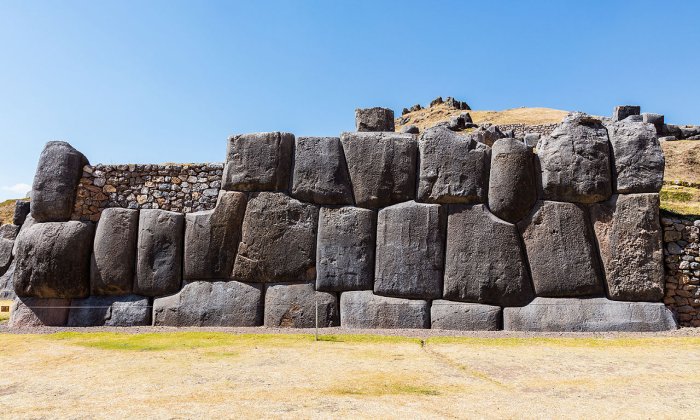
Sacsayhuamán, Cusco, Peru. Image credit: Diego Delso - CC BY-SA 4.0
According to a myth, Illapa filled a jug of water from the Milky Way and gave it to his sister to care for. It rained only when Illapa broke his sister's water jug, causing the rain to fall.
The Quechua people in the Peruvian Andes associated Illapa with Saint James, the patron of Spain. They celebrated both god Illapa and Saint James on July 25. The flashing swords and the explosions from the Spanish soldiers’ muskets reminded the Inca of lightning followed by a clap of thunder.
Sacsayhuaman, a true wonder of prehistoric South America, is constructed of flawlessly fitting cyclopean boulders, which zigzag across the plateau for approximately 400 meters.
It is believed that Sacsayhuaman was created during the time of Pachacutec or Pachacuti Inca Yupanqui (in Quechua: Pachakutiq means "he who overturns space and time" and Yupanki means "with honor") , who made it to the ceremonial center in honor of the great god Illiapa (god of thunder), which helped him in his struggles.
Therefore, it is said that some walls of Sacsayhuaman are shaped like thunder (zigzag).
Written by – A. Sutherland AncientPages.com Staff Writer
Copyright © AncientPages.com All rights reserved. This material may not be published, broadcast, rewritten or redistributed in whole or part without the express written permission of AncientPages.com
Expand for referencesReferences:
John E. Staller,Brian Stross, Lightning in the Andes and Mesoamerica
de Gamboa, Pedro Sarmiento. History of the Incas
More From Ancient Pages
-
 Finds At Timna Valley Date Back To King Solomon-Era And Point To Sophisticated Ancient Society
-
 What Was It Like To Be A Student In The Middle Ages?
-
 Unique 3,300-Year-Old Hittite Bracelet With Symbols Discovered By Farmer
-
 Sutton Hoo Ship Burial And Famous Helmet That Could Belong To Raedwald, King Of All The Kings Of Britain
-
 World’s Oldest Beer Factory Discovered In Abydos, Egypt
-
 A 2,700-Year-Old Urartians’ Ayanis Castle And Haldi Temple – Soon An Open-Air Museum
-
 142,000-Year-Old Shell Beads Found In A Cave Are The Oldest Known Evidence Of Human Communication
-
 Mystery Of Egyptian Tomb 10A And The Mummy’s Head – A 4,000-Year-Old Crime
-
 Hundreds Of Burials Discovered In Northern Lazio, The Home Of The Etruscan Civilization – Digitized
-
 Enigmatic Ale’s Stones – Sweden’s Megalithic Ship-Like Formation
-
 White Temple Of God Anu In Sacred Precinct Of Kullaba At Uruk
-
 Wooden Pre-Columbian Human-Like Statues Discovered At Chan Chan Complex In Peru
-
 Fossil Bones From The Largest Penguin That Ever Lived Unearthed In New Zealand
-
 Massive trophy skull rack discovered in the Aztec ruins
-
 Paleolithic Inhabitants Of Cyprus Established Settlements Much Earlier Than Previously Estimated
-
 Chonchon ‘Tue Tue’ Bird With Human Head Brought Bad Omens To Places It Haunted In Beliefs Of Mapuche Indians
-
 Archery Technology Emerged In The Americas 5,000 Years Ago – Much Earlier Than Previously Thought
-
 Jade Emperor – Supreme Ruler Of Heaven In Chinese Mythology
-
 Breakthrough: Oldest Egyptian DNA Extracted From Individual Who Lived During The Age Of The First Pyramids
-
 Magnificent Viking Treasure Accidently Found In Norway – Was It Hidden Or Sacrificed?

