
Palermo Stone: One Of The Earliest History Records Of Ancient Egypt
A. Sutherland - AncientPages.com - The Palermo Stone, carved on a black basalt stele, is one of the earliest Egyptian historical texts. The original location of the artifact is unknown, but one fragment is said to have been found at an archaeological site at Memphis in 1866, while three other fragments now in Cairo were probably discovered in Middle Egypt.
It is a large fragment of a stela known as the Royal Annals of the Old Kingdom of ancient Egypt and contains records of the kings of Egypt from the first to the fifth dynasty.

The king list of Egyptian pharaohs, represents one of the basic sources of information about the chronology and cultural history of ancient Egypt during the first five dynasties (c. 2925–c. 2325 BC), although the last name preserved on the stone is that of Neferirkare, the third of the nine kings of the 5th dynasty.
On the Palermo Stone there is also chronicled that there was a civilization prior to the present one. This civilization dates back between twenty and thirty thousand years.
Named for the Sicilian city, where it has been preserved since 1877, it is one of six existing fragments from a single stela that probably originally stood in an Egyptian temple or other important building.
The Palermo Stone is an irregular shield-shaped fragment, 43.5 cm high, 25 cm wide and 6.5 cm thick (maximum dimensions).
The original to which the Palermo Stone belonged, is believed to have been about 2.2 meters long, 0.61 meters high and 6.5 cm thick.
It is generally accepted, but not proven, that the large Cairo Fragment, may have belonged to the same original.
It is inscribed on both sides with horizontal lines of hieroglyphic text, the top row listing the names of predynastic rulers.
The following rows, each headed by the name of a different king, are divided into compartments, each compartment signifying one year.
See also:
Massive Fortress Buhen In Ancient Capital Of Egyptian Nubia
Mysterious Location Of The Amazing Land Of Punt - Can This Puzzle Be Solved One Day?
Meidum: Collapsed Pyramid Of Great Builder Pharaoh Snofru
Palermo Stone consists of 6 horizontal bands or registers of hieroglyphic text running right to left. Within the compartments the hieroglyphs always list one or more memorable events of that year.
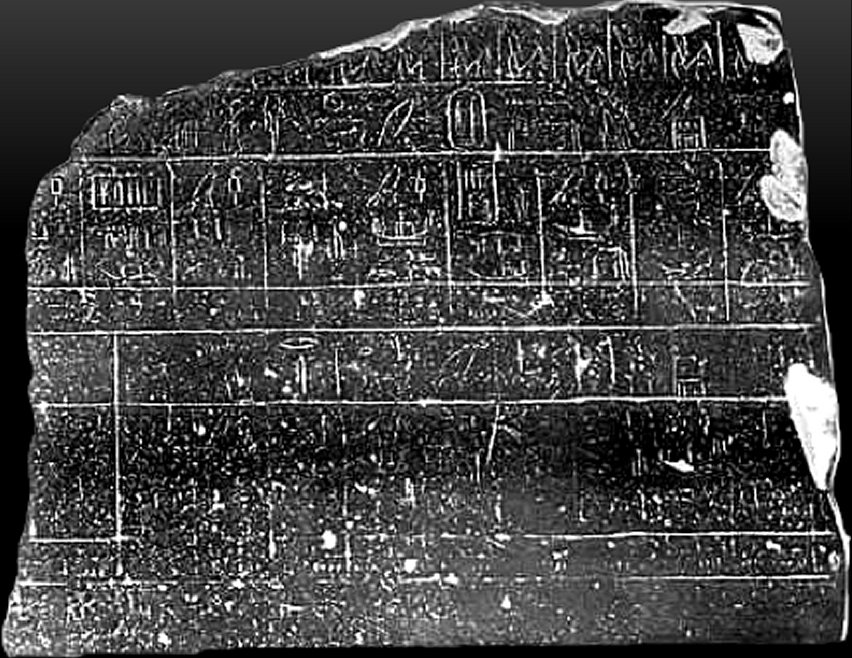
Cairo Fragment CF1 lists, among others, the start of the reign of Horus Djer. Credits: ancient-egypt.org
According to Palermo Stone, in the early 4th Dynasty, Sneferu sent a military expedition to Nubia. This expedition returned with 7,000 captives and 200,000 cattles. There is no further explanation in text, who the captives were and from which locations in Nubia.
The Palermo Stone was published and translated for the first time in 1902 by a German Egyptologist Heinrich Schäfer (1868-1957). The purpose of this ancient artifact is not clearly defined.
Was it meant to record historical events or had it another function?
Written by – A. Sutherland AncientPages.com Staff Writer
Copyright © AncientPages.com All rights reserved. This material may not be published, broadcast, rewritten or redistributed in whole or part without the express written permission of AncientPages.com
More From Ancient Pages
-
 What Did Ancient Mesoamerican Civilizations Know About Unusual Powers Of The Mind?
-
 On This Day In History: ENIGMA The Secret Code Used By Germans Was Finally Broken- On July 9, 1941
-
 Who Is Buried In The Giant Etruscan Tomb At San Giuliano Necropolis?
-
 1,000-Year-Old Multi-Shaped, Double-Sided Mold For Jewelry Found In Swiss City Of Chur
-
 Metal Artifacts In Southeast Asia Archaeological Theory – Challenged
-
 On This Day In History: Courageous And Heroic Radio Rescue At Sea – On Jan 23, 1909
-
 Underground Civilizations – True Rulers Of Earth – Part 1
-
 Cartography Shows That The Isthmus Of Tehuantepec Was Used As An Inter-Oceanic Passage In The 16th Century
-
 Brown Hares And Chickens Were Seen As Gods Not Food In Iron Age Britain
-
 New Clues May Explain Collapse Of Ancient City Teotihuacan In Mexico
-
 Viking’s Symbols Of Travels Prestige And Adventure Were Imported From Abroad
-
 Weird Archaeological Discovery In Ancient Scottish Cave – A Neolithic And Celtic Mystery
-
 Perseus – Courageous Adventurer Who Fulfilled A Prophecy
-
 Egyptian Royal Artifacts Found At ‘Ancient Buto’ Site, Egypt Probably Dated To King Psamtik I’s Reign
-
 Ancient Human Feeding Behavior Studied By Scientists
-
 Mysterious Black Cloud Caused A Global Catastrophe In 536 A.D. And 18 Months Of Darkness
-
 Discovery Of Stone Age Textiles Sheds New Light On The History Of Clothes Making
-
 Why Were American Soldiers Called Yankees And Where Does Yankee Doodle Come From?
-
 Pre-Pharaonic Petroglyphs Used To Study Egyptian Cult Of The Gods
-
 Walls Of Lugo: Finest Example Of Late Roman Fortifications – Stands The Test Of Time

