
Graeae: Three Sisters Of Fate Who Shared One Eye And Tooth In Greek Mythology
A. Sutherland - AncientPages.com - The Graeae were three sisters of fate who shared one eye and one tooth in Greek mythology. They were born as old women and their names were Deino (dread), Enyo (horror), and Pemphredo (alarm).
The number three is of great symbolical meaning in many myths. The Graeae share certain similarities with the three Norns, known as ‘Shapers of Destiny’ in Norse mythology. The Norns were goddesses who ruled the fates of people, determined the destinies and lifespans of individuals.
One might also compare the Graeae with the three spinners of Destiny, the Moirai who were also called the Fates in Greek mythology. The three Moirai determined the span of life of every mortal from birth to death. They were so powerful that no god had the right or the means to alter their decisions.
Although the Fates were the personifications of destiny, no human could blame the fates, as he was the only one responsible for his failures.

The Graeae were three sisters of fate who shared one eye and one tooth in Greek mythology. Image credit: Doorway To Other Worlds
The subject of fate is also reflected in Baltic religion where we encounter Laima, the Baltic goddess of fate who together with Dievs, the sky, and Saule, the sun, Laima determines the length and fortune of human life.
The mythical story of the Graeae has changed over the course of time. In their original conception, they were merely personifications of kindly and venerable old age, possessing all its benevolent attributes without its natural infirmities.
They were old and gray from their birth, and so they ever remained. In later times, however, they came to be regarded as misshapen females, decrepit, and hideously ugly, having only one eye, one tooth, and one gray wig between them, which they lent to each other when one of them wished to appear before the world. So, at times poets described them as "beautiful."
In other legends they are described as being half-swan or old, ugly hags. Their age was so great that a human childhood for them was hardly conceivable.
Born as the daughters of the Sea Gods, sea gods Phorcys and Ceto, and sisters of the Gorgons, the Graeae were powerful creatures and they appear in the myth of Perseus, the hero who killed Medusa, a monster, a Gorgon, generally described as a winged human female with a hideous face and living venomous snakes in place of hair. Gazers on her face would turn to stone.

Perseus Returning the Eye of the Graeae by Henry Fuseli
According to an ancient legend, Perseus was sent by the king to get Medusa's head. Perseus went to the three Graeae, that shared one eye between them, and through stealing it he made them tell him where the nymphs of the north lived. They gave him winged sandals, a magic bag that fit anything put in it, and Hades' cap which made him invisible whenever he wore it. Hermes gave him an unbreakable sword, and Athena a shield.
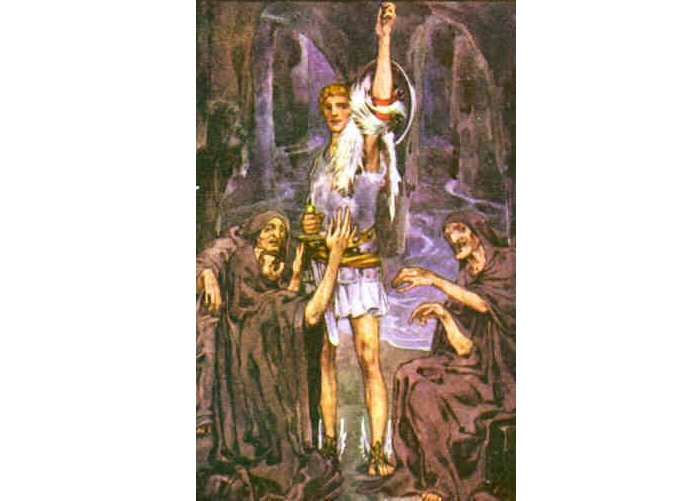
Perseus took the eye from the Graeae to kill Medusa.
With all this equipment, Perseus managed to kill Medusa by looking at her through the reflection of the shield and escaped her sisters by wearing the cap. His winged sandals flew him home. Later he offered Medusa's head to Athena.
The Graeae are also called Grey Sisters, Graiai, and Graiae.
Written by – A. Sutherland AncientPages.com Staff Writer
Copyright © AncientPages.com All rights reserved. This material may not be published, broadcast, rewritten or redistributed in whole or part without the express written permission of AncientPages.com
Expand for referencesEdith Hamilton, Mythology: Timeless Tales of Gods and Heroes
Bernard Evslin, Heroes, Gods and Monsters of the Greek Myths
More From Ancient Pages
-
 Tomb Of Nicolaus Copernicus: Is The Mystery Surrounding Astronomer’s Burial Place Really Solved?
-
 Forgotten Ancient Wisdom: People Have Two Souls – Native American And Pre-Christian Beliefs Reveal
-
 Controversial Ancient Tomb Could Prove The Existence Of Biblical Jonah
-
 Iron Ingots Probably From Ancient Mines Found In Large Quantity At The Bottom Of The River In Bosnia
-
 Women’s March On Versailles: One Of The Most Significant Events Of The French Revolution
-
 Treasures From Ancient City Of Hippos-Sussita Displayed In Exhibition For The First Time
-
 The Legend Of Little Deer – Interesting Cherokee Tale Of How Disease And Medicine Began, And Why The Native Americans Respect All Life
-
 Hacksilber Hoard Dated To 11th Century BC: Eastern Mediterranean Silver Trade Reconstructed
-
 Face Of Very Old “Vampire” Buried In Connecticut Reconstructed
-
 Temple Of Lord Vishnu Dated To Hindu Shahi Dynasty Unearthed In Pakistan
-
 The Curse Fell On King Midas And His Gold Desire Became A Nightmare
-
 Göbeklitepe-Like Kahin Tepe Is Oldest Worship Place In Black Sea Region – Interesting Finding
-
 Headless remains related to Huns or Sarmatians puzzle archaeologists in Kazakhstan
-
 Extremely Rare And Tiny Biblical Coins Discovered Near The Temple Mount
-
 Huge 40-Meter Long 16th Century Tunnel For Looting Was Exposed Inside Tower Tomb
-
 Obsidian Blades Reveals Dynamic Neolithic Social Networks – New Analysis
-
 It’s Possible To Find Your Ancient Doppelganger – This Is What You Need To Do
-
 On This Day In History: Walpurgis Night Celebration In Northern Europe – On Apr 30
-
 Precious Lost Ancient Book Of Wisdom Could Solve Biblical Mysteries
-
 Unusual Ancient Creatures Discovered In The Grand Canyon

