AncientPages.com - It's hard to imagine a world without spice today. Fast global trade has allowed the import and export of all manner of delicious ingredients that help bring Indian, Chinese, Vietnamese, Malaysian, Sri Lankan (and so many more) cuisines to our dinner tables.

Now, new research shows the trading of spices for culinary use goes way back—some 2,000 years, to be precise.
In a paper published July 21 in Science Advances, we and our colleagues detail our findings of what seems to be evidence of Southeast Asia's oldest known curry. It's also the oldest evidence of curry ever found outside India.
We made the intriguing discovery at the Oc Eo archaeological complex in southern Vietnam. We found eight unique spices, originally from different sources, which were likely used for making curry. What's even more fascinating is that some of these would have been transported over several thousand kilometers by sea.
Grinding into the evidence
Our team's research wasn't initially focused on curry. Rather, we were curious to learn about the function of a set of stone grinding tools known as "pesani," which the people of the ancient Funan kingdom likely used to powder their spices. We also wanted to gain a deeper understanding of the ancient spice trade.
Using a technique called starch grain analysis, we analyzed microscopic remains recovered from a range of grinding and pounding tools excavated from the Oc Eo site. Most of these tools were excavated by our team from 2017 to 2019, while some had been previously collected by the local museum.
Starch grains are tiny structures found within plant cells that can be preserved over long periods. Studying them can provide valuable insights into past plant use, diet, cultivation practices and even environmental conditions.
Of the 40 tools we analyzed, 12 produced a range of spices including turmeric, ginger, fingerroot, sand ginger, galangal, clove, nutmeg and cinnamon. This means the occupants of the site had indeed used the tools for food processing, including to powder the rhizomes, seeds and stems of spice plants to release flavor.
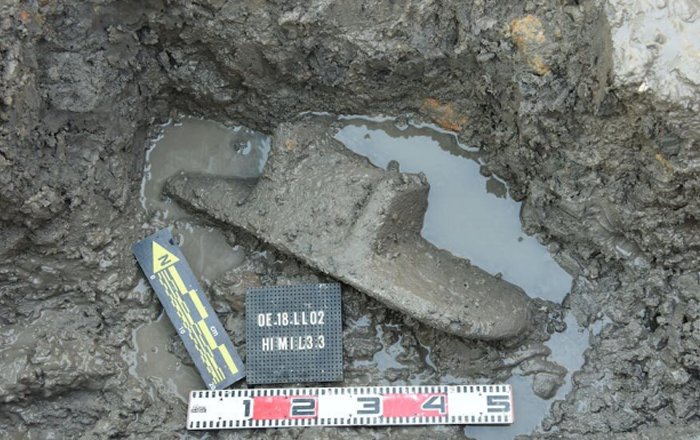
We excavated this footed sandstone grinding slab in 2018. On its surface we found ancient starch grains of ginger (Zingiber officinale), cinnamon (Cinnamomum sp.) and nutmeg (Myristica fragrans). Credit: Khanh Trung Kien Nguyen, Author provided
To figure out how old the site and tools were, our team obtained 29 separate dates from charcoal and wood samples. This included a date of 207-326 CE produced by a charcoal sample taken from just below the largest grinding slab, which measures 76cm by 31cm (pictured below and at the top of this article).
Another team working at the same site applied a technique called thermoluminescence dating to bricks used in the site's architecture. Collectively, the results show the Oc Eo complex was occupied between the 1st and 8th centuries CE.
A spicy history
We know the global spice trade has linked cultures and economies in Asia, Africa and Europe since classical times.
However, before this study we had limited evidence of ancient curry at archaeological sites—and the little evidence we did have mainly came from India. Most of our knowledge of the early spice trade has therefore come from clues in ancient documents from India, China and Rome.
Our research is the first to confirm, in a very tangible way, that spices were valuable commodities exchanged on the global trading network nearly 2,000 years ago.
The spices found at Oc Eo wouldn't have all been available in the region naturally; someone at some point would have transported them there via the Indian or Pacific Ocean. This proves curry has a fascinating history beyond India, and that curry spices were coveted far and wide.
If you've ever prepared curry from scratch, you'll know it's not simple. It involves considerable time and effort, as well as a range of unique spices, and the use of grinding tools.
So it's interesting to note that nearly 2,000 years ago, individuals living outside India had a strong desire to savor the flavors of curry—as evidenced by their diligent preparations.
Another fascinating finding is that the curry recipe used in Vietnam today has not deviated significantly from the ancient Oc Eo period. Key components such as turmeric, cloves, cinnamon and coconut milk have remained consistent in the recipe. It goes to show a good recipe will stand the test of time!
What's next?
In this study, we primarily focused on microscopic plant remains. And we have yet to compare these findings with other larger plant remains unearthed from the site.
During an excavation conducted from 2017 to 2020, our team also collected a significant number of well-preserved seeds. In the future we hope to analyze these, too. We may identify many more spices, or may even discover unique plant species—adding to our understanding of the region's history.
By completing more dating on the site, we might also be able to understand when and how each type of spice or plant started to be traded globally.
Written by PhD Candidate, Australian National University, and Senior Research Fellow, School of Culture, History & Language, Australian National University
Provided by The Conversation
This article is republished from The Conversation under a Creative Commons license. Read the original article.