Jan Bartek - AncientPages.com - In a historic breakthrough that fundamentally rewrites the history of English literature, computational researchers have confirmed “beyond any reasonable doubt” that William Shakespeare and Christopher Marlowe co-authored the 1596 history play Edward III.
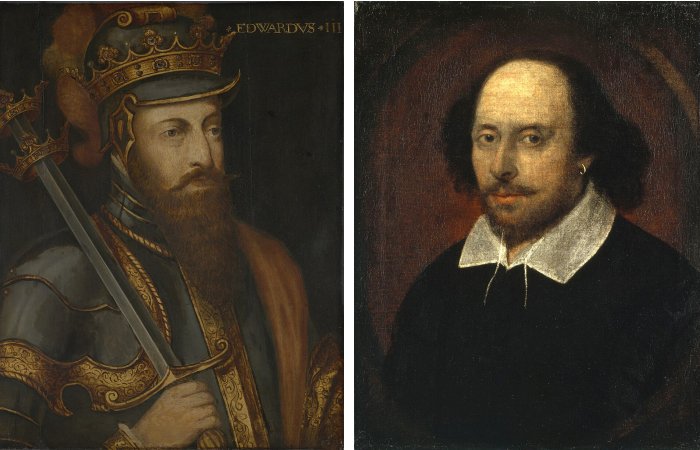
Left: Portrait of Edward III of England (1312-1377) - Right: Portrait of William Shakespeare. Public Domain
The landmark study, led by Dr. Rory Loughnane of the University of Kent's Center for Medieval and Early Modern Studies and Professor Brett Greatley-Hirsch of the University of Leeds, upends the centuries-old narrative that the two Elizabethan titans were merely bitter rivals. Instead, new data reveals a sophisticated, sustained creative partnership operating in the heart of London's early 1590s theater scene.
Digital Fingerprints On An Anonymous Text
Rather than relying on traditional, subjective readings, the team used advanced digital humanities methods to uncover the truth. By comparing function words and structural patterns with works by 10 contemporary playwrights, researchers isolated distinct "marker words" unique to each writer. The digital diagnostics split the anonymously published 1596 quarto into two structurally distinct pieces, with Shakespeare ultimately identified as the principal author of 23 sections, while Marlowe penned 9 distinct segments.
This division lines up perfectly with the play's unique, bifurcated narrative structure. Shakespeare pioneered the deeply psychological first half of the drama, which follows King Edward's obsessive and ultimately failed pursuit of the married Countess of Salisbury. These highly lyrical scenes eventually give way to a sprawling military epic in the second half, where Marlowe took the reins to compose bombastic, highly patriotic war sequences tracking the English campaigns in France.
Redefining A Literary Legend
The discovery dramatically alters our understanding of young Shakespeare's early career and his relationship with Canterbury's most famous poet. The data reveals an ambitious young writer in his mid-to-late 20s who actively collaborated, competed, and traded ideas with his peers rather than working as a solitary genius.
This joint work on Edward III, likely composed around 1592, indicates that their writing relationship was far more sustained than previously believed, complementing a prior discovery that Marlowe co-wrote parts of Shakespeare's Henry VI trilogy.
Tragically, this blossoming creative partnership was cut short in 1593 when Marlowe was killed in a lodging house brawl at just 29 years old. The sudden loss ended what Dr. Loughnane describes as a highly fruitful series of early career collaborations, leaving a massive "what-if" hanging over the trajectory of English theater.
The Mystery Of The Missing Folio
For centuries, Edward III sat in plain sight while historians debated its origins, largely because it was left out of Shakespeare’s definitive 1623 First Folio. Historians believe this high-profile omission stemmed from early modern copyright entanglements, as separate printers held the rights to the anonymous 1596 quarto, making a shared-profit inclusion difficult to coordinate. Political sensitivities may also have played a role, as the play's heavy anti-Scottish jibes made it volatile after the Scottish King James took the English throne in 1603.
See also: More Archaeology News
The full findings are scheduled for publication in the upcoming winter issue of Shakespeare Quarterly, alongside Dr. Loughnane’s new book, Shakespeare at Thirty. For theater lovers and historians alike, a forgotten corner of the Elizabethan stage has finally been brought into the light, transforming a legendary rivalry into English literature's most formidable partnership.
Source: University of Kent
Written by Jan Bartek - AncientPages.com Staff Writer