
Our Ancestors Made Drawings In The Sand At The Beach 140,000 Years Ago – Scientists Say
AncientPages.com - The urge to draw images in sand, or create sand sculptures, seems to be irresistible, as a walk on many a modern beach or dune surface will show. Sand is a vast canvas—and may have been used as one for far longer than people realize.
When people think of ancient paleoart, cave paintings (pictographs), rock engravings (petroglyphs), images on trees (dendroglyphs) or arrangements of rocks in patterns (geoglyphs) might come to mind. Until recently it was only possible to speculate that the oldest art might have been in sand.

This ammoglyph consists of a circular groove, a central depression and two possible knee impressions. Charles Helm
We are, respectively, a vertebrate ichnologist who studies the fossil tracks and traces of vertebrates, and a physical geographer, interested in the functioning and long-term evolution of coastal landscapes.
We're part of a team that has spent the past 15 years studying vertebrate tracksites on South Africa's Cape south coast that date back to the Pleistocene epoch, between 70,000 and 400,000 years ago. During the course of that research we've realized that not only could we identify hominin and animal tracks; we were able to recognize patterns that we propose our human ancestors made in the sand: in other words, a new form of paleoart.
The rocks we mostly find them in are known as aeolianites, the cemented versions of ancient dunes that form along the coastline. Such ancient "sand art" had never been described before, so we coined a new term for it: "ammoglyph" ("ammos" being Greek for "sand").
In a recent article in the journal Ichnos we provided dates for seven hominin ichnosites (a term that includes tracks and other traces) from the Cape south coast. What we interpreted as ammoglyphs were found at four of those sites. The oldest was dated to between 149,000 and 129,000 years ago.
Method
A key challenge when studying any paleo-record—whether trackways, fossils, or other kinds of ancient sediment—is to determine how old the materials are. In the case of the Cape south coast aeolianites, we use a dating method called optically stimulated luminescence.
This shows how much time has passed since the grains of sand were last exposed to sunlight, offering an estimate of when the aeolianite sediments were buried as the ancient dune surfaces were forming. Given how the tracks and markings in this study must have been formed—impressions made on wet sand, followed by rapid burial with new blowing sand—it is a good method as we can be reasonably confident that the dating "clock" started at about the same time as the trackways and markings were created.
Of course, we had to be diligent in trying to exclude other causes of the patterns in rock that we encountered, including modern graffiti. We were able to achieve this with greater confidence in some cases than others. Clearly, though, if our ancestors' tracks could be preserved on these dune and beach surfaces, so could the patterns that they might have made with a stick or a finger.
Understanding the marks
Two of the four sites we dated for this paper only contained what we believe to be ammoglyphs—with no associated track evidence of who made them. The other two contained either knee or footprint impressions in association with the ammoglyphs. At one of the latter sites human forefoot impressions were found in association with a number of linear grooves and small round depressions. We were not able to determine whether these represented paleoart, were some form of "messaging," or had a utilitarian function such as foraging.
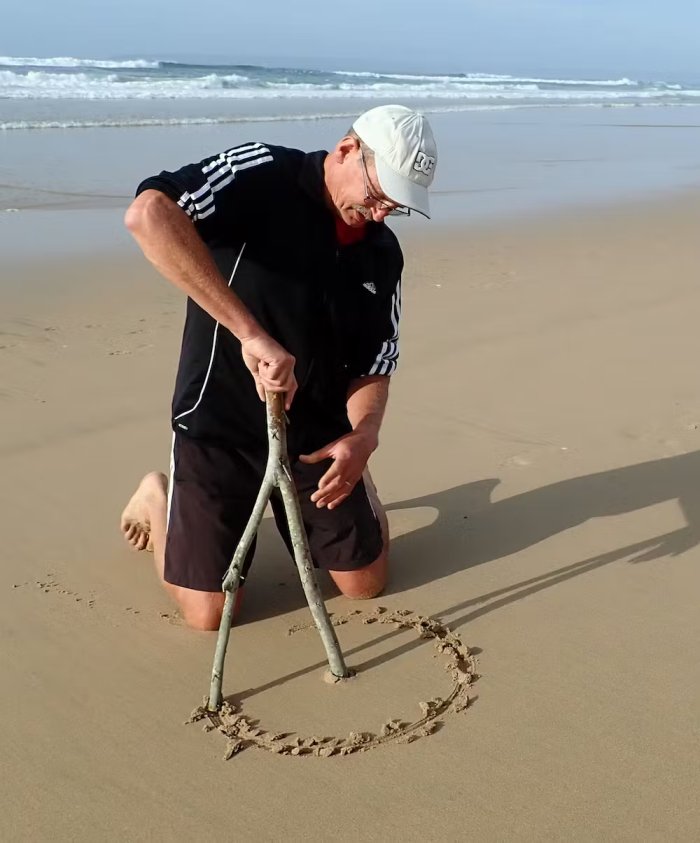
Author Charles Helm demonstrates how one of the ammoglyphs was probably made. Linda Helm
In terms of age, two of the probable ammoglyph sites stand out. The oldest was dated to between 149,000 and 129,000 years ago.
The findings at this site comprised a series of long, perfectly straight grooves in a triangular pattern that included a bisector of one angle. We jokingly referred to the artist as the "Pleistocene Pythagoras." This rock was found in a very remote, rugged area, and was destined to be destroyed by high tides and storm surges. We were able to successfully rescue it by helicopter and have it curated and displayed in the Blombos Museum of Archaeology in Still Bay.
The second site was dated to around 136,000 years ago, give or take about 8,000 years. It comprised almost two thirds of a circular groove, a central depression, and two possible knee impressions. The rock surface was broken at the edges of the circle; in all likelihood the original circle was complete. One property of sand that is absent on other potential paleoart surfaces is the ease with which a large circle can be inscribed on it, for example through using a forked stick.
Our interpretation for the circular ammoglyph is that the central depression represents the spot where one end of a forked stick was anchored by a kneeling human, while the other portion was rotated, yielding a near-perfect circle.
As anyone who has tried knows, it's incredibly hard to draw a perfect circle without a compass. We do not yet know how the perfectly straight lines were inscribed; we speculate that perhaps straight reeds were placed in the sand, but there is no way to know for sure.
We also noted similarities between the shapes of some of the purported ammoglyphs and the shapes of ancient geometric engravings made in caves on this coastline, such as Blombos Cave.
An ancient impulse
Thanks to the dates obtained through our published study, we can conclude that when we encourage our kids and grandkids to play in the sand, and they draw patterns and make sandcastles, they are indulging in a profoundly atavistic activity that extends far into antiquity, as far as at least around 140,000 years.
The creation of art is one of the characteristics that helps to make us human. Knowing that our ancestors so long ago did the same as we do today perhaps helps to add to that sense of "humanness."
Written by Charles Helm, Research Associate, African Centre for Coastal Palaeoscience, Nelson Mandela University, Andrew Carr, Senior Lecturer, University of Leicester
Provided by The Conversation
This article is republished from The Conversation under a Creative Commons license. Read the original article.
More From Ancient Pages
-
 Ice Age People Returned To Central Europe Much Earlier Than Previously Thought
-
 Who Was The Unknown Man Who Influenced Historical Events Shaping America’s Future Before Vanishing Forever?
-
 Fragment Of A 1,750-Year-Old New Testament Translation Discovered
-
 Has Yorkshire’s Lost Underwater Town Ravenser Odd Finally Been Found?
-
 Ezekiel’s Secret Ancient Knowledge About Lost Worlds – Thought-Provoking Theory Examined
-
 Radar Discovers Mysterious Tunnels Under Sforza Castle As Depicted In Leonardo da Vinci’s Sketches
-
 Stunning Discovery Of 1,000-Year-Old Knight’s Sword From Reign Of Poland’s First King Bolesław The Brave
-
 Underground Civilizations – Secret Subterranean Corridors And Strange People – Part 2
-
 Mystery Of Ancient “Magical” Mirrors – Some Of The Strangest Objects In The World
-
 Ancient Monuments The World Is Not Allowed To See – Forbidden Zone – Part 2
-
 Thousands Of Roman Coins Found Across Europe Are Fake – Archaeologists Say
-
 Circe: Powerful Divine Greek Sorceress Who Mastered Healing, Miracles And Transformed People Into Animals
-
 Olive Trees Were First Domesticated 7,000 Years Ago In The Jordan Valley
-
 Ancient European Buildings Form A Sacred Symbol When Viewed From The Air – Scientist Reveals
-
 Choctaw Indians’ Legend Of Nanih Waiya Cave Mound – Mysterious Underground Realm Of Their Ancestors And Their Battle With Giants
-
 A 1,800-Year-Old Amasya Mosaic Goes On Display For The First Time After Seven Years
-
 Miraculous Cauldrons Of The Ancient Celtic World
-
 On This Day In History: William Penn – English Philosopher, Quaker And Founder Of Pennsylvania Was Born – Oct 14, 1644
-
 Extraordinary Discovery Of ‘Time Capsule’ Belonging To Jules Verne – It May Contain Unpublished Works
-
 Hnefatafl: Ancient Viking Board Game “King’s Table” Popular In Medieval Scandinavia

