
‘Sea Monsters’ Were Real Millions Of Years Ago: New Fossils Tell About Their Rise And Fall
AncientPages.com - Sixty six million years ago, sea monsters really existed. They were mosasaurs, huge marine lizards that lived at the same time as the last dinosaurs. Growing up to 12 meters long, mosasaurs looked like a Komodo dragon with flippers and a shark-like tail. They were also wildly diverse, evolving dozens of species that filled different niches. Some ate fish and squid, some ate shellfish or ammonites.
Now we've found a new mosasaur preying on large marine animals, including other mosasaurs.

Thalassotitan teeth. Credit: Nicholas Longrich
The new species, Thalassotitan atrox, was dug up in the Oulad Abdoun Basin of Khouribga Province, an hour outside Casablanca in Morocco.
At the end of the Cretaceous period, sea levels were high, flooding much of Africa. Ocean currents, driven by the trade winds, pulled nutrient-rich bottom waters to the surface, creating a thriving marine ecosystem. The seas were full of fish, attracting predators—the mosasaurs. They brought their own predators, the giant Thalassotitan. Nine meters long and with a massive, 1.3 meter-long head, it was the deadliest animal in the sea.
Most mosasaurs had long jaws and small teeth to catch fish. But Thalassotitan was built very differently. It had a short, wide snout and strong jaws, shaped like those of a killer whale. The back of the skull was wide to attach large jaw muscles, giving it a powerful bite. The anatomy tells us this mosasaur was adapted to attack and tear apart large animals.
The massive, conical teeth resemble the teeth of orcas. And the tips of those teeth are chipped, broken and ground down. This heavy wear—not found in fish-eating mosasaurs—suggests Thalassotitan damaged its teeth biting into the bones of marine reptiles like plesiosaurs, sea turtles and other mosasaurs.

Thalassotitan size. Credit: The author
At the same site we've found what look like the fossilized remains of its victims. The rocks producing Thalassotitan skulls and skeletons are full of partially digested bones from mosasaurs and plesiosaurs. The teeth of these animals, including those of half-meter skull from a long-necked plesiosaur, have been partially eaten away by acid. That suggests they were killed, eaten and digested by a large predator, which then spat up the bones. We can't prove Thalassotitan ate them, but it fits the profile of the killer, and nothing else does, making it the prime suspect.
Thalassotitan, sitting at the top of the food chain, also tells a lot about ancient marine food chains, and how they evolved in the Cretaceous.
Evolution of a killer
The discovery of Thalassotitan tells us about marine ecosystems just before the asteroid hit 66 million years ago, ending the age of the dinosaurs.
Thalassotitan was just one of a dozen mosasaur species living in the waters off of Morocco. Mosasaurs made up a fraction of all the thousands of species living in the oceans, but the fact that predators were so diverse implies that lower levels of the food chain were diverse too, for the oceans to be able to feed them all. This means that the marine ecosystem wasn't in decline before the asteroid hit.
Instead, mosasaurs and other animals—plesiosaurs, giant sea turtles, ammonites, countless species of fish, mollusks, sea urchins, crustaceans—flourished, then died out suddenly when the 10-kilometer wide Chicxulub asteroid slammed into the earth, launching dust and soot into the air, and blocking out the sun. Mosasaur extinction wasn't the predictable result of gradual environmental changes. It was the unpredictable result of a sudden catastrophe. Like a lightning strike from a clear blue sky, their end was swift, final, unpredictable.
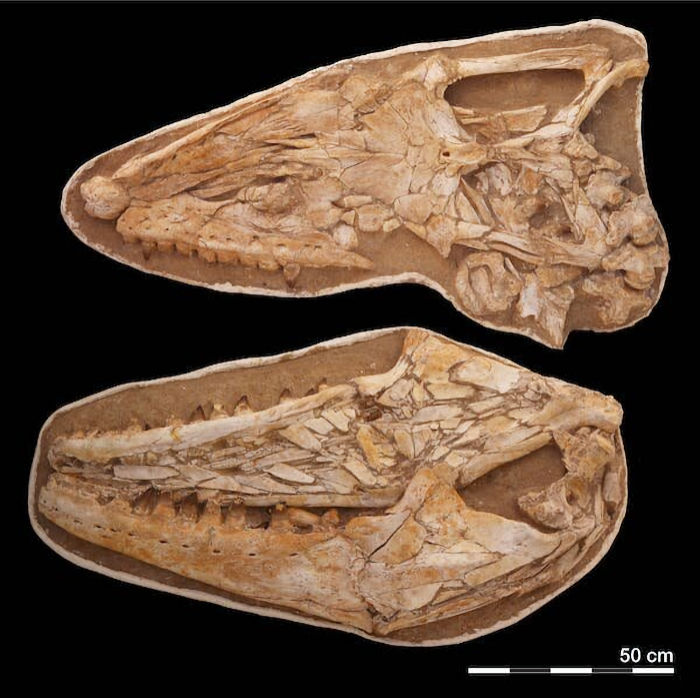
Thalassotitan skull. Credit: The author
But mosasaur evolution may also have started with a catastrophe. Curiously, the evolution of the giant carnivorous mosasaurs resembles that of another family of predators—the Tyrannosauridae. The giant T. rex evolved on land at about the same time that mosasaurs became top predators in the seas. Is that a coincidence? Maybe not.
Both mosasaurs and tyrannosaurs start to diversify and become larger at the same time, around 90 million years ago, in the Turonian stage of the Cretaceous. This followed major extinctions on land and in the sea around 94 million years ago, at the Cenomanian-Turonian boundary.
These extinctions are associated with extreme global warming—a "supergreenhouse" climate—driven by volcanoes releasing C02 into the atmosphere. In the aftermath, giant predatory plesiosaurs disappeared from the seas and giant allosaurid predators were wiped out on land. With predator niches left vacant, mosasaurs and tyrannosaurs moved into the top predator niche. Although they were wiped out by a mass extinction, Thalassotitan and T. rex only evolved in the first place because of a mass extinction.
The bigger they are, the harder they fall
Top predators are fascinating because they're big, dangerous animals. But their size and position at the top of the food chain also make them vulnerable. You have fewer animals as you move up the food chain. It takes many small fish to feed a big fish, many big fish to feed a small mosasaur, and many small mosasaurs to feed one giant mosasaur. That means top predators are rare. And apex predators need lots of food, so they're in trouble if the food supply is disrupted.
If the environment deteriorates, dangerous predators can quickly become endangered species.
It's this sensitivity to environmental change that makes predators like Thalassotitan so interesting for studying extinction. They suggest being a top predator is a risky evolutionary strategy. Over short timescales, evolution drives the evolution of larger and larger predators. Their size means they can compete for and take down prey. But over long timescales, specialization for the apex predator niche increases vulnerability to disasters. Eventually, a mass extinction wipes the top predators out, and the cycle starts again.
Written by Nicholas R. Longrich - Senior Lecturer in Paleontology and Evolutionary Biology, University of Bath
This article is republished from The Conversation under a Creative Commons license. Read the original article.
More From Ancient Pages
-
 Huge Ancient Hydraulic System Built By The Liangzhu Culture May Be World’s Oldest And Predate Mesopotamian Water Systems
-
 War Between Romans And Persians Lasted 721 Years: One Of The World’s Longest Human Conflicts In History
-
 28,000-Year-Old Lapedo Child: Human-Neanderthal Hybrid Reveals A Prehistoric Secret
-
 Mystery Of The Watchers And Book Of Enoch – Fallen Angels And Their Secret Knowledge
-
 On This Day In History: Emperor Constantine I Passes His Famous National Sunday Law – On March 7, 321 AD
-
 Rock Stars: How A Group Of Scientists In South Africa Rescued A Rare 500 Kg Chunk Of Human History
-
 Ancient Roman Women Wore Bikini In 1400 B.C.
-
 Colossus of Ramesess II At Karnak Temples Is Undergoing Restoration
-
 New Trove Of Treasures, Funerary Temple, 50 Sarcophagi Unearthed In Saqqara, Cairo
-
 Underwater Artifacts Shed New Light On Battle Of The Egadi Islands Between Romans And Carthage
-
 Ancient Tools Found In Maryland Re-Write The History Of First Humans In America
-
 Angerona – Goddess Of Silence During Cosmic Crises And Protector Of Ancient Rome
-
 Gungnir: Odin’s Magical Weapon That Provoked Or Reduced Conflicts In Norse Mythology
-
 Binary System Was Used By Ancient Polynesians 1,000 Years Before The Concept Of A Computer Was Introduced
-
 Never-Before-Seen Magnificent 2,000-Year-Old Second Temple Found By Western Wall In Jerusalem Revealed To The Public
-
 On This Day In History: Battle Of Vincennes, Indiana – On Feb 24-25, 1779
-
 Rock-Cut Tombs Of Beni Hasan With Spells, Prayers To Osiris And Anubis And Map To Underworld
-
 Zhang Heng Seismograph Could Record Earth’s Dangerous Movements
-
 Early Christian Crypt Unearthed In Zaldapa Fortress, Bulgaria
-
 Traditional Viking-Age Crafts: Glass Beadmakers And Their Secrets

