
Pharaoh Ahmose I Expelled The Hyksos Invaders And Changed History Of Ancient Egypt
Ellen Lloyd - AncientPages.com - Ahmose I was carrying a heavy burden on his shoulders when he ascended the throne to rule as the pharaoh of Egypt. He was still a young child, not more than 10 years, but much was expected of him. Death had followed in his family’s footsteps, and he was surrounded by enemies.
How could he accomplish something extraordinary and change the history of ancient Egypt?
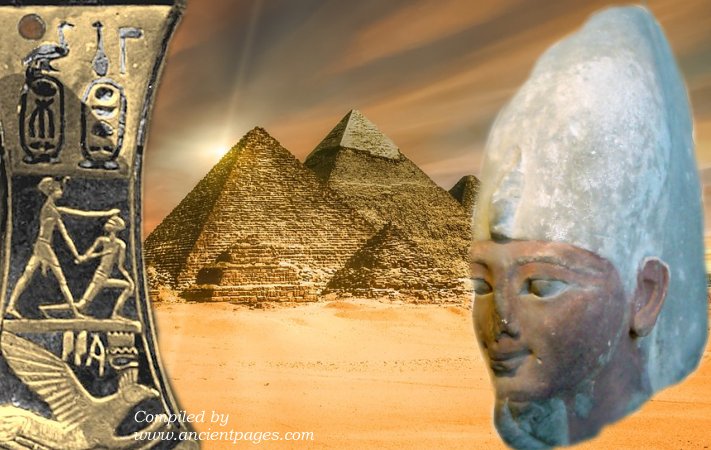
As the first king of the Eighteen Dynasty and founder of the New Kingdom, Pharaoh Ahmose I ruled c. 1569 – 1545 B.C. He is today not as not well-known as famous pharaohs such as for example Ramses II, Akhenaten, or Hatshepsut but his significance as ruler of ancient Egypt cannot be forgotten. Pharaoh Ahmose I changed the history of ancient Egypt and managed to accomplish what his father has started before being brutally killed.
Known as Nebpehtvre from his throne which means “The Lord of Strength is Ra,” Ahmose I was the son of Seqenenre Tao and the powerful queen Ahhotep. He had the misfortune to live during a turbulent period when his country had been invaded by the Hyksos people.
The origin of the Hyksos people is still a matter of debate. “Many researchers refer to the Hyksos as West Asian people, but who these people were is not exactly known.
They were officially known as “Foreign Rulers ('Heka Khawaset'). Their historical name “Hyksos” is of Greek origin.” 1
Sometime around 1650 B.C. these foreign warriors invaded and took over much of Lower Egypt establishing a new capital at Avaris.
The Hyksos occupation was later described as a highly traumatic event for the Egyptian people, but scholars often remark it is not clear whether this was actually the view of contemporary Egyptians who lived under their control.
Looking through the eyes of Pharaoh Ahmose I and his family one can say with certainty the Hyksos invasion was a very dramatic event. When scientists examined the mummified body of Ahmose’s father Seqenenre Tao they discovered the pharaoh suffered a violent death. Pharaoh Seqenenre Taa II died close to the battlefield and was ceremoniously executed by several attackers using Hyksos weapons.
Kamose, the stepbrother of Ahmose I was also killed by the Hyksos invaders. After his death, Ahmose succeded to the throne. Being only about 10 years at the time, he was still much too young to rule and his mother Ahhotep served as regent until he was about sixteen.
Now, he started to plot his revenge and his goal was to complete what his father never succeed with, namely the expulsion of the Hyksos invaders out of Egypt.
How Pharaoh Ahmose I Expelled The Hyksos Invaders
He received support from Queen Ahmose Nefertari, who was his wife as well as sister. Pharaoh Ahmose I did not waste any time. He focused all his energy and thoughts on preparing a plan on how to deal with the foreign invaders in the quickest and most efficient way.
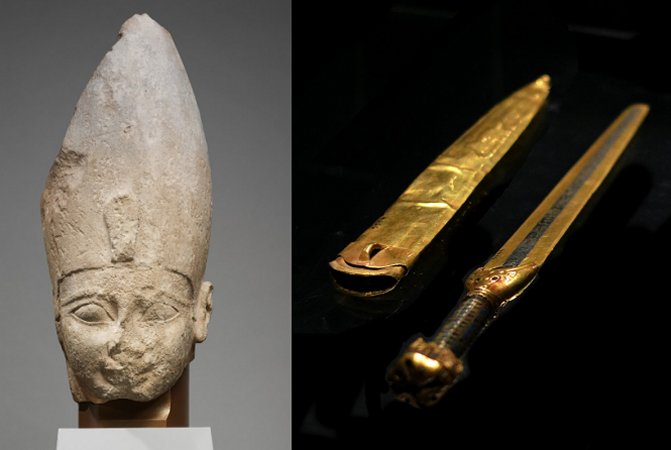
Left: A fragmentary statue of Ahmose I, Metropolitan Museum of Art. Credit: Publis Domain - Right: Dagger of Ahmose I, Luxor Museum. Credit: Heidi Kontkanen CC BY-SA 2.0
Pharaoh Ahmose I waited patiently until a good opportunity presented itself. When he learned the Hyksos king was requesting backup against the Thebans, he understood this was a perfect moment to strike against his enemies. The Hyksos were weak and vulnerable, and the pharaoh could use the element of surprise.
“The details of this campaign are recorded in the biographical texts inscribed in the tombs of two officers who fought under him (both named Ahmose); Ahmose, son of Ebana, and Ahmose Pennekheb. King Ahmose first launched a successful attack on Avaris, the Hyksos capital in the Nile Delta. The city having fallen, he chased his enemies into southern Palestine and subdued them. He then settled an insurrection to the south, in Nubia.
With Egypt now secure, he guaranteed its safety by returning to deal one final blow to the Hyksos in Palestine and southern Phoenicia. The testimonies of the two officers previously mentioned give evidence of great respect that his soldiers had for their king, who was only about twenty years old at the time of his victory.”2
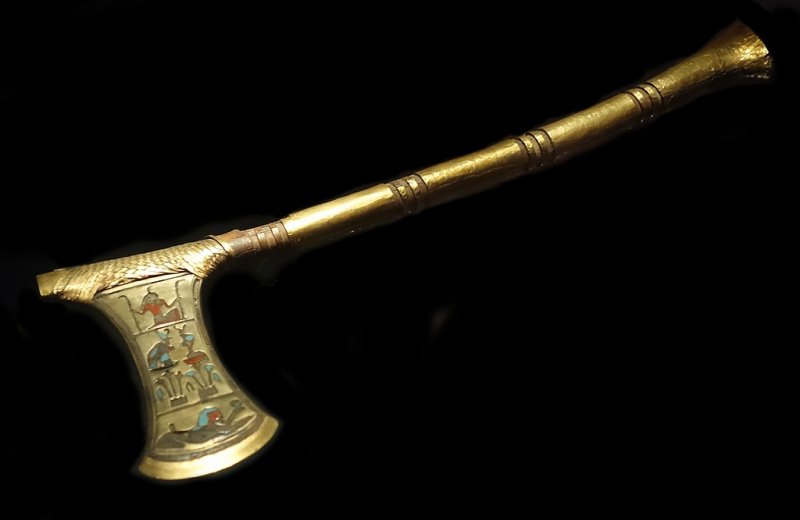
Ceremonial axe of Pharaoh Ahmose I. Credit: Jesse - CC BY-SA 2.0
Having expelled the Hyksos invaders, Pharaoh Ahmose I understood he must now strengthen the country and return its lost glory of the Middle Kingdom. Under Pharaoh Ahmose contact that had been broken under the Hyksos rule with foreign kingdoms were once again re-established. The Pharaoh reformed and strengthened the internal administration, established trade with nearby and distant kingdoms, and he ordered to resume the construction of monumental and royal buildings.
Good wards were given to those who were loyal to him and taxes were used to build dykes, canals, and irrigation systems. Egypt was reborn under Pharaoh Ahmose I. He was the one who founded the Eighteenth Dynasty of Egypt, classified as the first dynasty of the New Kingdom of Egypt. It was during this period Egypt reached its peak of glory and power.
When Pharaoh Ahmose I died, around 1525 B.C. he was succeeded by his son Amenhotep I who could enjoy ruling a strong, unified Egypt that flourished as A new Kingdom.
There is no doubt Pharaoh Ahmose I changed the history of ancient Egypt.
Updated on June 23, 2021
Written by Ellen Lloyd – AncientPages.com
Copyright © AncientPages.com All rights reserved. This material may not be published, broadcast, rewritten or redistributed in whole or part without the express written permission of AncientPages.com
Expand for references- Sutherland - Hyksos: Foreign Rulers Of Avaris Who Founded The Fifteenth Dynasty Of Egypt, AncientPages.com
- J. Gwyn Griffiths - Oxford Encyclopedia of Ancient Egypt
- Bill Petty - Ahmose: An Egyptian Soldier's Story
More From Ancient Pages
-
 Ancient Knowledge About Horse Taming Is Rewriting Our Picture Of The Past
-
 Pena Molexa (Lunar Boat): Megalithic Corner Dedicated To A Magician Woman Who Knows The Secrets Of Earth And Underworld
-
 Well-Known Powerful Yin Yang Symbol Dates Back To Ancient China
-
 Sacred ‘Sign Posts’ Of The Inuit People
-
 DNA Of 10,000-Year-Old Skeletal Remains And Kinship Of Earliest World Settlers
-
 Once Impressive Temple Of Hadrian In City Of Cyzicus Will Be Restored Soon
-
 Nine Great Wall Beacon Towers Discovered In China’s Inner Mongolia
-
 Gold Dated To Scythian-Saka Era Unearthed In Valley Of The Kings In East Kazakhstan
-
 Egypt’s Dendera Temple: Second Restoration Phase Is Now Completed
-
 Peaches Spread Across North America Through The Resourceful Networks Of Indigenous Communities
-
 Ancient High-Technology: Automatons In Greek Mythology
-
 Cup Of Jamshid – Holy Grail Of Ancient Persia Offered Immortality And Visions Of The Future
-
 Unusual Find – Headless Skeletons Discovered In A 7000-Year-Old Mass Grave In Slovakia
-
 Population Pressure And Prehistoric Violence In The Yayoi Period Of Japan
-
 Spectacular 2,500 Years Old Shwedagon Pagoda In Myanmar – World’s Oldest Pagoda
-
 Fascinating Discovery – First Female Viking Grave Discovered In Swedish Mountains
-
 One Of Egypt’s Oldest Christian Churches Discovered By Polish Archaeologists
-
 Forbidden Knowledge: Secret Ancient Gates Of The Shining Ones – Geomantic Energy Vortices – Part 2
-
 Ancient DNA Shows Neanderthals Used Plant-Based Medicine To Treat Pain And Illness
-
 Colossi Of Memnon: Gigantic Stone Statues Guarding The Temple Of Pharaoh Amenhotep III

