
Magnificent Pre-Dynastic City Of Sais And Its Lost Neglected Ruins
A. Sutherland - AncientPages.com - The history of Sais goes back to Egypt's pre-dynastic times (before 3100 BC). It was once a beautiful Egyptian city located in the western Egyptian delta along the right bank of the Rosetta Branch of the Nile River.
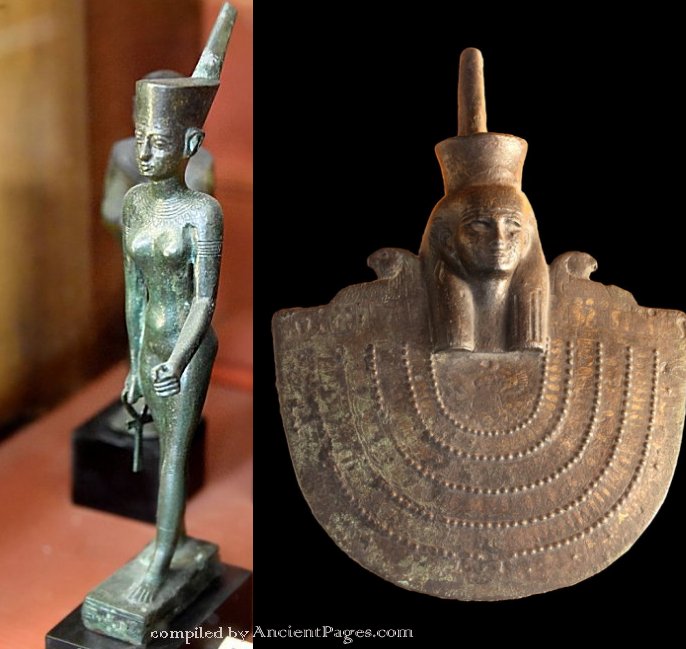
Left: Goddess Neith. Image credit: - CC BY-SA 4.0; Right: Goddess Neith. Image credit: Right: Aegis of Neith, Twenty-sixth dynasty of Egypt - Museum of Fine Arts of Lyon. Rama - CC BY-SA 2.0 fr
Today, the only visible ruins of the city near the village of Sa al-Hadjar are dated to the Late New Kingdom (c.1100 BC).
There are no surviving traces of this town prior to this period of time, but it is scientifically attested that the history of Sais goes back to pre-dynastic times. From the 3rd millennium BC, Sais was a famous economic, political, and religious center of the goddess of war and hunting, Neith, whose temple was to be erected by the founder of the first Dynasty.
Known as a center for science and the arts, the city was first mentioned in inscriptions of the archaic period. However, it played an important role in all historical periods and was most important in the late ages. It was then the state capital during the reign of the XXIV and XXVI dynasties.
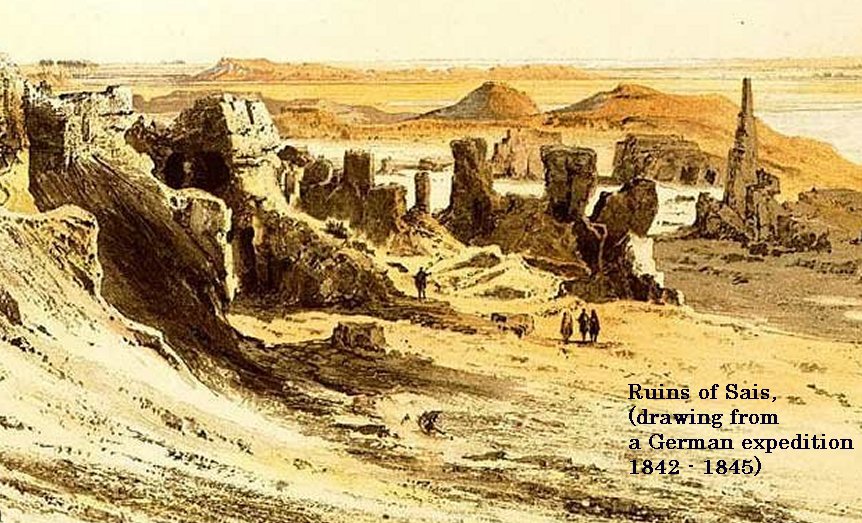
Herodotus and some other ancient sources confirm that Sais was a prestigious city of northern Egypt about 3100 BC, full of magnificent buildings and royal crypts, and the wives of the rulers of the first Dynasty (Merneit, Meritneit) had come from Sais.
Amasis, who ruled for 44 years and made many contributions to the country, was probably the 5th ruler of Egypt during the 26th Dynasty and has been called the last great Egyptian Pharaoh.
He established himself at Sais in Northern Egypt, and there – like in many other places in Egypt – he ordered the building of monumental buildings, including his tomb at Sais, which was unfortunately never discovered. Still, according to Herodotus' description, the tomb was beautiful:
'It is a great cloistered building of stone, decorated with pillars carved in the imitation of palm-trees, and other costly ornaments. Within the cloister is a chamber with double doors, and behind the doors stands the sepulchre…"
In the age of the Ptolemies (323 to 30 BC), Sais was an important center.
Ancient Sais was the center of the cult of the goddess of war and hunting, Neith, the patron goddess of Sais, a great protector of the people of the land, and the most accomplished mediator between humanity and the gods. From the Late Period (1000 BC onwards), the Neith temple was a center of pilgrimage.
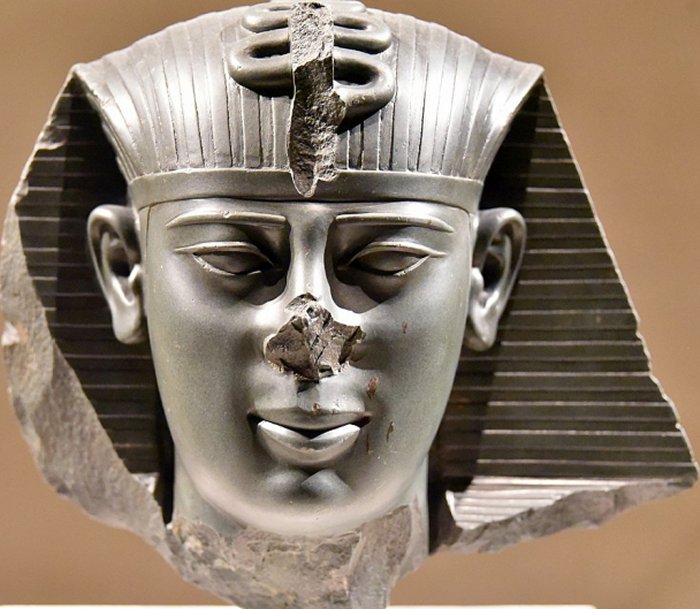 Head of Amasis II. Saite period, 26th Dynasty, c. 550 BCE. From Egypt. Neues Museum, Berlin, Germany. Greywacke, ÄM 11864. source
However, Sais had several other temples dedicated to the creator god Atum and one dedicated to the Egyptian Lord of the Underworld and Judge of the Dead, Osiris.
According to Herodotus, the grave of Osiris was located at Sais. The Temple of Sais had a medical school associated with it. The medical school at Sais had many female students and apparently women faculty, mainly in gynecology and obstetrics.
An inscription from the period survives at Sais and reads:
"I have come from the school of medicine at Heliopolis and have studied at the women's school at Sais, where the divine mothers have taught me how to cure diseases…".
Many kings of Sais were clever men; among them was King Nekau of the Twenty-sixth Dynasty, who ruled for 15 years and sent an expedition that circumnavigated Africa. King Nekau was the ruler who started the construction of a canal from the Nile to the Red Sea, later completed by the Achaemenid king Darius I.
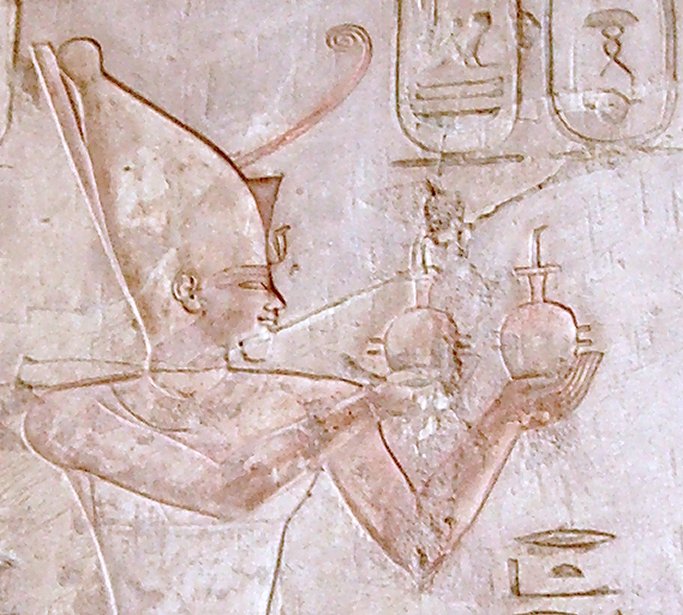 Relief of Psamtik I making an offering to Ra-Horakhty (Tomb of Pabasa). source
Necho I, appointed by the Assyrian king Esarhaddon, extended his jurisdiction over the Delta and Memphis after his conquest of Egypt in 671 BC. His son Psamtik I successfully reunited the whole of Egypt and founded the twenty-sixth Dynasty. Later, the successive kings of this Dynasty enlarged and embellished Sais.
The Persians invaded Egypt in 525 BC, just after Psamtek III became king. The fate of the city of Sais is not precisely known, but it is known that after ascending the throne, the Persian king Cambyses marched against Egypt, where he ruined the tomb of Amasis (also known as Ahmose II, which means "The Moon is Born, Son of Neith"). Moreover, he also thoroughly destroyed the city, including several temples.
The city was never subject to systematic archaeological research, and in ancient times, it was better known from historical sources of Herodotus and Strabo and descriptions of travelers.
Written by – A. Sutherland - AncientPages.com Senior Staff Writer
Updated on January 27, 2024
Copyright © AncientPages.com All rights reserved. This material may not be published, broadcast, rewritten or redistributed in whole or part without the express written permission of AncientPages.com
Expand for referencesMore From Ancient Pages
-
 Secrets Of Ancient Ivory Manikins Revealed
-
 Ancient Life-Size Marble Statue Of Hercules Discovered In Rome
-
 Mysterious Hammer Of Thor In Canada Was Built Before The Arrival Of The Inuit – Did Vikings Raise The Monument?
-
 On This Day In History: Edict Of Pistres ‘A New Law’ Against Viking Raids Issued – On July 25, 864
-
 DNA Sheds Light On Ancient History Of Dogs All The Way To The Ice Age
-
 Solving The Mystery Of Westminster Abbey’s Lost Chapel And Disemboweled Saint – New Evidence
-
 Giant Spider Yokai Tsuchigumo Confronts Minamoto No Yorimitsu And Something Strange Happens
-
 Oldest Giant Dinosaur Species Discovered In Argentina
-
 Tahpanhes – Biblical City Where Prophet Jeremiah And King Zedekiah’s Daughters Hid From The Babylonians
-
 Rose Cross – Powerful Symbol That Existed Long Before Christianity
-
 Ivar The Boneless: Famous Viking And Son Of Ragnar Lodbrok
-
 Museum Classifies Roman Emperor Elagabalus As Trans – But Modern Labels Oversimplify Ancient Gender Identities
-
 Never-Ending Battles Between God Ra And Indestructible Apophis In Ancient Egyptian Beliefs
-
 Two-Million-Year-Old DNA Opens A ‘Game-Changing’ New Chapter In The History Of Evolution
-
 Ancient Irish Games Hurling And Curling Were Forbidden In 1366 By The Englishmen
-
 Bronze Age Burial Site Unearthed By Archaeology Volunteers In Caerau Area Of Cardiff
-
 Coventry’s Mysterious Ogham Stone Displayed At Herbert Art Gallery And Museum
-
 Ancient City Of Carchemish Will Soon Be Ready To Show Its Historical Treasures
-
 On This Day In History: Cliff Palace At Mesa Verde, Colorado Discovered – On Dec 18, 1888
-
 The Tuli Mummy: Botswana’s Only Ancient Mummified Human Body Discovered So Far

