
Tír na nÓg – Mythical Land Where Time Floats Slower Than In Mortal Lands
A. Sutherland—AncientPages.com—In Celtic and, especially, Irish mythology, Tir na n'Og is a realm of the afterlife and one of the Happy Islands known from legends.
The 'Land of the Forever Young' was often identified as an underground realm or a mysterious land beneath the sea.
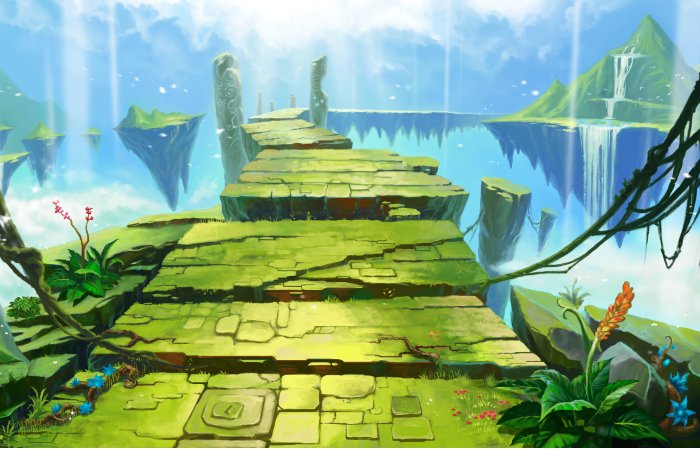
Tir na nOg - mythical realm of the afterlife. Credit. Adobe Stock - Konstantin Gerasimov
The inhabitants of this magical place would remain forever young and happy. Nobody wanted food or drink, and illness, ugliness, and death did not have access to Tir na n'Og.
Floating Time On Magical Tir na nÓg Island
As on other Happy Islands also on Tír na nÓg, the time flows slower than in the land of mortals.
Legend says that "one year on earth equals one minute in Tir na nÓg. It would explain how the beings of similar otherworlds in other ancient traditions could have an almost unimaginable life span.
On Tír na nÓg, the suspension of the aging process takes place for all who dwell there, and it's undoubtedly the most prominent quality of this realm of the afterlife.
In the early saga 'The Adventure of Nera' (Echtrae Nerai), about a warrior of Connacht in the Ulster Cycle, it is written that: "it is within the world you have left, as an apple is within its skin, and all who die in your world come to this one. But within this world is another called the 'Land of Wonders,' and those who die here, or who can wish to do so, go to the Land of Wonders.
Within the Land of Wonders, there is yet a world called the 'Land of Promise,' and those who die in the Land of Wonders are born into the Land of Promise, but they cannot die there until they can wish to do so…"
Oisin's Visit In The Land Of Youth
In the 'Song of Oisín in the Land of Youth' (Laoi Oisín and Tir na nÓg) dominates a wealth of riches, a never-ending spring, and sumptuous feasts accompanied by excellent music.

As we remember, a similar place was also the Elysian Fields in Greek beliefs, and Valhalla in Norse mythology was also a paradise-like place for warriors.
According to an enchanting ancient legend, the most famous human visitor to Tir na n'Og was the legendary Celtic poet and the greatest poet of Ireland, Oisin. Oisin (Ossian) was the son of Fionn Mac Cumhail, a legendary Irish hero, clairvoyant, and leader of Fianna warriors.
Occasionally mortal men were invited to Tir Nan Og, and Oisin (Ossian) was one of them.
In Scottish tradition, Oisin went into a síd or to Tír na nÓg ("the Land of Youth"), where he met a pretty woman who said, "Will you not go with your mother?"
Then she opened a door in the rock, and Oisin remained with her for centuries, although it seemed only a week. But when he wished to return to the land of mortals, she told him that none of them was left.
In an Irish version, on the other hand, Oisin entered a cave and there saw a woman, also gorgeous (but not his mother). Her name was Niamh, and she was the daughter of the King of Tir na nÓg. Oisin spent three hundred years there, although, for a mortal Oisín, this long time passed like just a few days.
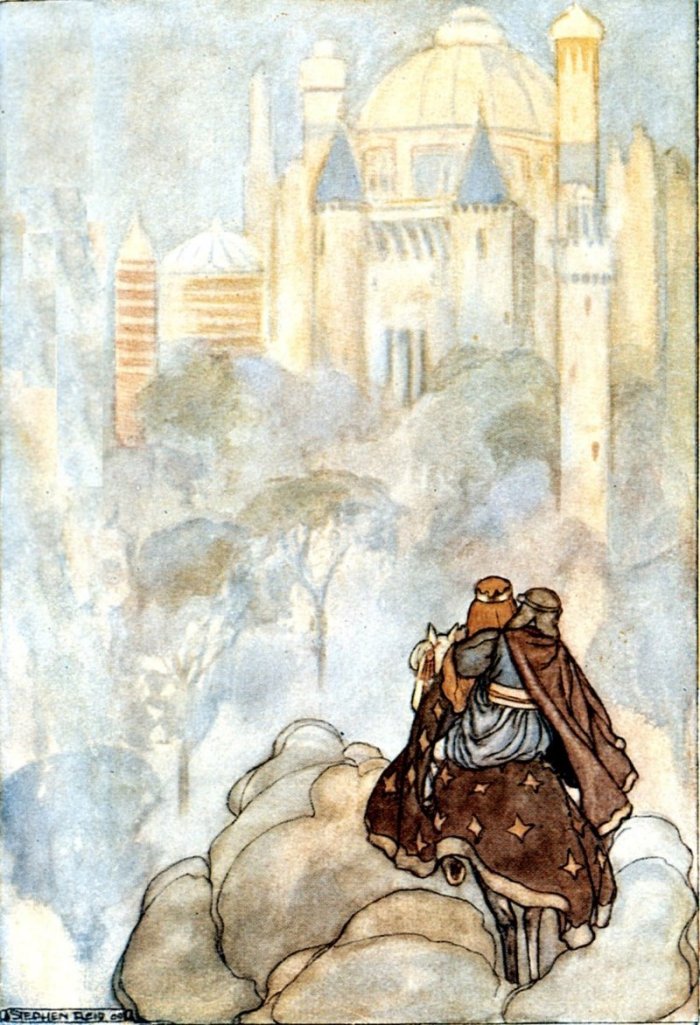
Oisín and Niamh travelling to Tír na nÓg, illustration by Stephen Reid in T. W. Rolleston's The High Deeds of Finn (1910). STEPHEN REID - THE HIGH DEEDS OF FINN AND OTHER BARDIC ROMANCES OF ANCIENT IRELAND BY T. W. ROLLESTON, illustrated by STEPHEN REID http://www.gutenberg.org/files/14749/14749-h/14749-h.htm#IL16
He was happy in "the Land of Youth" but not entirely because he longed for home. Niamh gave him a magical white steed and warned him not to dismount the animal, but on his way home, Oisin met men trying to lift a marble flagstone. They asked appealed to him for aid, and stooping from his horse, he raised the stone; but as he did so, his foot touched the ground, whereupon his horse vanished, and he found himself a worn, blind old man... " 1
Sidhe And Festival Of Samhain
The ancient Celtic festival of Samhain was celebrated 2,000 years ago in the areas now known as Ireland, the United Kingdom, and northern France. People who lived in early medieval Ireland believed that during the festival, "the earth-bound spirits were briefly free to leave the sídhe ("mounds"). Otherwise, they lived underground in fairy mounds or an invisible world that coexists with the world of humans. In this understanding of cosmology, the sídhe are the entrance places to Tír na nÓg. Still, they also mean supernatural creatures in Scottish and Irish myths, similar to the fairies or elves but quite different from humans.
In the Book of Invasion, this world is described as a parallel universe, in which the sidhe walk amongst the living. Later, the hills and the people inhabiting them became known as sídhe. Among many Celtic traditions, also in Scotland, there was an ancient belief originating from the Irish mythology of the Tuatha Dé Danann living in Tír na nÓg that this wonderful world was entered through prehistoric mounds. These Irish underground homes were the fairy sídhe.
Otherwise, hillsides and ancient burial mounds were associated with the "little people" dancing and living under them.
Written by – A. Sutherland - AncientPages.com Senior Staff Writer
Updated on March 18, 2024
Copyright © AncientPages.com All rights reserved. This material may not be published, broadcast, rewritten or redistributed in whole or part without the express written permission of AncientPages.com
Expand for referencesReferences:
- MacCulloch, John Arnott. Celtic Mythology (pp. 180-181).
More From Ancient Pages
-
 Mystery Of The Lost Continent Destroyed By An Ancient Cataclysm – Mysterious Islands – Part 2
-
 Viklaumadonna Hides A Thousands-Year-Old Secret
-
 Mystery Of Biblical Adam – A Hidden Story Within A Story Open To Interpretation
-
 10 Incredible And Bizarre Ancient Cases Of Mass Hysteria
-
 Mysterious, Well-Preserved Ancient Foreign Mummies Found On Remote Islands In North America
-
 Unraveling The Mystery Behind The Perplexing Story Of Pied Piper Of Hamelin
-
 Incredible Find – 3,000-Year-Old Canoe Found In Wisconsin’s Lake Mendota
-
 Archaeologists Found A 16th-Century Shipwreck Of Merchant Ship Close To Saint-Tropez, France
-
 Lost Viking Village Borgund And Its 45,000 Artifacts Hidden In A Basement Examined By Experts
-
 Oldest DNA From Domesticated American Horse Solves An Legendary Shipwreck Mystery
-
 Ancient Egyptian Capital Tell El-Amarna Mapped Through Satellite Imagery System
-
 North America’s First People May Have Arrived By Sea Ice Highway 24,000 Years Ago
-
 Joseph Pujol – The Professional Farter Who Entertained People
-
 Controversial Roman Emperor Heliogabalus Wanted To Be A Woman And Much More
-
 Mysterious Kallerup’s Double-Headed Figurine – Evidence Of Unknown Norse God Or Worship Of Roman God Janus In Ancient Scandinavia?
-
 Why Was Lovesickness A Feared Disease During The Middle Ages?
-
 Hel – Loki’s Terrible Daughter And Goddess Of The Land Of Dead
-
 Proof That Neanderthals Ate Crabs 90,000 Years Ago Is Another ‘Nail In The Coffin’ For Primitive Cave Dweller Stereotypes
-
 Ancient Burial Of A Princess Who Fell Off A Cliff Raises Many Questions
-
 Megalithic Structures Are Not Mass Graves For Neolithic Plague Victims

