
Enigmatic Cernunnos – Most Ancient, Stag-Antlered, Peaceful God Of Celtic People
A. Sutherland - AncientPages.com - Cernunnos is one of the most mysterious deities worshiped by the ancient Celts. His widespread and complex cult dates to the Bronze Age and proto-Celtic period.
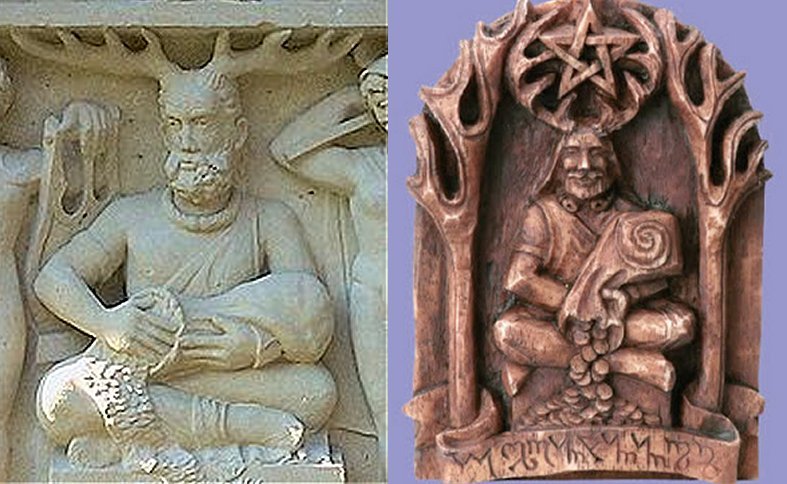
Left: Cernunnos on the Reims Altar. Source; Right: Cernunnos with pentagram and cornucopia. Source
Even after the Roman conquest of Gaul, Cernunnos, 'lord of wild and all things,' survived in the old beliefs and on the Romans' votive stones.
Generally, he is the god of the forest and animals, associated with animal and human fertility, identified with the cycle of seasons, and associated with life, death, and rebirth. He appears in the woods as an elderly bearded man with antlers (or horns) mounted on his head, but his cult depends on regional variations.
The earliest known depictions of Cernunnos were found at Val Camonica, in northern Italy, under Celtic occupation from about 400 BC. Still, the most famous scenes depicting Cernunnos surrounded by various animals, are found on the Gundestrup Cauldron.
However, there is only a handful of information about the god Cernunnos, and it originates from two inscriptions from France and one from Germany.
Cernunnos was worshipped primarily in Britain, although there are traces of his cult in Ireland. The Christian Church strongly opposed him because of his powerful pagan influence. He was used as a symbol of the Antichrist and, as such, figured in Christian medieval manuscripts and art.
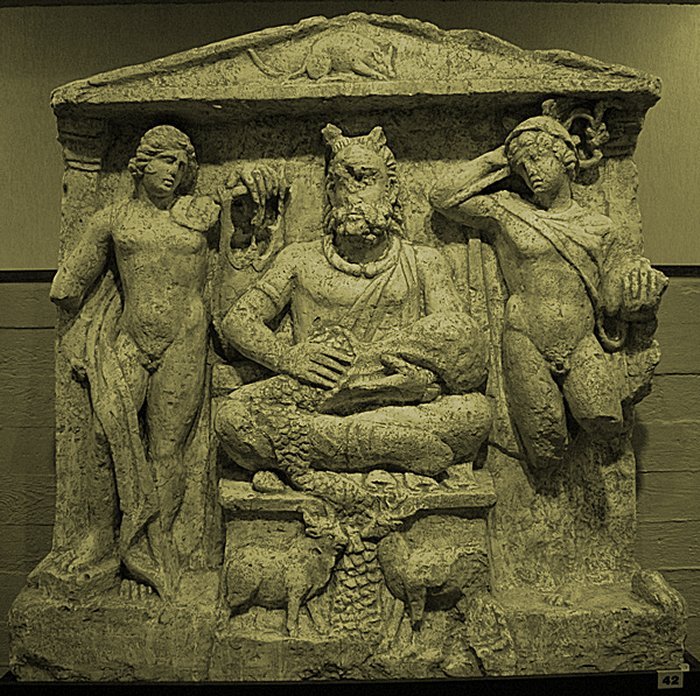
The Reims Altar of Cernunnos (with Apollo and Mercurius), the animals, and cornucopia), ca. 30 AD–ca. 100 AD. Image credit: Reims, Musée Saint-Remi
Interestingly, Cernunnos's name appears only once on a first-century AD stone in Paris, which depicts the head of an elderly, bearded man wearing antlers with torcs hanging from them and with stags' ears. But the god himself was venerated before this period: at Camonica Valley, a site whose rock art abounds in stag imagery, a fourth-century BC image depicts a prominent standing figure of a god with antlers and torcs…" 2
The god has many titles, including "Lord of Wild Beasts," "Lord of the Beats," the "Lord of the Animals, and the "Horned One."
Otherwise, he is typically depicted sitting in a cross-legged position (similar to yoga). This deity's animal forms are the stag, reindeer, and the horned serpent or dragon. In some other depictions, snakes form the god Cernunnos' legs.
The name of the old god Cernunnos is preserved in modern Herne the Hunter and the giant Cerne Abbas folklore. Other Celtic names for Cernunnos include Dagda. In the "Battle of Magh Tuireadh" (Cath Maige Tuired), two texts about battles fought by the Tuatha Dé Danann, the first against the Fir Bolg, the second against the Fomorians, Dagda reveals that his real name is Fer Benn ("horned man"), like the horned god of the forest, Cernunnos.
As Patron of Druids and a symbol of spiritual and magical knowledge, Cernunnos was associated with two essential attributes: the Staff of Life and the Cauldron of Plenty, also known as cornucopia.
According to legends, when Cernunnos "touched a creature with the top end of this wand, it would immediately die but touched with the other end, it would directly come back to life.
It is a metaphor for reincarnation and also for the cycles of time. The staff, sometimes portrayed as a spear or sword, represented the god or male principle – the yang force.
Sometimes, the staff was exaggerated into the form of a large club; it appears thus on the Cerne Abbas giant and in Irish stories of the Dagda…" 1
Many depictions of Cernunnos also show him with a pentagram. A carved stone figure in Rheims depicts Cernunnos with a stag and a bull drinking from a stream of coins (cornucopia). This depiction is believed to mean that stags are associated with wealth.
Written by – A. Sutherland - AncientPages.com Senior Staff Writer
Updated on March 26, 2024
Copyright © AncientPages.com All rights reserved. This material may not be published, broadcast, rewritten or redistributed in whole or part without the express written permission of AncientPages.com
Expand for referencesReferences:
Susan E. Alcock, Mariana Egri, James F. D. Frakes. Beyond Boundaries: Connecting Visual Cultures in the Provinces of Ancient Rome
- Lewis-Highcorrell D. Witch School First Degree: Lessons in the Correllian Tradition
- Green M. Animals In Celtic Life and Myth
More From Ancient Pages
-
 Schoolboy Finds A Huge 3,000,000-Year-Old Megalodon Shark Tooth On British Beach
-
 Three Prehistoric Domus De Janas (House Of The Fairies Or House Of Witches) Unearthed In Sardinia, Italy
-
 Paris Catacombs: Huge Underground Labyrinth Full Of Secrets
-
 On this day in history: Li Shimin becomes Emperor Taizong of Tang, China – Sep 4, 626
-
 Great Heathen Army’s Power Revealed – Previously Unknown Viking Sites And Routes Found In Britain
-
 Portus: History Of Ancient Roman Hub Of Commerce – Reconstructed With New Methods
-
 3,800-Year-Old Wall Relief Created By Ancient Caral People Unearthed In Peru
-
 2,000-Year-Old Altar Depicting Snake Figure Unearthed In Lycian City Of Patara
-
 Secret Writing On Mummy Papyrus Revealed – Scan Technique Will Shed Light On Daily Life In Ancient Egypt
-
 Voice Belonging To 3,000-Year-Old Egyptian Mummified Priest – Recreated
-
 Trident: Powerful Religious Symbol Found In Many Ancient Cultures
-
 Ancient Mesopotamian City Lagash Reveals More Archaeological Secrets
-
 Mummy Of Pharaoh Amenhotep I Digitally Unwrapped For The First Time In 3,000 Years
-
 Rare Iron- And Viking-Age Mortuary Houses Discovered In Norway
-
 Ancient Graffiti Unearthed At Roman Vindolanda Reveals What One Roman Thought Of Another
-
 ‘Bad King John’ Of England: His Lost Treasures Have Never Been Found
-
 Viking Cork Settlement Re-Writes Ancient History Of Ireland
-
 Monks Mound In Ancient Cahokia Was Not What Scientists Previously Thought – New Study
-
 For The Ancient Maya, Cracked Mirrors Were A Path To The World Beyond
-
 Earliest Record Of An Aurora Discovered In The Bamboo Annals

