
Hypatia Of Alexandria – Brilliant, Controversial Scientist And Her Dramatic End
Ellen Lloyd - AncientPages.com - Hypatia was a great ancient scholar who was more interested in science than religion. Her quest for scientific knowledge was admirable but clouded her judgment. She sometimes forgot or ignored the reality of the world she was living in.
Hypatia's accomplishments and fatal ending serve as a reminder that it takes time before most people can embrace new ideas, and there will always be those who are reluctant to change in society. Her death shows the true meaning of religious intolerance and the consequences thereof.
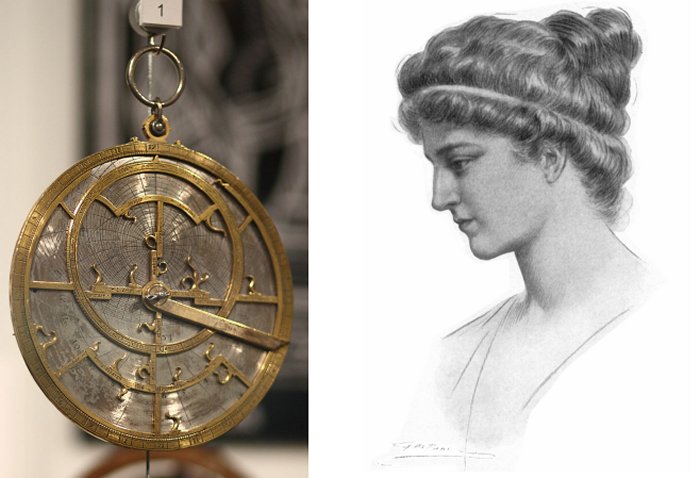
Left: A planispheric astrolabe from the workshop of Jean Fusoris in Paris circa 1400, on display at the Putnam Gallery in the Harvard Science Center. Image credit: Public Doman - Right: Portrait of Hypatia by Jules Maurice Gaspard (1862–1919). Image credit: Public Domain
In ancient times, scientists were often accused of witchcraft. Scholars were treated with suspicion. The line between science and superstition was thin. What should be classified as science, magic, or occult knowledge was debated.
The life story of Hypatia has captivated many generations. It is a sad story about a woman who dedicated her entire life to science and teaching. It was unfortunate for Hypatia that she lived during a time when people valued religion more than scientific progress. Today we know that science and religion can co-exist and even complement each other, but this was not the case not so long ago.
Being falsely accused of witchcraft and caught between two religious fractions, Hypatia met a gruesome death.
Who Was Hypatia?
There is not much information about Hypatia's life. According to historical records, Hypatia was the daughter of the Greek scientist Theon of Alexandria. Who her mother was, is unknown. Hypatia was born sometime between 370 A.D. and 350 A.D. She was raised in Alexandria, a city in Egypt that was founded by Alexander the Great shortly after he was crowned Pharaoh and declared the son of God Amun.
During the time of Hypatia, Alexandria was part of the Roman Empire. Hypatia's father was a mathematician and astronomer, and she most likely inherited her scientific curiosity from him. Theon was also interested in astrology and the art of interpreting gods' wishes by studying birds' songs. Hypatia did not devote her time to occult studies. She was passionate about mathematics, astronomy, and philosophy and constructed several scientific instruments. She built many astrolabes, but she did not invent them.
These instruments were already used at least 500 years before Hypatia was born.
Astrolabes were sophisticated ancient computers used to determine how the sky looked at a specific place at a given time. The oldest astrolabes date back to two thousand years ago.
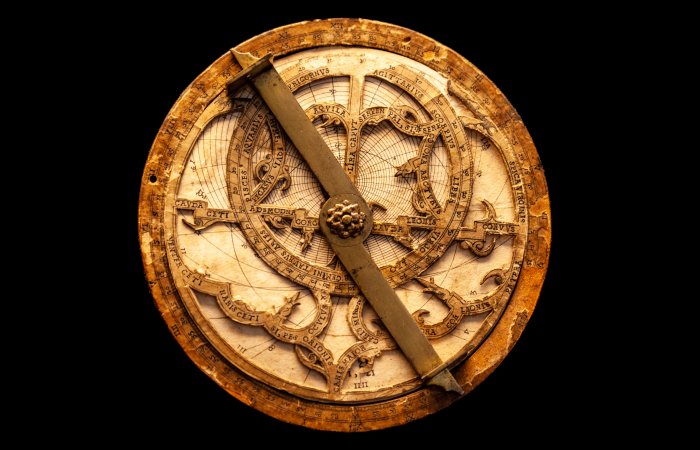
Credit: Adobe Stock - markrhiggins
Choosing a life without religion was dangerous, especially in an area where Christianity was spreading rapidly. However, it seems religion was irrelevant to Hypatia, a prominent thinker of the Neoplatonic school in Alexandria. Though several sources refer to her as being a Pagan, there is also evidence that she did not worship any gods, and she was not a Christian either.
Among her students were student were Christians, Pagans, and some Jews. Her young male students loved her, and she gained political influence through them, but her contact with influential people did not prevent her from being killed.
Hypatia lived on her own, never married, and remained a virgin. Those who tried to pursue a romance with her always failed as she was not interested in love relationships.
Marvelous Treasures Kept In The Serapeum Were Destroyed
In the Serapeum, a temple dedicated to the Greco-Egyptian god Serapis, there was a magnificent book treasure consisting of valuable literature and works used by Hypatia and her students. Inside the temple was also a huge blue statue of the god Serapis covered in gold and precious stones. The temple housed an offshoot collection of the Great Library of Alexandria.
One man who was eager to get rid of the Serapeum was Pope Theophilus of Alexandria. The Roman Empire declared Christianity the official state religion, and those with other religious beliefs were persecuted.

View of the Serapeum remains in Alexandria. Image credit: Daniel Mayer, Public Domain, CC BY-SA 4.0
In 391 A.D., Theophilus ordered troops to destroy the Serapeum. It should have been easy, but many Pagans sacrificed their lives to protect their gods and treasures in the temple. It took some time, but eventually, Christians gained control over the temple. The giant statue of the god Serapis was smashed to pieces. Many of the temple's treasures were sold, and money was distributed among the poor. All the books in the temple were burnt, and the Serapeum was rebuilt and turned into a Christian church.
It should be noted that although Pope Theophilus was responsible for the destruction of the Serapeum, the Great Library of Alexandria had already ceased to exist in any recognizable form centuries before Hypatia's birth.

Drawing from the Alexandrian World Chronicle depicting Pope Theophilus of Alexandria, gospel in hand, standing triumphantly atop the Serapeum in 391 AD. Image credit: Public Domain
During this time, many people converted to Christianity. It seemed the most logical thing to do if you were willing to accept the religious change in the country.
Hypatia's Life Became Much More Difficult When Pope Theophilus Died
Pope Theophilus of Alexandria had no real issue with Hypatia. He tolerated her school, admired her scientific quest for knowledge, and even allowed her to establish close relationships with Roman prefects and other prominent political leaders. Thanks to the Pope's tolerance, Hypatia became a famous person with political influence in Alexandria. However, when Pope Theophilus of Alexandria died in 412 A.D., Hypatia's situation changed dramatically. Theophilus' nephew Cyril was made Pope or Patriarch of Alexandria, but only after a riot between his supporters and those of his rival Archdeacon Timotheus.
There were frequent clashes between Pagans, Christians, and Jews.
Angry Mob Murdered Hypatia Of Alexandria
Hypatia was protected by her close friend Orestes, the Roman prefect of Alexandria. However, Orestes was in a political feud with Cyril. When tension between the two parties rose, Cyril accused Hypatia of preventing Orestes from reconciling with him. She was also accused of witchcraft.
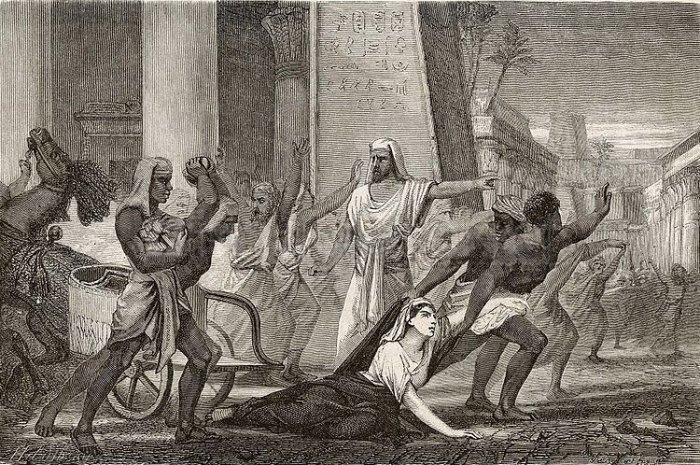
Illustration by Louis Figuier, from 1866, representing the author's imagining of what the assault against Hypatia might have looked like. Image credit: Public Domain
In 415 A.D., when Hypatia was on her way home after finishing her lectures at the university she was attacked by an angry mob of Christian monks. They dragged her to a church, where they stripped her naked and burned her.
Hypatia of Alexandria whose thoughts, ideas, and behavior were much ahead of time could not survive in a world that wasn't ready for people like her. No one deserves a fate like the one that met Hypatia whose life and death have been featured in movies and books.

Left: Cyril of Alexandria (412-444), against whom Oreste clashed. Image credit: Public Doman Right: Cyril of Alexandria was later declared saint. Image credit: Public Domain, CC BY-SA 3.0
Christianity arose in power, and Alexandria lost its importance as an intellectual and cultural center. Cyril gave orders to burn the University of Alexandria and demolish Pagan temples. Intellectuals and artists either fled the country willingly or were deported.
The Church declared Cyril a saint, and Christians were grateful to him for suppressing Paganism and fighting for the true faith. Modern scholars suggest that Hypatia was part of the basis for the legend of Saint Catherine of Alexandria, who confronted 50 Pagan philosophers and was sentenced to death.
Updated on February 8, 2023
Written by Ellen Lloyd – AncientPages.com
Copyright © AncientPages.com All rights reserved. This material may not be published, broadcast, rewritten or redistributed in whole or part without the express written permission of AncientPages.com
Expand for referencesMore From Ancient Pages
-
 Secret Tunnels Used By Knights Templar Leading To The Treasure Tower – Discovered
-
 Discovered Inscription On Ancient Stone Vessel Reveals Location Of Legendary Tomb Of Chinese Emperor
-
 Mysterious El Caracol At Chichen Itza: What Did Maya Astronomer-Priests Observe In The Sky?
-
 ‘Stone Club Head Of Mesilim’ Probably The Most Powerful Sumerian Ruler At That Time
-
 Were Mysterious Fire Pits Found At La Quemada Used As Giant Torches?
-
 Well-Preserved 7,300-Year-Old Wooden Cabins Discovered In La Draga
-
 Pliska: Ancient City Ahead Of Its Time With Secret Underground Tunnels, Sewage And Heating Systems
-
 On This Day In History: Battle Of Ayacucho Was Fought In Peru – On Dec 9, 1824
-
 Lao Tzu: Legendary Thinker And Founder Of Taoism Who Advocated Modesty, Self-Restraint And Balance
-
 Rare Bes Mugs Reveal Ancient Egyptians Drank Hallucinogenic Cocktails During Rituals
-
 Only Apocalyptic Destruction Can Eliminate The Gap Between Rich And Poor – Historian Says
-
 Magnificent Pagodas In Indein Village And Undiscovered Secrets In The Myanmar Jungle
-
 Mysterious Denisovans – New Study Offers New Evidence
-
 Roman Treasure Decorated With A Triskelion Symbol Found On The Isle Of Anglesey
-
 Giant Bath Tub Built For Tsar Alexander I – Why Was It So Large?
-
 Eduba: Scribal School In Ancient Mesopotamia
-
 Achaemenid Empire Was The World’s Largest Ancient Empire
-
 Almost 3,000 Year-Old Burial Site Of Urartian Royals Discovered In Turkey’s Famous Van
-
 How Was The Mysterious Menga Dolmen Built By Neolithic People? New Scientific Theory Presented
-
 Ptolemaic Workshop For Repairing And Construction Of Boats Unearthed In Sinai

