
Medici Family – Powerful Renaissance Godfathers And Patrons Of Galileo Galilei
David Tee - AncientPages.com - The term Renaissance Godfathers describes the Medici family well.
The fact that the Medici family were bankers at heart, gave them access to untold resources which they used to obtain civic power over the city of Florence. As history tells us, they were not the only famous or powerful family of the Renaissance era, but they lasted the longest and ruled Florence for roughly 250 years.
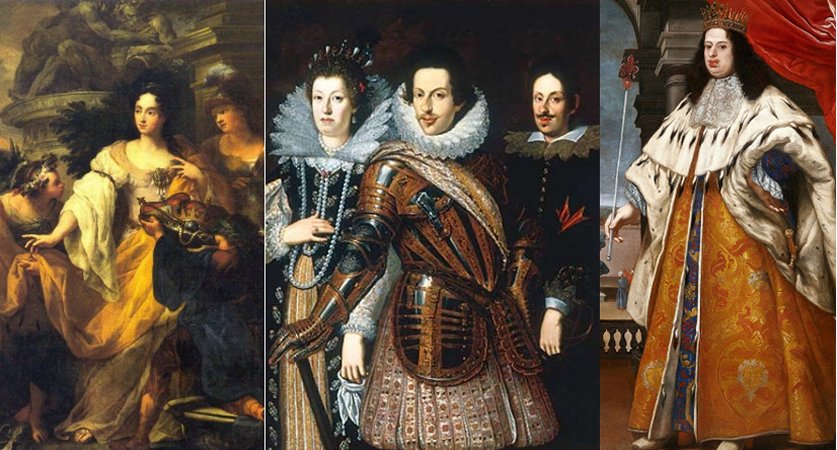
Left: Anna Maria Luisa de' Medici, the last of the Grand Ducal line, in Minerva, Merkur und Plutus huldigen der Kurfürstin Anna Maria Luisa de' Medici (English: Minerva, Mercury and Pluto pay homage to the Electress Anna Maria Luisa de' Medici) after Antonio Bellucci, 1706- Credit: Public Domain
Middle: The Grand Duchess Maria Maddalena, The Grand Duke Cosimo II, and their elder son, the future Ferdinando II. Credit: Public Domain Right: Cosimo III, the Medicean grand duke, in Grand Ducal regalia. Credit: Public Domain
The Albizzi family were far more powerful and richer than the Medici but they preferred war to governing and were soon ousted for their war efforts. Luca Albizzi married a cousin of the Medici family which helped bring the riches and political power of the Albizzi’s to an end.
Other families that became enemies of the Medici’s were the Pazzi and the Borgia. Both families made accusations and treacherous acts against the Medici family and all failed to be successful. They fell into ruin not long after their failures.
Treachery And Corruption Follow The House Of Medici
Even though the original head of the powerful Medici family, Cosimo, was sentenced to 10 years of exile for trying to stifle Florentine freedom, the richest man in Europe at that time used bribery and well-connected friends to keep him alive.
He also used his wealth to discreetly control Florentine life, often using money as a way to ruin opponents.
Cosimo’s Heirs
The grandsons of Cosimo did not rule long but they ruled as out and out tyrants. After Giuliano was killed, Lorenzo turned the Florentines against the Medici family with his very wild lifestyle. Although these two men supported the arts and promoted the works of Michelangelo and other famous artists, that work did not spare them the wrath of the citizens of the city of Florence.
But it was Lorenzo’s son, Piero, who brought a temporary halt to Medici rule when he accepted harsh peace terms from the French after their invasion. Piero was forced out of the city and died in exile.
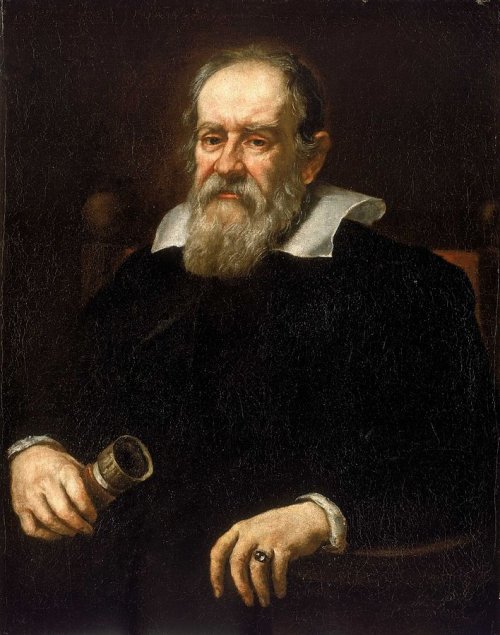
Portrait of Galileo Galilei (1636), by Justus Sustermans - Credit: Public Domain
It wasn’t until the Spanish defeated the French and forced the Florentine leaders to accept Medici rule, that the Medici family returned to prominence and power. The new Medici rulers were like their forefathers. Politically ruthless but great supporters of the arts.
The Medici’s And The Roman Catholic Church
At that time the Roman Catholic Church (RCC) was very powerful. There were few churches if they were allowed to exist, who could rival the RCC. This means that like most other families the Medici’s were staunch RCC adherents.
In fact, 4 members of the Medici family went on to become Pope. Giovani, 1475 to 1521, was Pope Leo X. Giulio di Giuliano, 1478- 1534, was Pope Clement VII. Then, Giovanni Angelo, 1499 to 1565, was Pope Pius IV and Alessandro Ottaviano, 1535 to 1605, had the shortest reign as pope. He did not last even a year.
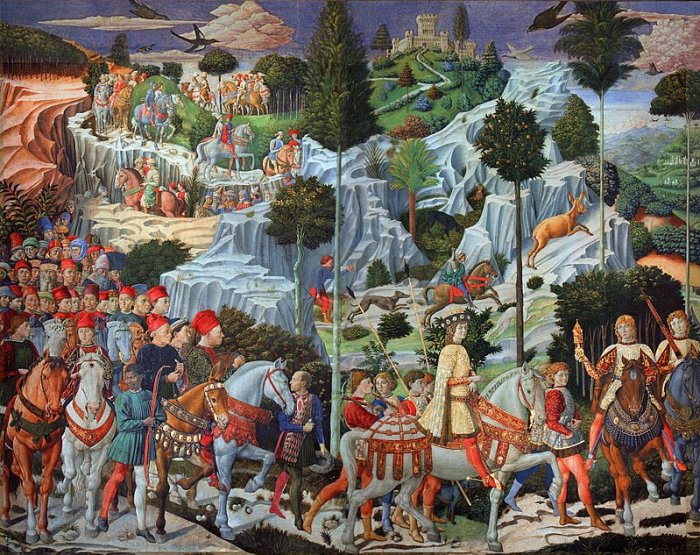
Medici family members placed allegorically in the entourage of a king from the Three Wise Men in the Tuscan countryside in a Benozzo Gozzoli fresco, c. 1459. Credit: Public Domain
Those were not the only family members to reach high heights religiously or politically. Piero’s daughter, Catherine de Medici, married Henry II of France and 3 of her sons would replace their father on the throne. Maria married Henry IV and her daughters went on to become Queens of Spain and England.
The Medici family were patrons of the famous Galileo Galilei, who tutored several generations of Medici children.
Unfortunately for Galileo, the Medici family was not as strong as the leaders of the Inquisition and they failed to protect him when Galileo was arrested.
The Decline Of The Medici Power
It may be said that when Ferdinand II came to power, the influence of the Grand Duchesses may not have prepared him to rule as well as he should have. He was 10 when he became a Grand Duke and when he was old enough he took over for his father.
He was in charge of Tuscany and Florence at the time of the Plaque and Galileo’s problems. While Ferdinand led well throughout the plague crisis, it was not enough to grant him the power to protect Galileo.
This lack of leadership and power was passed down to his son and grandson. The son was religiously intolerant and very incompetent while his grandson did not rule long enough to alter the decline.
It was in 1735 that the Medici’s lost control of Florence and Tuscany forever. The European powers at the time took over, giving France Lorraine and Austria Tuscany. Austria sent troops to occupy Tuscany and Florence in 1737.
Written by – David Tee AncientPages.com
Copyright © AncientPages.com All rights reserved. This material may not be published, broadcast, rewritten or redistributed in whole or part without the express written permission of AncientPages.com
Expand for referencesMore From Ancient Pages
-
 Ancient Town Pontefract, England Reveals Some Of Its Secrets
-
 Crop Circles: Are They Cosmic Messages That We Cannot Decipher?
-
 Ancient DNA Reveals Hunter-Gatherers From Mexico Moved To California 5,200 Years Ago
-
 Heyoka – Sacred Clown Who By Doing The Opposite Helps And Guides In Daily Life
-
 Legendary Saraswati River Is Not A Legend – It Existed 4,000 Years Ago
-
 America’s First Casino Was Created By The Promontory Culture 700 Years Ago
-
 Viking Burial With An Unusual Box And Spectacular Grave Goods Found In Aarhus, Denmark
-
 Central Asia Identified As A Key Region For Human Ancestors
-
 On This Day In History: The Name Of America Used For The First Time On World Map – On Apr 25, 1507
-
 On This Day In History: Munich Agreement Was Signed – On Sep 30, 1938
-
 Lost Ancient Texts Of The Star Catalogue Composed By The Greek Astronomer Hipparchus Found
-
 Strange Underwater Mini-Pyramid Older Than Stonehenge With Unknown Purpose – Who Built It?
-
 Biblical Cherubim – Sweet Angels Or Dangerous Creatures With A Hidden Agenda?
-
 A Huge Site Dated To Roman-Era Unearthed In Reims (Marne), France
-
 Oldest case of leukemia found on 7,000-Year-old skeleton
-
 Magnificent Meteora And ‘Suspended In The Air’ Greek Monasteries
-
 Forbidden Knowledge: Secret Ancient Gates Of The Shining Ones – The Beginning – Part 1
-
 Aglaonice (Aganice): Female Greek Astronomer From Thessaly Was Believed To Be A Witch
-
 Why Was Ayllu Very Important For The Inca People?
-
 Is A Viking Settlement And An Even Older Church Hidden Under St. Clement’s Church In Norway?

