
Xochipilli: Aztec God Of Love, Music, Song And Ecstatic Mushroom Trance
A. Sutherland - AncientPages.com - Among the main sculptures that have come to us from the ancient Nahuatl culture is Xochipilli, the 'Lord of Flowers'.
Scholars believe that the figure of this deity was carved about one generation before the arrival of Spaniards.
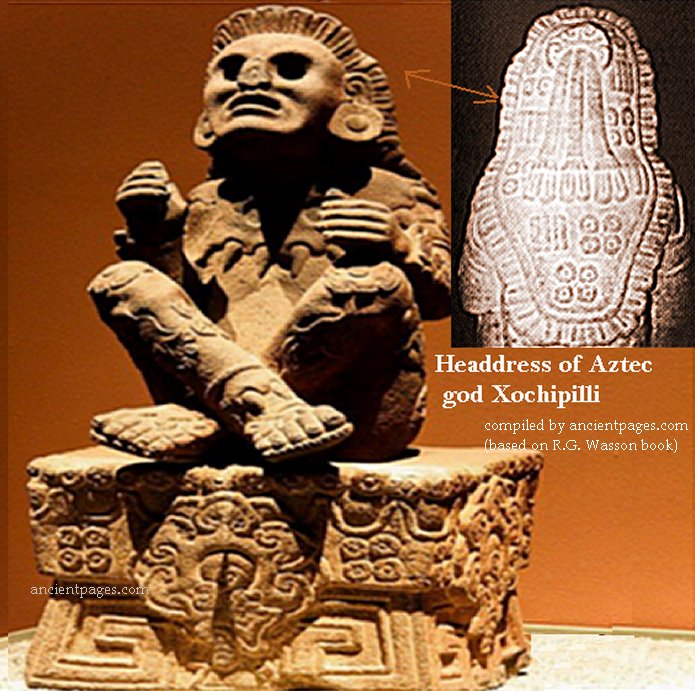
Xochipilli - Aztec God of Flowers, Dance, Song, Love – statue from Art. Museo Nacional de Antropologia,Mexico City.
Xochipilli’s name contains the Nahuatl words xochitl ("flower") and pilli (either "prince" or "child"), and therefore means "flower prince". He is also referred to as Macuilxochitl, which means "five flowers".
Discovery of a remarkable statue
In the mid-1800s, an impressive statue of Xochipilli, carved in stone, was unearthed on the western slopes of the volcanoes Popocatepetl and Iztaccihuatl near Tlalmanalco, south-eastern Mexico. The statue is now housed in the Museum of Anthropology and History of Mexico City.
The statue of Xochipilli is 79 cm high and carved in stone. It represents an extraordinary work of art and depicts Xochipilli, the “god of flowers” who is related to a number of pleasurable activities such as dance, song, music, love, feasting, painting, writing, and song.
The deity is sitting on a temple-like granite base, about 43 cm high and 60 cm per side. His body – in an ecstatic visionary trance - is adorned with sacred flowers (psychotropic plants) and other garments that richly decorate a beautifully carved, basalt temple platform.
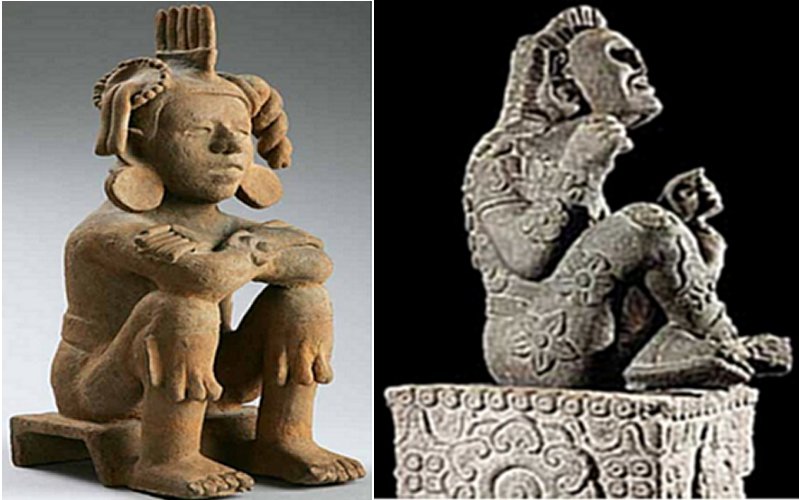
Left: Xochipilli, Aztec terracotta, Lombards Museum; Right: Xochipilli covered with “flowers”. Museo Nacional de Antropologia Mexico
It is widely known that the Aztecs possessed advanced knowledge of hallucinogenic plants, which are known to have been used in sacred rituals of this culture.
Sacred mushrooms and flower plants but not quite ordinary ones
In his book “The Wondrous Mushroom - Mycolatry in Mesoamerica”, Robert Gordon Wasson (1898 –1986), an American author and ethnomycologist, describes Xochipilli, the deity of ecstatic mushroom trance. The deity is totally absorbed in temicxoch, 'the flowery dream' state that follows the ingestion of hallucinogenic plants.
He "wears a mask with hollowed-out eyes, his face lifted upward with a fixed gaze. This is a depiction of a man in ecstatic trance. His feet are crossed, toes curled, hands held lightly above the knees at the level of the heart. All around the base of the figurine as well as on his body are images of various flowers, including the hallucinogenic morning glory (ololiuhqui), and mushrooms in profile…"
The “flowers”, however, are not the ordinary ones but rather botanically unspecified plants, frequently mentioned in Nahuatl poetry and as Wasson explains for the Nahua poets and singers, "flowers" and "flowering" or "dream flowers" referred to the visionary experience induced by teonanacátl mushrooms.
Wasson, with the advice of Richard Evans Schultes, director of the Harvard botanical museum, identified the “flowers” that Xochipilli has on his body. Surprisingly, they are not any ordinary plants but species that contain psychoactive substances; they are so-called “dream flowers” or Temicxoch. The divine Xochipilli, writes Gordon Wasson, is absorbed in Temicxoch; he is in ecstasy.
"The flowers took them to another world . . . a world that they called their Tlalocan, a world of strange and wondrous beauty, where they reveled in sensations beyond imagining," writes Wasson.
As we mentioned earlier, Xochipilli symbolizes song and dance, games, love and flowers, maize and beauty. He was also highly respected as the protector of mushrooms, especially earlier mentioned “teonanacátl mushrooms”. This unusual Psilocybin sponge only grows in a small region of Mexico at 3300 - 3700 meters above sea level on the volcano Popocatepetl (where the statue of Xochipilli was found).
As one of the fertility gods, he was a deity linked with agriculture and the cultivation of staple crops such as maize. Many archeologists believe he was first worshipped during the years of the Teotihuacan civilization but was later adopted by the Aztecs.
This kind of mushroom is also known as the “sacred mushroom of visions” and its name teonanacátl means "divine flesh" (or "divine flesh"). It certainly gives us an idea of how important and respected this mushroom was by the Aztecs.
Xochipilli was particularly worshiped at Xochimilco, built in the 16th century by the Spanish on the ruins of Tenochtitlan, the old Aztec capital, Mexico City. The most common offering to this god was pulque, the alcoholic beverage, and corn.
Written by – A. Sutherland AncientPages.com Staff Writer
Copyright © AncientPages.com All rights reserved. This material may not be published, broadcast, rewritten or redistributed in whole or part without the express written permission of AncientPages.com
Expand for referencesMore From Ancient Pages
-
 Advent: Facts And History About The Christian Season Celebration
-
 Jamukha: Mongolian Leader, Military And Childhood Friend Of Genghis Khan But Not Forever
-
 On This Day In History: First Wireless Transmission Of Morse Signals Sent – On Mar 12, 1896
-
 On This Day In History: Emperor Romulus Augustus Deposed – On September 4, 476
-
 Athena – Goddess Of Wisdom Delivered Punishments And Gifts
-
 Legend Of The Blue Men Of Minch: Were They Mythological Creatures Or Real Men?
-
 Pre-Columbian Societies Declined 2,000 Years Ago Due To Sea Level Fall
-
 Amazing Prehistoric Forest Submerged Under Water Thousands Of Years Ago Re-Emerges On Welsh Beach
-
 Mysterious 70-Million-Year-Old Underground Village And Magnificent Tower Of Eben-Ezer In Belgium
-
 On This Day In History: Naval Battle Of Porto Bello Begins – On Nov 20, 1739
-
 Re-Writing History Of England’s Domesday Book Of William I The Conqueror
-
 Modern Humans Have Their Homeland In Botswana – New Study
-
 Evidence For A Divergence Between Eastern And Western Mediterranean Indo-European Languages Finally Provided By Ancient Genomics Study
-
 Rare Stone Showing Ancient Rome’s City Limits – Accidentally Found
-
 Garden Of Eden And Its Four Rivers – Possible Locations Of Biblical Paradise Suggested By Archaeologists, Historians And Biblical Scholars
-
 Beautiful Mosaics In 1,300-Year-Old Church Discovered In The Lower Galilee
-
 On This Day In History: Adventurer Thor Heyerdahl And His Kon-Tiki Reached French Polynesia – On August 7, 1947
-
 Newly Unearthed Colossal Statue Probably Depicts King Psammetich I And Not Ramses II
-
 Scientists Use Ancient DNA To Explore Early European Adaptation
-
 Machu Picchu Was Built With The Royal Unit System – New Research Suggests

