
God Of The Gallows And How Odin Hanged Himself From Yggdrasil To Know Secrets Of Runes
A. Sutherland - AncientPages.com - Odin is associated with war and death, humanity's knowledge of the runic alphabet, poetry, healing, and sorcery.
Odin was always seeking wisdom, even at great personal cost, and indeed, it wasn't easy because he had to pay a high price for these treasures.

For instance, Odin got the seid (seidr) gift from a Vanir goddess, Freya, who shared it with all the Aesir gods and goddesses, and Odin became the chief practitioner of this magic could see the future and influence the fate of others.
In his quest for wisdom, Odin sacrificed his eye in exchange for a drink from Mimir's well, but he did not limit himself only to Mimir's wise advice. His constant wandering in search of more knowledge continued because he wanted to possess much more.
Odin Sacrifices Himself To Gain Wisdom
While sitting one day on the throne of Asgard, Odin watched the Norns occupied with their work, dictating fate and shaping destiny with their runes (the earliest alphabet used by the Norse).
He was jealous of their powers, and he also wanted to possess this hidden knowledge that allowed the Norns to exert so much control over the world. And so, he decided that he would acquire the wisdom of the mysterious runes.
In "Havamal" (or 'Words of the High One'), which is one of the poems in the Codex Regius of the Elder Edda, it describes how to obtain the priceless runes, Odin voluntarily sacrificed himself on the Yggdrasil tree without bread and drink, until he died.
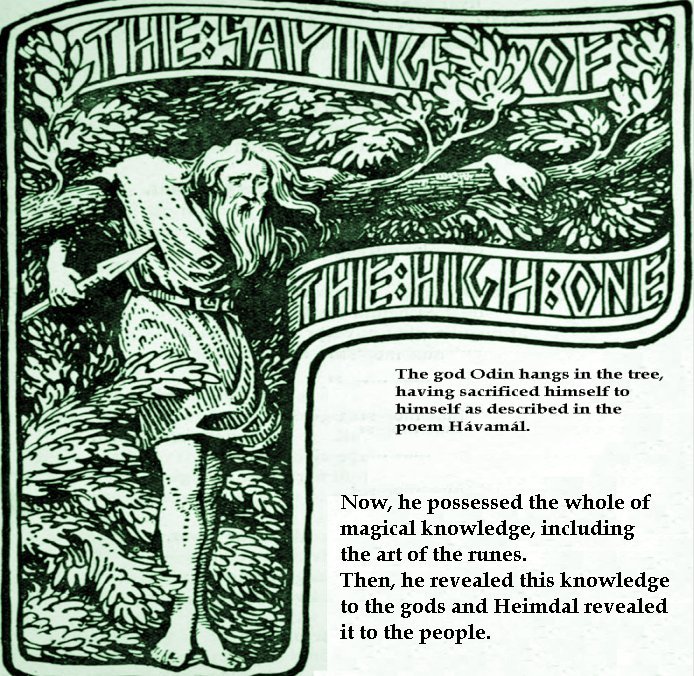
Odin's Self-sacrifice" (1908) by W. G. Collingwood. Image via Wikipedia
"…I know that I hung on a windy tree nine long nights, wounded with a spear, dedicated to Odin, myself to myself, on that tree of which no man knows from where its roots run.
No bread did they give me nor a drink from a horn, downwards I peered; I took up the runes, screaming I took them, then I fell back from there..."
Thus, in his never-ending search for wisdom and knowledge, Odin, once again, paid the highest price possible. He learned nine magic songs and eighteen highly powerful charms; with spells, he could heal emotional and physical wounds. The magic he learned made it possible for him to bind and defeat his enemies, making their weapons totally useless.
Armed with the knowledge of the many mysteries of the runes and their enormous power, Odin composed the following verse:
"….Then I was fertilized and became wise; I truly grew and thrived. From a word to a word I was led to a word, From a work to a work I was led to a work…" (as cited by Roy Jackson in "Viking: Viking Mythology: Ancient Myths, Gods and Warriors), who adds that the source of this poem is believed to be an Old Norse Poem, once part of the "Poetic Edda".
Now, he possessed the whole of magical knowledge, including the art of the runes and their unlimited power. It was a very meaningful sacrifice to Odin and one of his greatest experiences.
Then, he revealed this knowledge to the gods, and Heimdallr revealed much of these treasures to the people, but certainly not all of them.
What Does This Story Teach Us?
This is a beautiful story saying that to become great, gain power, and especially knowledge. We also have to sacrifice our time, energy, and health.
It's often a long-term process, but in the end, it is worth the effort.
The story also teaches us we can achieve many things in life, but in most cases, nothing that is worth something comes easy. We have to struggle and fight for the things we want in life.
Updated on January 21, 2024
Written by – A. Sutherland AncientPages.com Staff Writer
Copyright © AncientPages.com All rights reserved. This material may not be published, broadcast, rewritten or redistributed in whole or part without the express written permission of AncientPages.com
Expand for referencesReferences:
Crossley-Holland K. The Penguin Book of Norse Myths
Sturluson S. The Prose Edda
More From Ancient Pages
-
 On This Day In History: ‘Devil’s Footprints’ Appeared In Devon, England – Feb 8/9, 1855
-
 Alexander The Great And The Prophecy Of The Tree Of The Sun And Moon
-
 Unique Chachabamba Complex Hidden In Peruvian Forest Reveals Its Secrets
-
 Fall Equinox Explains Unusual Alignment Of Egypt’s Great Pyramids – Engineer Says
-
 Archaeologists And Historians Argue With Geneticists Over Controversial Viking DNA Study
-
 Ancient ‘Refrigerator’ And Unique Coins Discovered In Roman Military Camp In Bulgaria
-
 Exceptionally Rare 1,300-Year-Old Golden Pommel Found In Blairdrummond, Scotland
-
 Humanity’s Earliest Recorded Kiss Occurred In Mesopotamia 4,500 Years Ago – New Study
-
 Owain Glyndwr: Famous Medieval Welsh Warrior Prince And Symbol Of Independence
-
 Melisandre, The Red Woman: The History Behind Game Of Thrones’ Mysterious Mystic
-
 Mysterious Kaali Crater And The Holy Lake – Sacred Ancient Places In Estonia
-
 Extremely Rare And Tiny Medieval Sundial Discovered In Germany
-
 Citrus Was An Ancient Roman Symbol Of Status And Luxury
-
 Teotihuacan’s Puzzling Red Glyphs Could Be Unknown Ancient Writing
-
 Magnificent Hattusa: Capital Of The Hittite Empire
-
 Mysterious Ancient Underwater Structure Beneath MacDonald Lake Reveals Traces Of A Lost Civilization In Ontario
-
 Mystery Of Ancient “Magical” Mirrors – Some Of The Strangest Objects In The World
-
 More Than 300 ‘Sun Stones’ Dated To Stone Age Discovered On Danish Island Of Bornholm
-
 Illuminati: Facts And History About The Secret Society
-
 Concept Of Fate In The Eyes Of Slavic People

