
Giant Balor Of The Evil Eye – Terrifying Fomorian King And Grandfather Of Celtic God Lugh
A. Sutherland - AncientPages.com - In Irish mythology, Balor and the Fomorians represent the powers of darkness, evil, and death.
Balor was the king of the Fomorians. Like the Cyclops, he had only one magical eye known as "the evil eye," and it was Balor's greatest weapon. Only one glance from his eye could kill.
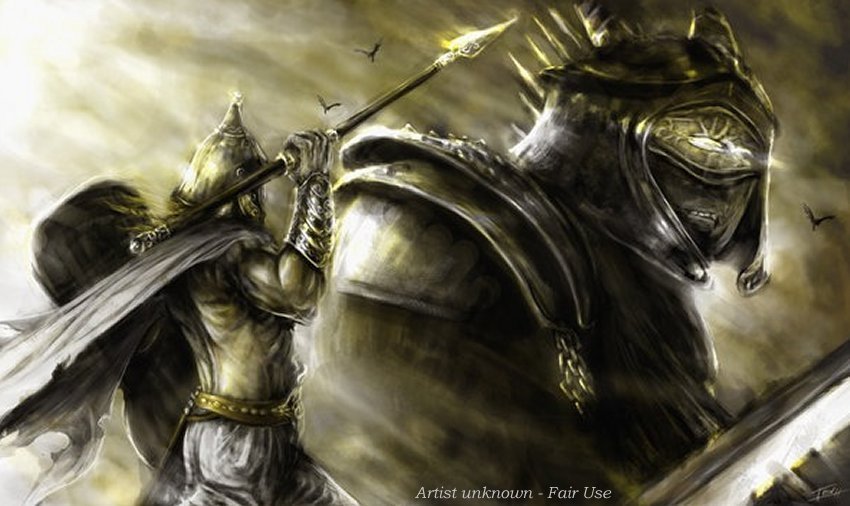
The eye was always covered with seven very heavy eyelids (cloaks), keeping it cool and safe, and four strong men were needed to lift them. When the eyelids were taken off one by one, the eye could strike down all it looked upon, and the whole land caught fire.
The eye was constantly closed and used only against enemies on the battlefield.
Why Was Balor's Eye So Powerful?
Legend says that one day, Balor spied on some Druids who were preparing a portion of knowledge and wisdom. The substance penetrated Balor's eye and gave it magical power.
Some of it splashed out and hit him in the eye.
Tradition has it that in older age, Balor's eye became exhausted, and its eyelid had to be hoisted up by his servants with ropes and lifters.
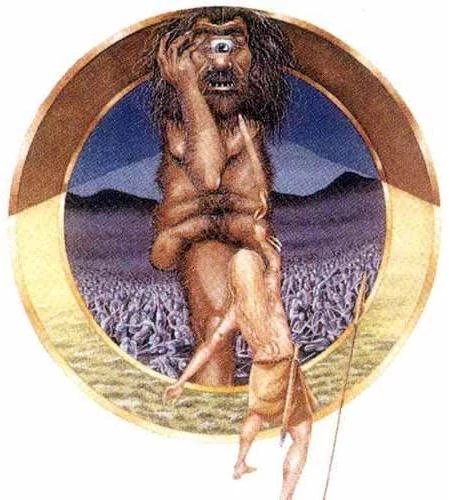
Giant Balor. Credit: villains.wikia.com
As a leader of the Fomorians, Balor ruled Ireland before the arrival of settlers. He was a mighty but also tyrannical ruler, commonly associated with terror and fear, which paralyzed the Irish people.
Balor himself feared no man, no enemy, but one thing terrified him much and was his only weakness.
Ancient Prophecy And Fate One Cannot Escape
It was an ancient prophecy about Balor's final destiny.
Frequently mentioned in Irish mythological stories, this Druid's prophecy says Balor would be killed one day by his grandson.
To trick fate, Balor decided to imprison his daughter, Ethniu, in a tower on Tory Island, away from all contact with men. Thus, she could never become pregnant, and Balor's life could be spared.

Fomorians: Supernatural Race Of Giants Who Came From Atlantis
But once again, fate proves impossible to escape. Balor's greed also contributed to his downfall, for he stole a magical cow of fertility, the Glas Ghaibhleann, having the ability to produce never-ending copious amounts of milk. According to one version of the story, the magical cow belonged to Cian (Kian the Mighty), a member of the Tuatha Dé Danann. To retrieve the prized animal, Cian had to devise a revenge plot.
He knew the Druids' prophecy about Balor's death from his own grandson's hands and why Balor had locked his daughter, Eithne, in a tower, where she was strictly guarded by twelve matrons, preventing her from ever seeing a man.
Disguised as a Druidess, Cian entered the stronghold where Eithne lived and seduced her. The fruitful relationship resulted in three children, one of whom was Lugh. When Balor discovered the trick, he ordered the children to be drowned. Only one child, Lugh, survived and was secretly raised under challenging times of continuous conflict between the Danaans and the Fomorians, demonic creatures ruled by tyrannical king Balor.
The Fomorians preyed upon the various settlers and waged wars against them until the Danaans, at last, finally defeated them in a terrible war (the Second Battle of Mag Tuired) that ended in the Fomorians' downfall.
Despite being half-Fomorian, Lugh fought on the side of the Tuatha de Danann, and he played an essential role in the Fomorians' downfall. Balor struck down many Tuatha de Danann, and he could conquer them all, but first, he had to meet his grandson, Lugh, and confront his skills with his deadly eye.
He ordered his servants to pull up the eyelids, and while his deadly eye was partially open, Lugh chose a perfect moment to attack it. He shot a sling stone that sank into Balor's brain and then cut off his head. The incident wreaked chaos among the Fomorian soldiers and fulfilled the prophecy that Balor would die at his grandson's hand one day.
It is said that even as Balor lay on the ground, his evil eye was so strong that it killed twenty-seven of his Fomorian warriors who looked at it.
Written by – A. Sutherland AncientPages.com Staff Writer
Copyright © AncientPages.com All rights reserved. This material may not be published, broadcast, rewritten or redistributed in whole or part without the express written permission of AncientPages.com
Expand for referencesReferences:
Ward A. The Myths of the Gods: Structures in Irish Mythology
Jackson J. Celtic Myths
More From Ancient Pages
-
 DNA From Doggerland That Separates The UK From Europe – New Study
-
 Tomography And Radiocarbon Dating Used To Examine Australian Aboriginal Knife
-
 Codebreakers Crack Secrets Of The Lost Letters Of Mary, Queen Of Scots
-
 15,000-Year-Old Shell Beads Found Kebara Cave Are The Oldest Known Use Of Organic Red Pigments
-
 Enigmatic Voynich Manuscript: Computer Scientists From Alberta Use AI To Decipher Document
-
 Ereshkigal – Ruler Of The Sumerian Underworld And Most Feared Deity In Mesopotamian Pantheon
-
 Mysterious Artifacts Scattered Around Mount Baigong, China
-
 How On Earth Did The Ancient Egyptians Raise Their Colossal Obelisks?
-
 Archaeologists to revisit Fort Rock Cave, Oregon – site of the world’s oldest sandals
-
 3,500 Underground Man-Made Maresha/Beit Guvrin Caves And Tunnels In The Holy Land
-
 Tír na nÓg – Mythical Land Where Time Floats Slower Than In Mortal Lands
-
 Unique Discovery – 2,000-Year-Old Roman Coins Found On Gotska Sandön In Sweden
-
 Change Of Burial Tradition Among The People of Early Medieval Europe
-
 On This Day In History: Copernicus’ s Book Banned By Catholic Church – On Mar 5, 1616
-
 Sculpture Of Lord Vishnu Dated To The Early 9th Century Found In Kashmir
-
 Britain’s Long-Distance Tin Trade Was A Game-Changer For The Bronze Age
-
 Discovery Of Unusual Ancient Skeleton Offers Evidence Giants Inhabited California
-
 Ancient DNA’s Analysis Delivers Crucial Clues To Migratory Patterns During The First Millennium AD
-
 2,300-Year-Old Roman Lead Weight In Assos Is The Largest Ever Discovered
-
 Giant 4,500-Year-Old Axe Grinding Site Discovered In Scotland

