
Mysterious Kaali Crater And The Holy Lake – Sacred Ancient Places In Estonia
Ellen Lloyd - AncientPages.com - About 7,500 years ago, a giant meteorite slammed into the Earth, carving out a hole 110 m across Estonia's largest island, Saaremaa.
Several kilometers above the Earth’s surface, the meteorite broke into pieces from the pressure and heat of the atmosphere. When the meteorite pieces hit the ground, there was an explosion compared to a small nuclear bomb. The landscape changed completely and the blast created eight smaller craters nearby. The area is today known as the Kaali Meteorite Crater Field.
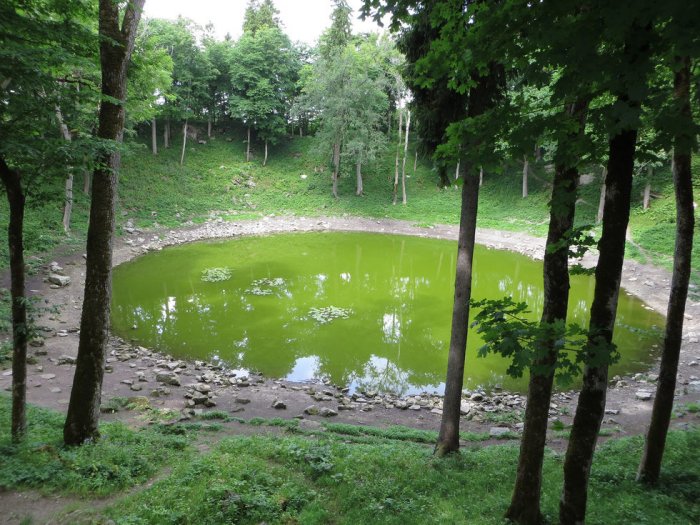
Kaali crater - A green pool of water at the largest meteorite craters at Kaali on Saaremaa island in Estonia. Credit: Brostad - Flickr
Ancient people considered objects that fell from space to be sacred. The Kaali crater and its lake became therefore a sacred site for centuries.
A Bronze Age cult built a large stone wall around the largest of the Kaali craters. The ancient ruins of this immense stone wall are still there today.
Archaeological evidence reveals that Kaali Lake, also known as Holy Lake was a place of offering for many centuries. The nearby forest is still called Puhamets, which means "Sacred Forest." There is no doubt this place was of great spiritual importance to our ancestors.
The stone wall surrounds the crater is interesting. The length of the wall was about 470 meters, its width around 2.5 meters, and its height to two meters.
Stones 1.5 to 1.8 meters in diameter were used in its construction, and the wall is stronger than any similar structures in the region. While excavating the site, researchers found evidence of a fortified settlement inhabited from the 5th to 7th century BC, a small hoard of silver jewelry from the 3rd to 5th centuries AD, and piles of domestic animal bones, some dating to as late as the 17th century.
Scientists think ancient offerings still remain undiscovered at the bottom of the six-meter-deep Kaali lake. Offerings continued to be made in secret long after the Church forbade such as "pagan " practices.
Silver ornaments have also been found that date to 300-500 A.D. Therefore, it is very probable that the lake was considered holy, and offerings were made there for centuries.

Credit: Wikipedia
Unfortunately, deposits of oak trees in the water prevent exploration of the lake. Scientists cannot probe beyond four meters below the surface, and we may never know what lies at the bottom of Kaali Lake.
The Holy Lake has been mentioned in many Estonian legends and is a subject of folklore. Lennart Georg Meri,(1929-2006), writer, translator, film-maker, diplomat, and politician, President of Estonia in 1992 - 2001, wrote in his book Hõbevalge" (Silverwhite) that he had found descriptions of the meteor's fall to earth in archaic runes. Kalevala 47 runes do indeed give a very realistic description of fire falling from the sky that burned houses, fields, fens, and humans.
Meri also suggested that the Baltic Jaanipaev (Midsummer) bonfire traditions are a reenactment of the event. There is no evidence of this, but the Kaali crater is a popular tourist destination today and we still don’t know what is hidden at the bottom of the lake.
Written by Ellen Lloyd – AncientPages.com
Updated on September 12, 2021
Copyright © AncientPages.com All rights reserved. This material may not be published, broadcast, rewritten or redistributed in whole or part without the express written permission of AncientPages.com
Expand for referencesMore From Ancient Pages
-
 Ancient Hebrew Inscription Reveals Location Of Biblical Mount Sinai
-
 Giant Thousand-Year-Old Urns Discovered In The Amazon City Of Fonte Boa
-
 Ancient Marble Statue Of Sphinx Discovered In Tang Dynasty Tomb
-
 On This Day In History: Sack Of Rome Took Place on May 6, 1527
-
 Ancient Race Of Star Worshippers And Secret Message Stored In Unusual Monument
-
 The Iceni’s Queen Boudicca Who Revolted Against Roman Rule
-
 Archaeological Discovery Of “Once-In-A-Lifetime” Medieval Gold Necklace In Britain
-
 Basajaun: Giant Blacksmith, ‘Lord Of The Woods’ And How People Learned Secrets Of Agriculture
-
 Mysterious Undeciphered Carvings And Script On Stela Of Montoro
-
 On This Day In History: George Bernard Shaw Died – On Nov 2, 1950
-
 Wayland The Smith: Legendary Master Blacksmith And Lord Of The Elves
-
 Tullus Hostilius: Warrior King Of Rome, Who Succeeded Numa Pompilius And Feared Prophecies
-
 Mystery Of The 80 Million-Year-Old Sharks’ Teeth In The City Of David
-
 How Was The 3,600-Year-Old Nebra Sky Disc Made? New Clues
-
 Royal Inscription Of Naram-Sîn Of Akkad: The First Ancient King To Use Blocks For Printing Bricks
-
 Golosov Ravine – Mysterious Time-Warping Mist Causing Unexplained Disappearances And The Ancient Shrine Of God Veles
-
 Resourceful Neanderthals Could Dive 13ft If Necessary To Collect Shells
-
 Mass Production Of Stone Bladelets Led To A Cultural Shift In Paleolithic Levant
-
 Hyksos: 15th Dynasty Rulers Of Ancient Egypt, Were An Internal Takeover
-
 Mysteries Of Old Europe – Intriguing Gradeshnitsa Tablets Might Hold Secrets Older Than Egyptian Hieroglyphs

