
Mystery Of The Lavau Celtic Prince And The Beautiful Ancient Artifacts Hidden In His 2,500-Year-Old Tomb
AncientPages.com - Some years ago, archaeologists discovered an exceptional tomb of a Celtic Prince. The 2,500-year tomb was unearthed on the outskirts of Lavau in France’s Champagne region.
Inside the tomb researchers from National Institute of Preventive Archaeology (INRAP) found remarkable ancient Greek and Etruscan artifacts, but this was not the end of the story. It soon became clear that the tomb of the Lavau Celtic Prince had many hidden secrets.

The tomb was found near the village of Lavau, France. Image credit. Denis Gliksman, Inrap
One Of The Greatest Archaeological Discoveries In France
The French state ordered a more detailed exploration of the area and many more priceless artifacts were unearthed in the vicinity. Soon, archaeologists found magnificent artifacts from the 5th century B.C., including a bronze cauldron ornamented with the head of the god Dionysus.

The Lavau Prince rests on his chariot with gold jewels. image credit: Denis Gliksman, Inrap
The skeleton of the Celtic prince was also unearthed. He was laid out on his chariot, still wearing beautiful jewelry. He who was still remains a mystery, but this particular discovery is considered one of the most important archaeological discovery made in France in recent decades - comparable to the 1953's discovery of grave belonging to the so-called 'Lady of Vix'.
Artifacts Produced By Skilled Ancient Craftsmen
Examination of the Lavau Celtic Prince’s tomb has been going on for two years now, ever since it was unearthed in 2015. The artifacts have been analyzed in a laboratory and the first results are reaching the public. Using sing X-ray radiography and tomography as well as 3D photography, scientists hope the artifacts can shed light on Iron Age European trade and unravel the identity of the Lavau Celtic Prince.
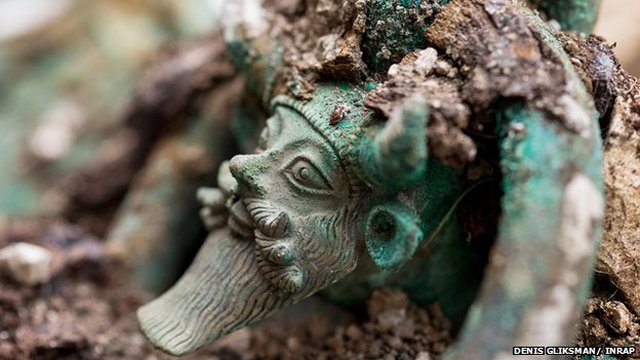
The artifacts feature images from Greek or Etruscan iconography, archaeologists said.
One of the goals is to understand the influences from different cultures in the way the ancient objects were decorated. For instance, a large jar used to pour wine is made up of Greek-style ceramic and decorated with golden Etruscan motifs and silver Celtic designs. Hopefully, 3D photography and chemical analyses can shed more light on the origin of the ancient artifacts.
See also:
Unique 2,500-Year-Old Celtic Jewelry – Oldest Iron Age Gold Treasure Ever Found In Britain
Remarkable Le Catillon II Hoard – World’s Largest Collection Of Celtic Coins And Jewellery
Does Celtic Art Have Links With Iron Age Art Of The Eurasian Steppes?
Scientists have so far been able to confirm that the artifacts discovered in the tom of the Celtic prince were manufactured by various ancient cultures. X-ray radiography shows that the belt worn by the prince is decorated with threads of silver, assembled together to form Celtic motifs. This is a unique object, as none similar have ever been recovered elsewhere before.
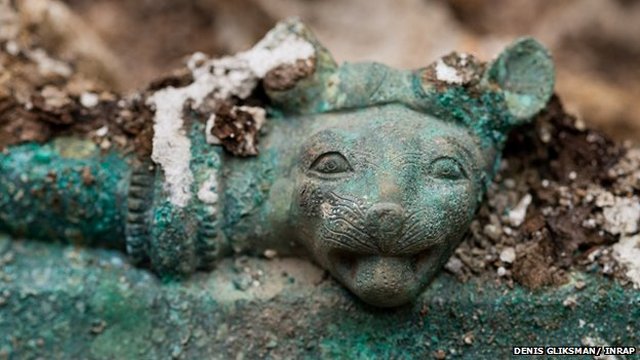
The burial chamber is one of the largest recorded for this period, according to Inrap.
Furthermore, an analysis of the metals in the bronze cauldron - one of the most elaborate artifacts recovered from the grave - suggests that the people who created it perfectly mastered smelting and engraving techniques.
Cultural and economic interactions were taking place between the Celtic and Mediterranean worlds at the time the Lavau Celtic Prince was alive.
It has also been established beyond doubt that the person buried in the grave was male and not a female as some previously suggested. Researchers plan to continue the examination of the tombs, skeleton and artifacts until 2019, to try and find out more about the prince's identity and to learn more about the origins of all the objects he had taken with him in the afterlife.
AncientPages.com
Expand for references
More From Ancient Pages
-
 The Unicorn In The Bible Was An Oryx – Ancient Translation Mistake
-
 Selah – Mysterious Biblical Word Of Unknown Meaning
-
 Stonehenge May Have Aligned With The Moon As Well As The Sun
-
 Unusual Medieval Picture Stone Found Under House In Klotzow, Germany
-
 On This Day In History: Battle Of Naulochus Was Fought Off The Coast Of Sicily – On Sep 3, 36 BC
-
 Spread Of Transeurasian Languages Was Due To Agriculture Study Reveals
-
 Has The Mystery Of Cerne Abbas Giant Been Solved?
-
 3,300-Year-Old Bronze Figurine Of Canaanite God Unearthed At Lost Biblical City
-
 Lilith – Beautiful Demonic And Brave Symbol Of Equality And Adam’s First Wife Who Refused Subordination
-
 Was Prehistoric Baghdad Battery A Unique Find Of The Ancients? – Did Its Manufacturers Discover Electricity By Accident?
-
 Three Punic Wars Between Rome And Carthage Lasted Almost A Hundred Years
-
 ‘Harmal’ Plant Was Used For Smoking And Inhaling In Arabia As Early As 2,700 Years Ago
-
 Fascinating Accounts Of Incredible Vehicles, Cosmic Cities In Vedic Literature
-
 Mysterious Ancient Human Skeletons Found In Florida Lake Puzzle Archaeologists – Unknown Lost Settlement?
-
 Striking Ancient Stone Idols: The Forgotten Polovtsian Statues Of Eastern Europe
-
 Ancient Secrets Of The Damascus Steel – Legendary Metal Used By Crusaders And Other Warriors
-
 University Of Warsaw Archaeologists Return To Study Large Ancient City Of Ptolemais
-
 Gods’ Creation Of Five Different Human Races – Ages Of Man On The Earth And The End Of The World
-
 On This Day In History: The Gregorian Calendar Implemented – On Oct 5, 1582
-
 The Strange Story Of The Grave Of Copernicus

