
Asgard: Enter The Ancient Kingdom Of The Powerful Norse Gods
Ellen Lloyd - AncientPages.com - Join us on a voyage through ancient times to secret lands, high mountains, dark forests, and beautiful lakes, to a world where magic and wisdom played a dominated part, and meet the powerful Norse gods who lived together in the realm called Asgard, a place situated beyond and above the human world.
In Norse mythology, there are nine worlds and these are divided into three levels, one stacked above each other.
 Yggdrasil and its nine worlds. Credit: Adobe Stock - Ko_Te
At the top was Asgard, the home of the gods. Beneath Asgard lay Midgard, the world of men surrounded by vast oceans. This is where humans, dark elves, dwarves, and giants lived. In Midgard, there is also a special place called Jötunheimr, the dwelling place of the giants, (Old Norse Jötnar). It was also known as Utgard which means “Beyond the Fence.”
Beneath Midgard was Niflheim, the land of the dead, also included Hel, where those who died of sickness, old age, or accident were judged.
Asgard - The Kingdom Of Norse Gods
Asgard, the kingdom of the gods was originally inhabited by the Aesir alone. In Old Norse Mythology the Aesir are the principal gods of the pantheon.
During a period of time, another tribe of gods known as the Vanir shared this place together with the Aesir.

The Aesir and Vanir fought many wars.
However, these two groups of gods fought a long and bloody war, which in the end, led to that only a few of the Vanir came to live in Asgard. There is actually little information about this ancient war. Still, we are told that the Vanir were deities of fertility, ruling over land and sea, and the Aesir were associated with war, magic, and the sky. The differences between these two groups must have led to disputes and battles.
In Asgard, the gods held regular meetings and discussed how to deal with significant problems, like for example how to regain hostages from the giants and how to protect their secret treasures.
Who Were the Aesir And Where Was Asgard Located?
But where was Asgard and who were the Aesir? At this point, our journey becomes a real adventure.
The location of this mysterious place is not given. Scholars believe that Asgard was a mythical place in the heavens, unapproachable to mortal men. It is said that Asgard was a magnificent celestial city of golden and silver palaces. The Aesir built the entire city.
But was this wonderful city really in the heavens?
Actually, there are two significant aspects we must pay attention to in relation to Asgard, the realm of the Norse gods. To begin with, Asgard was protected by a huge wall that was raised during the war against the Vanir. The wall was needed or the kingdom of the gods would be defenseless. This mighty barrier was so strong and high that it offered complete protection against the evil giants. Asgard was entirely surrounded by this very high wall and there was only one entrance to the city - through a great gate.
Asgard, the abode of the gods and Midgard, the home of humans and giants was connected by a bridge called Bifrost, which is described as a rainbow consisting of three plaited strands of fire. The bridge was built by the gods with more skills than any other structure
Bifrost was protected by the Norse god Heimdallr who possessed extraordinary powers. With his remarkable sight, Heimdallr could spot enemies at a long distance. When the rainbow bridge was in danger, the gods were warned by the sound of Heimdallr’s trumpet, the Gjallarhorn.
The question is - If Asgard was a place in the heavens, why would the gods need a huge wall to protect them from the giants who lived on the Earth?
The second aspect in relation to Asgard is of linguistic nature. In Scandinavia, the word "gard" means "yard" or "country-yard". It can also be a reference to a "country-house" or a "manor".
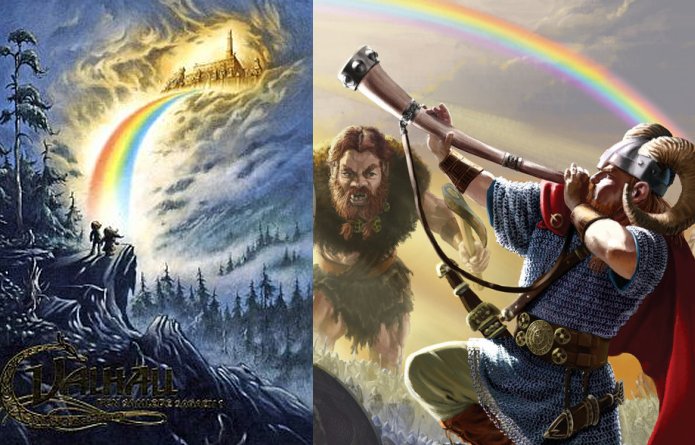
Asgard was guarded by the Norse God Heimdall.
Perhaps Asgard was a country-house located on a high mountain. As we already know from other mythologies the gods often had their abode in the mountains.
The high wall built around Asgard was protection to keep the enemies away.
It is also possible that Asgard and Midgard were separated by water, maybe a large lake. It would explain the use of Bifrost, the bridge connecting the realm of the gods with the world of humans and giants. The most important sources for the Norse beliefs are the tenth century Voluspa and the thirteenth century Grimnismal and Vafthbrudnismal, three poems which the Icelandic chronicler Snorri Sturluson expanded upon from other unknown sources in his detailed account in the Prose Edda.
In the Edda, the Norse gods are not only referred to as the Aesir but also Tivar, which means the Shining Ones.
As in all other countries, the gods of Scandinavia were also described with words meaning "bright," shining." and like the Tuatha De Danaan in Ireland, the Norse gods were not considered immortal but rather regarded as superhumans.
The Shining Ones arrived in Scandinavia after a long journey. Here, they established a new kingdom and taught people how to kindle the holy fire, instructed them in runic wisdom, gave them the knowledge of medicine, agriculture, and everything that was needed in their daily life.
Here the gods fought their battles and used their magical weapons. They possessed technology and wisdom, not of this world, and were considered magicians and gods by the locals.
Written by Ellen Lloyd – AncientPages.com
Copyright © AncientPages.com All rights reserved. This material may not be published, broadcast, rewritten or redistributed in whole or part without the express written permission of AncientPages.com
Expand for referencesReferences:
O'Donoghue H. From Asgard to Valhalla
Karlsdottir A. Norse Goddess Magic
Wagner W. Asgard and The Gods
More From Ancient Pages
-
 Treasure Trove Of Arabic Coins Dated Back 1,000 Years Unearthed In Graveyard In Poland
-
 Uplistsikhe Devastated By Genghis-Khan Hordes But Once City-Fortress Of Queen Tamar
-
 Astronomically Aligned Temples And Pyramids Of Ancient World
-
 İnkaya Cave Study Brings To Light 86,000-Year-Old Traces Of Human Life
-
 On This Day In History: Astronomer John Couch Adams And The Discovery Of Planet Neptune – On July 3, 1841
-
 Forgotten Ancient Wisdom: People Have Two Souls – Native American And Pre-Christian Beliefs Reveal
-
 Mystery Of The Forgotten Explorers And Ancient Artifacts That Re-Write History Of North And South America
-
 Mayan Elites Lived In Pre-Hispanic Teotihuacán – New Evidence
-
 Kudurru Of Melishihu – Stone Records From The Kassite Dynasty In Babylonia
-
 Ceibal Is The Oldest Known Ceremonial Site Of The Maya Civilization
-
 Incredible Ancient Roman ‘Service Station’ With Hundreds Of Artifacts And Dozens Bodies Found In Hertfordshire, UK
-
 What Happened To Drunken Women In Ancient Rome?
-
 On This Day In History: King Charles II Is Restored To The Throne Of England, Scotland And Ireland – On May 29, 1660
-
 A 1,000-Year-Old Bronze Coin Accidentally Discovered By A Little Boy
-
 Runic Inscription On The Viking-Age Galloway Hoard Deciphered
-
 Impressive Ancient Underground Tombs And Chapels Unearthed In Saqqara, Egypt
-
 Legend Of The Immortal Wandering Jew Cursed By Jesus
-
 Rare Bronze Seal Matrix Of St. George Slaying The Dragon Discovered In French Castle
-
 How Did Sea Level Rise Impact Human Groups During Mesolithic And Neolithic Periods?
-
 Thousands Of Ignored ‘Nummi Minimi’ Coins Found In Ancient Marea, Egypt With Hidden Fascinating History

