
Confucius: Philosopher, Educationist And Great Intellect With A Noble Morality
AncientPages.com - Today, it is time for another great man of ancient times and the most important figure in the Chinese history - Confucius. Better known as Master Kong or Kong Fuzi, in China, Confucius was a fifth-century BC philosopher and thinker, whose influence upon East Asian intellectual and social history is immense.
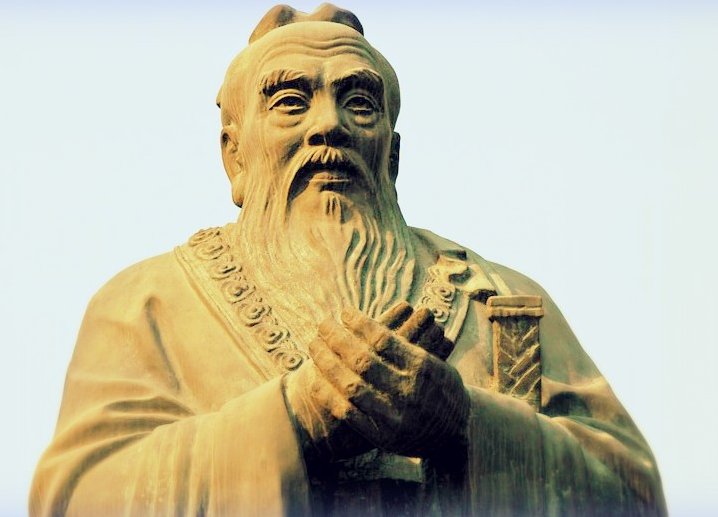
However, he was also a very controversial philosopher and teacher. Much of his approach to education and his ideas were strikingly experimental or in advance of those generally accepted.
He is considered the first great educationist, and his teachings taught in schools, had a great impact on both the past and present Chinese culture; their great power have survived until today.
In his hometown, Confucius established his own school – for both rich and poor students - in order to provide them with the teachings of the ancients. Confucius did not consider himself a ‘creator’ but rather a ‘transmitter’ of these ancient moral traditions. His school taught writing, rules of behavior and basic knowledge.
His teachings were later compiled and became known as Confucianism, which is not about a religion; it is about treating others with politeness, fairness and respect.
He was born in 551 BC in the State of Lu, (known today as Qufu in Shandong Province) in an impoverished aristocratic family. His father was a military officer and died when the son was 3 years old. Mother raised him alone. He knew poverty and endured a poverty-stricken and humiliating youth but despite a hard life, he dedicated himself to study at the age of 15.
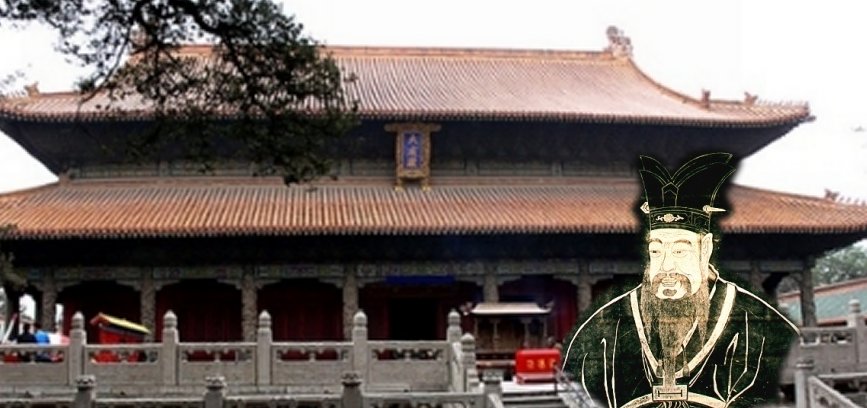
Temple of Confucius in Qufu, the Dacheng Hall
In Chinese, his name was Kong Qiu; Kong was the family name while Qiu (meaning "hill") was his given name.
Confucius - an intellect with a noble morality - pursued truth, propriety, righteousness, wisdom, and trustworthiness, kindness and perfection throughout his life and his success and failure were largely due to his character. Some of Confucius’ famous words were:
“Everything has its beauty but not everyone sees it” and “Our greatest glory is not in never falling, but in getting up every time we do”.
Or: “Forget injuries, never forget kindness”.
According to ancient sources, his political career was not successful, but as a teacher and philosopher, Confucius was brilliant and full of achievements.
However, he was also a very controversial philosopher and teacher.
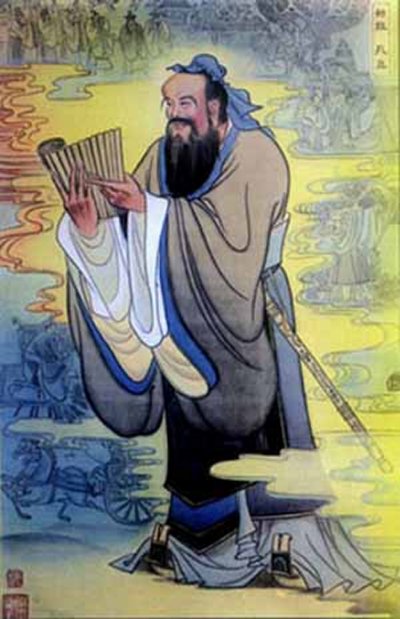 Much of his approach to education and his ideas were strikingly experimental or in advance of those generally accepted.
For example, he promoted the ideas "to educate all despite their social status" and "to teach according to the students' characteristics".
Especially, the first his idea broke with an old tradition as only the aristocracy had the privilege of education.
He also said, "Studying without thinking leads to confusion; thinking without studying leads to laziness."
Also as a political adviser, Confucius promoted several ‘unpopular’ reforms; he advocated low taxes, he demanded to entrust the leadership to "people noble and learned," regardless of their origin.
From 498 BC (when he was 53 years) many of his disciples began to cover the highest positions in government, Confucius still had a troublesome life and was often starving.
Probably, he did not gather many followers during his life; but there were many of them during the centuries following his death.
Legend has it that when he died, his students mourned him for three years, and the most faithful of them Tzu Kung – a businessman, an accomplished speaker, a good leader, who, probably led his own Confucian school at some point – visited the master’s grave in Qufu for six years saying: "since the beginning of mankind until now there wasn't a man equal to Confucius."
Confucius’ simple, undogmatic maxims are still popular. He argued that the moral sense in man is the equivalent of the cosmic order of nature. He never referred to the supernatural.
What make Confucius so special is that he did not claim that his doctrine comes from divine inspiration or other source inaccessible to ordinary people. Confucianism is not a religion, but rather a system of ethics, learning how to be a good, moderate, socially and ethically valuable man.
His statues became the subject of worship in schools, temples were built in his name and educated people often had (and probably have even today) a tablet of Confucius’ writings displayed in their houses.
The teachings of Confucius - ‘the king without a throne’ and his spirit are still alive.
Copyright © AncientPages.com All rights reserved. This material may not be published, broadcast, rewritten or redistributed in whole or part without the express written permission of AncientPages.com
More From Ancient Pages
-
 Pharaoh Merneptah – His Giant Sarcophagus And Unique Victory Stele
-
 Ancient Secrets Of Mistletoe – Sacred Celtic Plant With Magical Powers
-
 It’s Possible To Find Your Ancient Doppelganger – This Is What You Need To Do
-
 Yama – Hindu God Who Rules Over The Dead And Souls And Guards Akashic Records
-
 Mysterious Ancient City Of Ebla That Existed Thousand Years Before Biblical Kings David And Solomon
-
 Ancient Tomb Of Maya Ruler Te’ Chan Ahk Discovered In Guatemala
-
 Magnificent Meteora And ‘Suspended In The Air’ Greek Monasteries
-
 Imet: A Long-Forgotten Ancient City In Egypt’s Eastern Nile Delta – Discovered
-
 One Of A Kind Viking Age Hammer Of Thor Discovered In Ysby, Sweden
-
 2,000-Year-Old Smuggled Glazed Bricks Sent Back To Iran By Switzerland
-
 Handshaking Is An Ancient Tradition – When, Where And Why Did We Start To Clasp Hands?
-
 Secret Underground Chambers Of Caynton Caves And The Knights Templar Connection
-
 First Sumerian Revolt – People Oppose The Harsh Akkadian Empire
-
 Ramanathaswamy Temple Has Spectacular Corridors With Over 4000 Pillars
-
 Khara-Khoto ‘Black City’ – Besieged By Genghis Khan But Flourished Under Mongol Rule
-
 The Hobbit – An Ancient Hominin Species May Still Be Living In The Forests Of Flores Island – Anthropologist Says
-
 Sir Christopher Wren – Genius Mind Of Most Influential British Architect Of All Time
-
 Late Roman-Era Rooms, Offering Vessels Unearthed At Ancient City Of Antiocheia, Southern Türkiye
-
 Unexpected Discovery Of Huge Iron Age Roundhouse At Dinas Dinlle, Wales
-
 Evidence Of Lost Advanced Ancient Technology In Babylon

