
Nemesis: Winged Goddess Of Justice And Revenge
Ellen Lloyd - AncientPages.com - When we hear the word Nemesis, we think of an opponent or enemy that is very difficult to defeat. If you are a Star Trek fan, you associate the name with the episode Nemesis, in which Captain Picard meets his most dangerous adversary.
The word Nemesis originally meant the distributor of fortune, neither good nor bad, simply in due proportion to each according to what was deserved.
In Greek mythology, Nemesis was a winged goddess of justice and revenge. Often called "Goddess of Rhamnous," an isolated place in Attica, Nemesis was remorseless, and her name means "to give what is due. She was also known as Adrasteia, meaning "the inescapable."

Justice & Divine Vengeance Pursuing Crime, by Pierre Paul Prud'hon (1759-1823), French Neoclassical painter. Credit: Public Domain
Who Was The Goddess Nemesis?
Nemesis has been described as the daughter of Zeus, but according to Hesiod, she was a child of Erebus and Nyx. She has also been considered the daughter of Nyx alone.
Her cult may have originated at Smyrna, an ancient Greek city located at a central and strategic point on the Aegean coast of Anatolia.
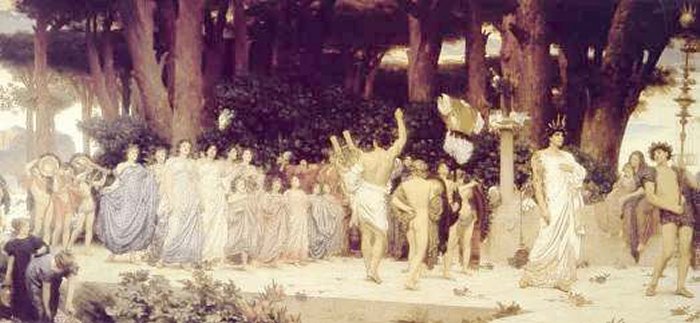
A festival called Nemeseia was held in Athens. Frederic Leighton, 1st Baron Leighton (1830–1896). Credit: Public Domain
A festival called Nemeseia was held in Athens. Its object was to avert the vengeance of the dead, who were supposed to have the power to punish the living if their cult had been neglected. This evolved into a festival giving homage to Adrasteia/Nemesis. Sacrifices were made to her in the hopes of avoiding her gaze and judgment or in an attempt to invoke her aid for a perceived slight. She was considered the patron Goddess of Gladiators & the Arena in Rome, and sacrifices were offered before every bout.
Nemesis usually holds a sword, but she can hold balance, scales, or measuring rods in some images. She has enormous wings and travels in a chariot drawn by Griffins, which were beasts with the head and wings of an eagle and the body of a lion.
In classic Greek tragedies, Nemesis appears chiefly as the avenger of crime and the punisher of hubris (arrogance before the gods).
How Nemesis Punished Narcissus
One Greek myth tells how Nemesis punished Narcissus, a hunter in Greek mythology and son of the river god Cephissus and the nymph Liriope. Narcissus was a beautiful young man who was also very arrogant and disdained those who loved him. One day, while Narcissus was hunting in the woods, the Oread nymph Echo spotted him and immediately fell for him.
When Narcissus sensed someone was following him, Echo eventually revealed herself and tried to hug him. However, he pushed her off and told her not to disturb him. Echo, in despair, roamed the woods for the rest of her life and wilted away until all it remained of her was an echo sound.
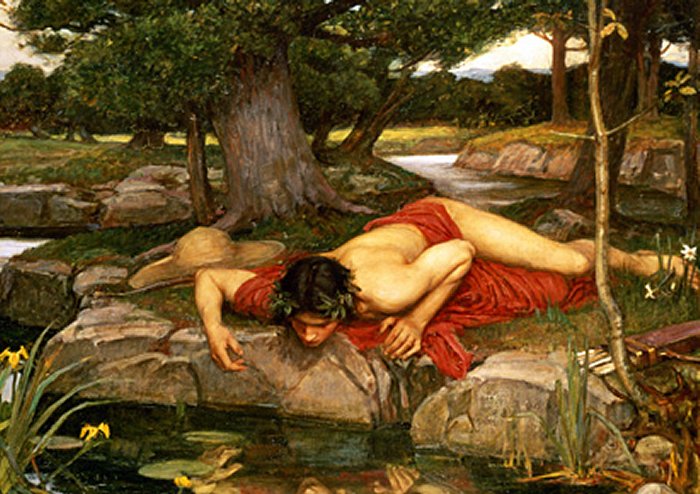
Narcissus was punished by Nemesis. Painting by John William Waterhouse. Credit: Public Domain
Nemesis, the goddess of retribution and revenge, learned what had happened and decided to punish Narcissus for his behavior. Nemesis led him to a pool, where he saw his reflection and fell in love with it. Unable to abandon his reflection, he died there.
Nemesis believed no one should ever have too much good, and she had always cursed those blessed with countless gifts.
Updated on February 1, 2023
Written by Ellen Lloyd – AncientPages.com
Copyright © AncientPages.com All rights reserved. This material may not be published, broadcast, rewritten or redistributed in whole or part without the express written permission of AncientPages.com
More From Ancient Pages
-
 Struggle To Get Mail On Time Has Lasted More Than 5,000 Years – Part 3
-
 Prehistoric Artwork In Chauvet-Pont d’Arc Cave 10000 Years Older Than Previously Thought
-
 Seven Fires Prophecy Of The Anishinaabe People And The Future Of The Turtle Island – Are Humans Standing At The Crossroads?
-
 Amazing Adventure Of The Viking Who Escaped A Death Sentence Using His Artistic Talents
-
 Keshwa Chaca – Last Suspension Rope Bridge Of Inca People
-
 Roman Fort Of Apsaros Reveal Some Of Its Archaeological Secrets
-
 Silent Witnesses: Further Dark Secrets Of Batavia Shipwreck – Uncovered
-
 Sumerian City Of Girsu: Political, Religious Center With Large Archive Of Thousands Of Cuneiform Tablets
-
 Nearly 2,000-Year-Old Aqueduct Discovered Near Ancient Monastery Khor Virap In Armenia
-
 Cache Of 13,000 Ostraca Unearthed In Upper Egypt’s Sohag
-
 Ancient City Of Troy Was Destroyed By An Earthquake That Ended The Trojan War – Archaeologists Say
-
 A 1,000-Year-Old Intact Mummy Unearthed In Ancient Pachacamac Site, Peru
-
 Ancient Urartu Settlement, Water Tunnel And Rock Tombs Found In Erzurum, Eastern Turkey
-
 On This Day In History: Roman Emperor Caligula Was Born – On August 31, 12 AD
-
 Byzantine Granary With 11 Pithoi Found In Byzantine City Of Amorium In Central Turkey
-
 First-Ever 3D Model Allows You To Explore The Iconic Easter Island Statues Up Close
-
 On This Day In History: Sverre Sigurdsson Became King Of Norway – On June 29, 1194
-
 Rare Ancient Human Footprints Found On Gower Peninsula, Wales Are 7,000 Years Old
-
 Scientific Disagreement Over The Bronze Age Tin Ingots From The Uluburun Shipwreck
-
 Spells, Charms, Erotic Dolls: Love Magic In The Ancient Mediterranean

