
Shamash: Mesopotamian God Of Sun, Truth, Justice And Healing
Ellen Lloyd - AncientPages.com - Shamash was the Sun god in the mythology of the ancient Near East. He was associated with truth, justice, and healing and was one of the most active gods in the pantheons of ancient Sumer, Babylonia, and Assyria. In Sumer, he was worshipped as the god Utu.
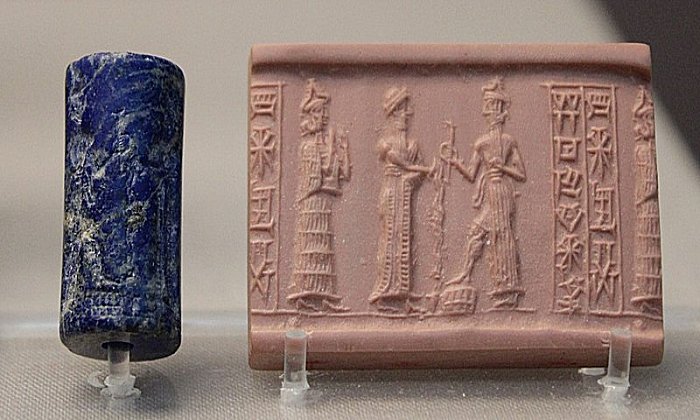
Lapis lazuli cylinder seal. A suppliant goddess (left, with necklace counterweight) stands behind the robed king (center), who pours libation before the ascending sun god, who holds the rod and ring of justice and rests his foot on a rectangular chequered-board mountain. Bur-Dagan, son of Kurub-Adad, inscribed on the seal, is probably the owner's name. From a tomb in Ur, dated c. 1900 BC. BM 121418. Image credit: Zunkir - CC BY-SA 4.0
Shamash was the judge of gods and men.
As a powerful solar deity, Shamash, whose consort was the goddess Aya, exercised the power of light over darkness and evil. In this capacity, he became known as the god of justice and equity and was the judge of both gods and men. At night, Shamash became the judge of the underworld.

This is a preview of our premium article available only to members of Ancient Pages.
Become a member to read more - Click here
If you are already a member and have logged in to your account, you can access the article here

See also:
Mesopotamian God Nabu Inscribed The Human Fates Determined By The Gods
Adapa – Why Did The Wise Apkallu Refuse The Gift Of Immortality?
More From Ancient Pages
-
 Unexplained Lights Over English City Reported By Police May Have A Deeper Meaning
-
 Unexplained Phenomenon In East Anglia – Ancient Mystery Deepens As More Unusual Sightings Are Reported – Part 2
-
 Mysterious Ancient Artifacts Discovered In Virginia That We Were Never Meant To See
-
 Secret Dwelling Place Of Reptilian And Dragon-Like Creatures In Europe
-
 Ezekiel’s Secret Ancient Knowledge About Lost Worlds – Thought-Provoking Theory Examined
-
 Unexplained Mystery In Ohio – Unusual Force Puzzles Scientists
-
 Three Fun Paradoxes Created By Ancient Greek Philosophers To Puzzle Over
-
 Horrifying Flying Head That Terrorized The Iroquois
-
 Viking Ivar The Boneless Could Be Buried In Repton – Remarkable Viking Burial Holds Clues To Where Ragnar Lodbrok’s Son Died
-
 Records Of Pompeii’s Survivors Have Been Found – Archaeologists Are Starting To Understand How They Rebuilt Their Lives
-
 Khopesh Sword – Symbolic Weapon Of The Pharaohs And Emblem OF Egyptian Deities
-
 Unusual Celestial Phenomenon Observed In Ancient Egypt 3,500 Years Ago
-
 Secret Ancient Knowledge Of The Toltecs Examined
-
 House Of Dragons – Stories And British History That Inspired The Beasts Of Westeros
-
 What Happened To The Pythagorean Brotherhood?
-
 Secrets Of A Lake That Could Re-Write Ancient History Of America – Ancient Visitors From Distant Countries – Part 3
-
 Secrets Of The Scarab – Ancient Sacred Symbol In Human History
-
 Nastrond (Náströnd): Grisly Hall Of Corpses – Norse Vision Of Most Terrible Place In Niflheim, Kingdom Of The Dead
-
 Mysterious Ancient Warrior With 12 Toes Puzzles Archaeologists
-
 Mystery Of Paracelsus’s Magical Sword Azoth – Rumors Or Truth?

