
Mystery Of The Lydenburg Heads
A. Sutherland - AncientPages.com - In 1957 a young boy, Karl-Ludvig "Ludi" von Bezing (now famous Austrian-South African mineral collector), saw pieces of some mysterious heads while playing in the field on his father's farm, near Lydenburg, Mpumalanga, South Africa.
He returned to the area a few years later and, over a period of several years, collected the pieces of seven heads. This internationally important discovery is known as the Lydenburg Heads.
The artifacts are one of the earliest known forms of African sculpture in Southern Africa. There are seven hollow terracotta sculptures that are named after the site at which they were discovered in the late 1950s.
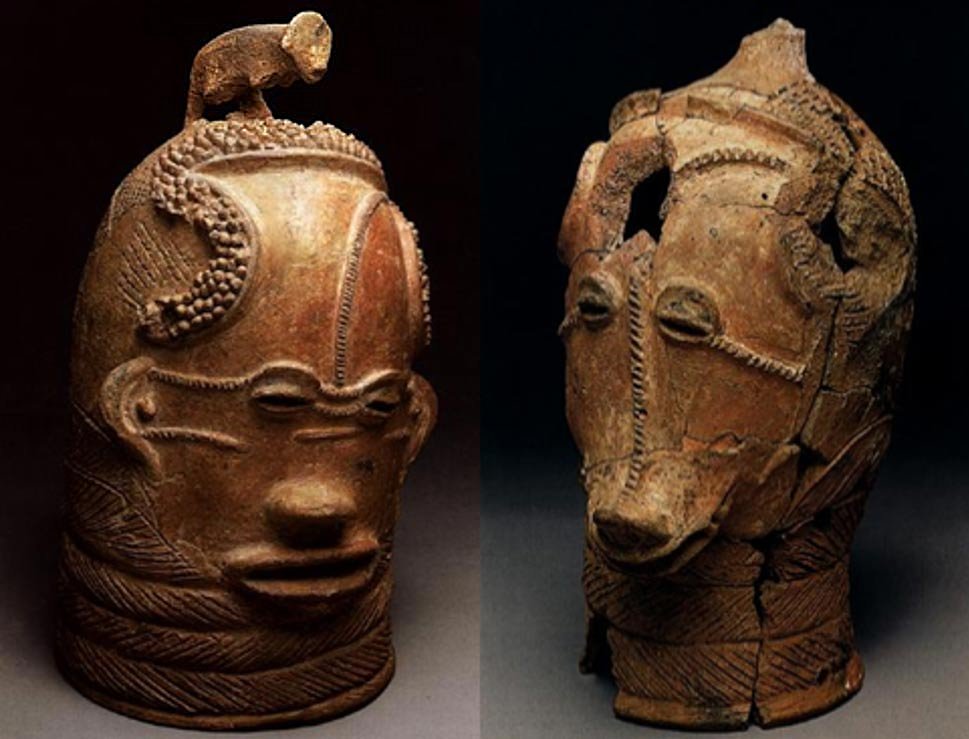
The heads have scarification marks (scars intentionally created to form patterns on the flesh) on the forehead, temples, and between the eyes. Six of the heads are human and the seventh is some kind of an animal replica.
Nearly life-size terracotta heads are ancient masks officially dated back to 500 AD and represent the earliest and unique sculpture found in southern Africa.
Excavations suggest that the heads may have been burned and deliberately buried, rather than just discarded or abandoned.
The reconstructed heads are not identical but do share a number of characteristics. Modeled strips of clay form the thinly opened oval eyes, slightly projecting mouths, noses, and ears, and raised bands decorating the faces, while the backs of the heads are adorned with incised linear patterns.
The columnar necks are defined by large furrowed rings, Necks ringed with fat have been and continue to be viewed as a sign of prosperity by many African peoples.
However, it is currently impossible to know whether the rings on the Lydenburg heads were intended to be read in this way due to the barely sufficient information available on the ancient culture that produced them.
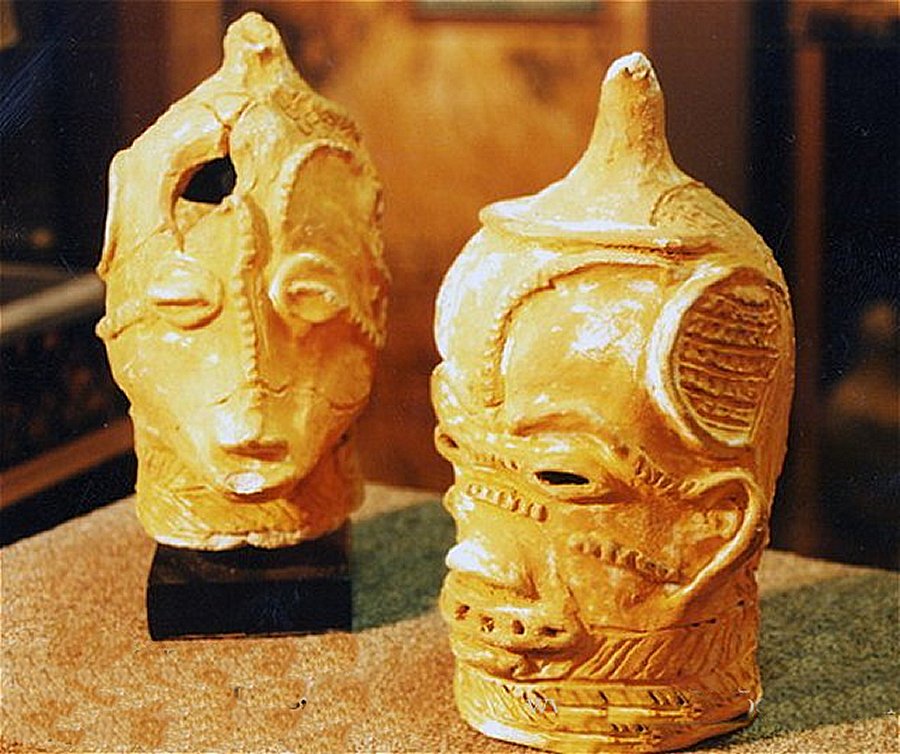
Nearly life-size terracotta heads are ancient masks officially dated back to 500 AD and represent the earliest and unique sculpture found in southern Africa.
The purpose of the heads is obscure.
Little is known of people who created them but the careful manner, in which they were buried suggests that the masks were of significant value for the people who laid them under the ground.
The heads have scarification marks (scars intentionally created to form patterns on the flesh) on the forehead, temples, and between the eyes. Six of the heads are human and the seventh is some kind of an animal replica.
Of the seven heads, two of them are large enough to be worn as helmets and are surmounted by animal figurines. The other five are decorated with a hole on either side of the neck which was likely used to attach them to a costume or structure.
Animals are a common motif in African mask making. They represent the spirit of an animal and one that bears the mask, becomes that animal himself which allows for communication with that animal, for instance, to ask the animal to keep away from the village. In other cases, the animal is a symbol of virtue.
The most common animals that are represented with masks are buffalo, hyena, hawk, crocodile, and antelope. Antelope is one of the most widely used animal masks, additionally, a small unidentifiable animal sits atop one of the Lydenburg heads.
What kind of role did this unrecognizable animal play for the creators of the Lydenburg Heads? While their actual use continues to be a mystery, archeologists have suggested that they were likely used during initiation rituals as in during the rites of enactment that signified the transition to a new social status or perhaps membership into an exclusive group.
In absence of contemporaneous written documents, the only possibility is to guess at the use and meaning of a head such as this one.
The animals appear only on those Lydenburg heads large enough to have served as helmet masks. The original heads are now housed in the Iziko National Musem in Cape Town and their replicas are displayed in the Lydenburg Museum, Lydenburg, Mpumalanga.
Written by – A. Sutherland AncientPages.com Staff Writer
Copyright © AncientPages.com All rights reserved. This material may not be published, broadcast, rewritten or redistributed in whole or part without the express written permission of AncientPages.com
More From Ancient Pages
-
 Bonobos And Chimps: What Our Closest Relatives Tell Us About Humans
-
 Sam Bass – Texas’s Beloved Bandit Who Was Admired By The Poor
-
 The Word Salary Has Roots In Ancient Rome And History Of Salt
-
 On This Day In History: 55 Delegates Convened To Write What Would Become The U.S. Constitution – On May 14, 1787
-
 Female Pharaoh Twosret Was Exploited, Used And Almost Erased From History
-
 Unique 4,000-Year-Old Board Game – Unearthed In Oman
-
 Our Lineage’s Species Formation Pattern Was Unlike Anything Else
-
 Rise And Fall Of City-States In Ancient Mexico And Peru Influenced By Climate Change
-
 9,000-Years-Old Underwater Artifacts Found Off The Western Australia Pilbara Coast – Protect Flying Foam Passage Scientists Say
-
 Ancient City Of Koh Ker Was Occupied Much Longer Than Previously Thought
-
 Mystery Of Monte Albán – Ancient City ‘At The Foot Of The Heavens’ Built By The Zapotecs
-
 Ancient Temple Dedicated To Aztec God Xipe Totec Discovered In Mexico Reveals A Gruesome Story
-
 Mystery Of Nazca’s Controversial Three-Fingered Mummies Continues – Attempt To Confiscate The Ancient Remains!
-
 10,000-Year-Old Human Face Reliefs Discovered At Sefertepe, Türkiye
-
 Masroor Temples – India’s Marvelous Ancient Cave Temples
-
 2.37-Meter Sword And Unusual Shield Mirror Unearthed In Ancient Mound In Japan
-
 Well Of Urd (Urdarbrunn): Abode Of Fate Goddesses And Powerful Symbol In Norse Beliefs
-
 Arch Of Triumph In 2000-Year-Old City Of Palmyra – Destroyed
-
 Genghis Khan Has 16 Million Relatives – You Could Be One Of Them
-
 Jigai – Suicide Ritual For Wives Of Samurai – Feminine Counterpart Of Seppuku

