
AncientPages.com - On May 14, 1787, fifty-five State delegates from every state - except Rhode Island - met in Philadelphia to convene a Federal Convention (Constitutional Convention). The Philadelphia Convention adjourned on September 17, 1787. 38 of the 55 delegates signed the document after three and a half months.
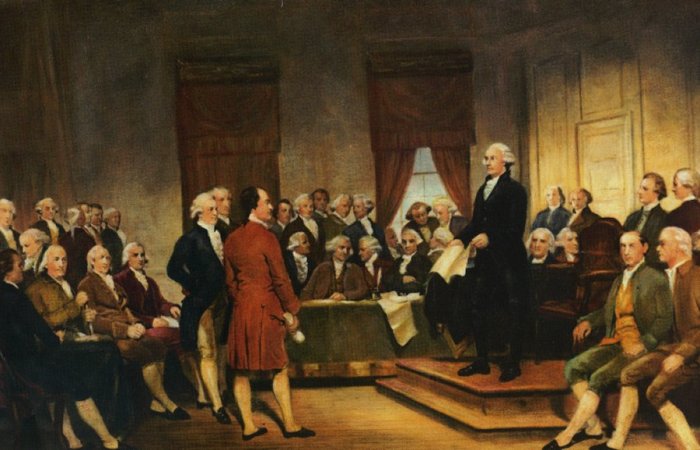
Washington at the Constitutional Convention of 1787, signing of the U.S. Constitution. Photographer: Junius Brutus Stearns, painter / TeachingAmericanHistory.org - Wikimedia Commons
This historical event, one of the most important events in the history of the United States of America, took place in the poorly ventilated Independence Hall of the State House.
The goal of this meeting was to address the problem of governing the new United States of America. The delegates were primarily lawyers, merchants, and planters who represented their personal and regional interests.
George Washington was elected to preside over the Convention, which drafted the Constitution in 1787; it was adopted on September 17, 1787, and ratified on June 21, 1788. Two plans were proposed for such a system.
Not surprisingly, the populous states favored the Virginia Plan, which envisioned representation proportional to population.
The New Jersey Plan, preferred by the small states, called for equal numbers of representatives from each state, regardless of population.
The Convention was productive, and an agreement was reached via the Connecticut Compromise, which incorporated both parts.
The upper house (Senate) would have equal representation from each state, while the lower house (House of Representatives) would assign delegates according to their population.
The Convention gave the federal government full power to tax, borrow money, establish uniform duties and excise taxes, coin money, fix measures and weights, grant patents and copyrights, and build post roads and set up post offices.
The national government had the power to raise and maintain an army and navy and regulate interstate commerce.
It was given the management of Indian affairs, war, and foreign policy; it could control public lands, admit new states, and pass all necessary and proper laws for executing these clearly defined powers.
AncientPages.com
Expand for referencesReferences:
Olson G. Blood Spilled for Freedom: America's Struggle for Survival 1776-1815