
Goibniu: The Sword Smith Of Tuatha De Danann Who Forged Weapons For Battles In Celtic Mythology
A. Sutherland - AncientPages.com - Members of the tribe Tuatha De Danann included many prominent divine personalities such as Dagda, a chief god and his wife, Boann; Morrígan, a goddess of war and fate; Dian Cecht, a god of healing and medicine and his two children, Miach and Airmid; Manannán mac Lir, a god of the sea; Lugh, god of light, sun, and crafts, and his father, Cian.
 Photo by Sigo Paolini. source
Other divinities included Brigid, a fiery goddess of poetry who protects storytellers and bards; Ogma, associated with eloquence and language; and many more magicians and artisans.
We must not forget about Goibniu, a god of metalsmithing, one of the three gods of the craft. He and Creidne, a god of metalworking, and Luchta, the carpenter, helped make magical weapons for the Tuatha De Danann.
Goibniu (his Welsh counterpart was Gofannon, and his Gaulish, Gobannos) is well-remembered from the Second Battle of Mag Tuired as a devoted and tireless armorer, providing Lugh (Lug Lámfhota) with the spear that penetrates Balor's eye.
Goibniu had extraordinary skills and delivered super-lethal weapons. He also made all the best weaponry for the warriors of the goddess Dana.
Goibniu worked with two other gods (perhaps his brothers), Luchta (Luchtain), the carpenter, and Creidne (Creidhnc), the bronze wright, and they were known as the Tri Dée Dána.
In Celtic Mythology: "A Concise Guide to the Gods, Sagas, and Beliefs", we read that "in the great battles between the Tuatha and the Fomorians, Creidne was constantly frustrated by the fact that they would kill the same soldiers, carrying brand new weapons, day after day. In frustration, they sent a spy to the Tuatha camp to discover the secret of this magic.
After coming back, the spy reported that he saw "how Goibniu forged lance heads with three blows of his hammer, while Luchta cut shafts for them with three blows of his ax, and Creidne fixed the two parts together ..."
Goibniu was a master; every weapon forged by him "always found its mark and never failed to kill," and the bodies of the dead and wounded warriors were all dipped in the magic Well of Health ("Tobar Slaine") and were thoroughly restored.
Cauldron Of Plenty, Magical Cow And Magical Drink
He is mentioned next to Dagda as one of the owners of the Cauldron of Plenty (a cauldron that is never dry. It was never empty of food and could also be used to restore life to fallen warriors.
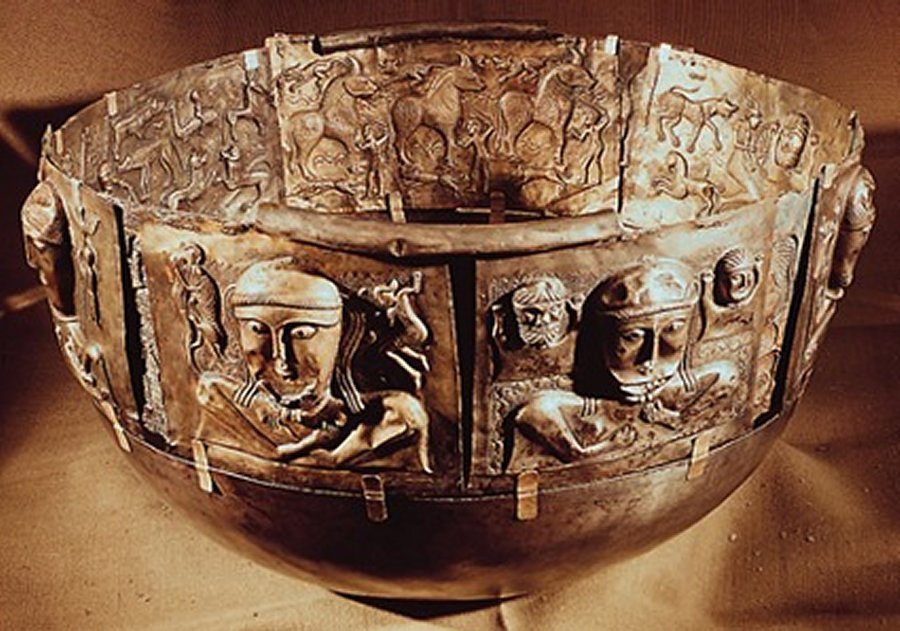
The Gundestrup Cauldron is an impressive artifact associated with the Celtic culture. It is a magnificent vessel made from richly decorated plates of silver that were assembled into a single cauldron. It depicts warriors and other scenery and is dated to the 1st or 2nd century BC. Read more
According to some tales, the magical cow known as Glas Ghoibhneann ("the grey of Goibniu") was supposed to belong to him, and the animal gave an unlimited amount of milk. She would fill any vessel placed under her.
In one myth, Goibniu was also the host of other-worldly feasts, the so-called 'Fled Goibnenn', which took place in the afterlife. The guests consumed vast quantities of an intoxicating drink (now identified as ale). Instead of getting drunk, they were protected from old age and decay.
Goibniu personally served the divine drink to his guests. This potion was widely distributed before significant battles.
Drinks that give supernatural powers are mentioned in many myths and legends. For example, the Amrita granted immortality and strength; it could ensure victory in the fight against demons, with which the gods had to fight to protect the divine drink. References to this miraculous nectar can be found not only in the Rig Veda, the oldest of the sacred books of Hinduism, and in Buddhist or Sikh literature.

Archaeologists and historians have also wondered whether the mead consumed by Norse gods and later Vikings had the healing properties of honey.
Mysterious Lineage Of Goibniu
Goibniu's name derives from the word 'smith' (in Old Irish' gobha' and modern Irish 'gabha'), but not much is known about the crafting god of Tuatha. There is much disagreement regarding his parents and his other relatives.
On the one hand, if we consider his Welsh counterpart, Gofannon, it could theoretically mean that Goibniu was the son of Danu, or even a brother of the chief god, Dagda and Dian Cecht. On the other hand, he could have been a grandson of the war-god Néit, as is Balor, and one of the four sons of Esarg, along with Creidne, Luchta, and Dian Cécht, the healing god.
In an alternate text, he is the brother of the Dagda, Nuadu, Creidne, and Luchta, with whom he helps to conquer Ireland for the Tuatha Dé Danann. In other sources, he was related to Gobán Saor (Gobbán Saor), a highly-skilled smith or architect in Irish history and legend. Or was he perhaps a foster father of Lugh (Lug Lámfhota), a god of the sun or light?
Written by – A. Sutherland - AncientPages.com Senior Staff Writer
Updated on March 24, 2024
Copyright © AncientPages.com All rights reserved. This material may not be published, broadcast, rewritten or redistributed in whole or part without the express written permission of AncientPages.com
Expand for referencesReferences:
MacCulloch, J.A. Religion of the Ancient Celts.
Anne E. Duggan, Donald Haase, Helen J. Callow, Folktales and Fairy Tales
More From Ancient Pages
-
 3,000-Year-Old Wooden Structure Found In Hittite Tunnel Mentioned On Cuneiform Tablets
-
 Archaeologists Discover Long-Lost Scottish Monastery Of Deer And Solve An Old Manuscript Mystery
-
 Has The Viking Ship Burial Of King Bjørn Farmann Been Found At Jarlsberg Manor, Norway?
-
 1,700-Year-Old Roman Shoes And An Exceptional Glass Workshop Unearthed In France
-
 Deciphered Ancient Stone Tablets Contain Sacred Knowledge That Could Re-Write History
-
 Unique Statue Of Roman Emperor Trajan Unearthed In Ancient City Of Laodicea,Turkey
-
 North America’s New Snake Species Deepen Our Understanding Of Reptile Social Behavior And Development
-
 Andvaranaut: Magical Ring That Made Gold And Was Stolen By Norse God Loki
-
 Earliest And Largest Scythian Princely Tomb Discovered In Siberia By Swiss Archaeologist
-
 ‘Impossible’ Ancient Knowledge Of The Gods’ Star – First Observations – Part 1
-
 Lost Laodicea Temple And Seleucid Relics – Archaeological Search Continues
-
 Long-Lost Paleontological Site With More Than 100 Unique Fossils Re-Discovered In Brazil
-
 Acheulian Culture Of Ethiopian Highlands And Their Prehistoric Tool Selection To Make Society’s Life Easier
-
 Giant Mesoamerican Monument Aguada Fénix Was A Cosmogram And Represented The Order Of The Universe
-
 Unique Ancient Man-Made Underground Structure In New England Puzzles Experts – Who Built It And Why?
-
 Neanderthals Had Capacity To Speak And Understand Language Like Humans
-
 Vatican Announces The Death Of Pope Francis On Easter Monday Aged 88
-
 Mysterious Ancient Lost Civilization Of North America Had Interest In One Particular Constellation
-
 The Mysterious Metaphysical World Of Isaac Newton
-
 The 5,500-Year-Old Underground Rock Settlement With Illuminated Galleries In Ancient City Of Hadrianopolis, Turkey

