
Tuatha De Danann: Mythical Race Of God-Like Beings With Supernatural Abilities In Celtic Mythology
A. Sutherland - AncientPages.com - Thousands of years ago, a god-like race of Tuatha De Danann ("children of Dana") came to Ireland. They brought four magical treasures, widely mentioned in early Irish literature.
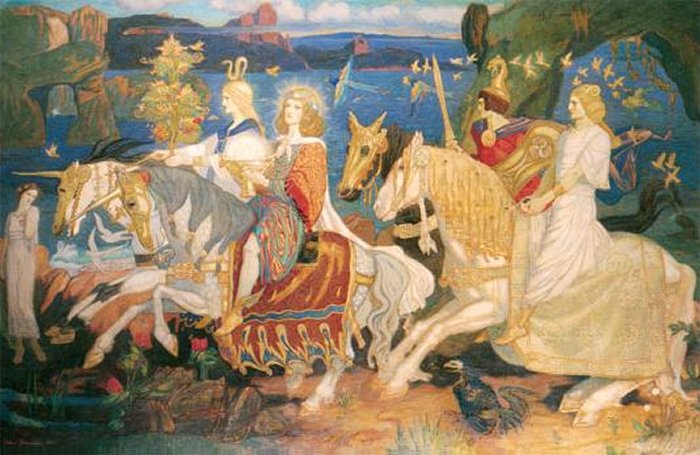
The Tuatha Dé Danann as depicted in John Duncan's "Riders of the Sidhe" (1911) via Wikipedia
These treasures included Lia Fail ("The Stone of Destiny"), the sword of Lugh ("Invincible Spear"), the Sword of Nuada -"Shining Sword," and the Cauldron of the Dagda.
Tuatha De Danann is said to have come to Ireland from the north of Europe, where they had spent many years learning arts and magic. They were large, strong, and beautiful beings that mingled with mortals and remained superior to them.
People believed they were a race of gods or demigods with supernatural powers, human traits and personalities, and a large variety of skills in art, crafts, music, language, love, and war. There were also Druids among them.
Arrival Of Tuatha De Danann
The 'Annals of the Four Masters' (also known as the 'Annals of the Kingdom of Ireland') described medieval Irish history and were compiled by Franciscan monks.
The story of the Tuatha De Danann, a mythical race of god-like beings with supernatural abilities, is told in these chronicles. They came to Ireland across the seas in the mists or a cloud.
Myths and legends also confirm that their arrival produced a magical mist so thick that no one could see their appearance. Some other versions say that they burned their ships to camouflage their arrival and thus, hide from the inhabitants of this land.
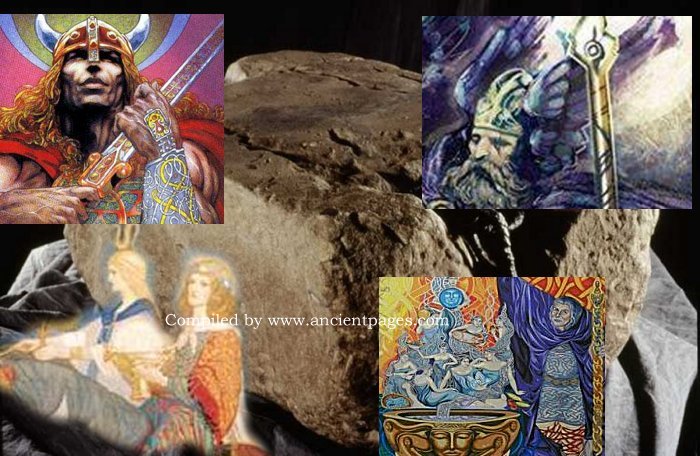
Four Magical Treasures Of Tuatha De Danann - read more
Their principal residences were Brug na Boinne, a district along the river Boyne near Stackallen Bridge in Leinster, one of the provinces situated in the east of Ireland, and the fairy-mound (sidhe = shee) of Femin in Tipperary, in the southwestern part of the country.
The Tuatha De Danann Produced Several Important Leaders
Each member of the Tuatha De Danann (Tuatha Dé Danann) has a special significance, skill, or capacity. Many of the tribe's most famous characters and qualities were mentioned in countless tales set centuries apart, and these sources showed them to be immortal.
One of the prominent members of the Tuatha was Dagda. He was a chief god associated with fertility, agriculture, strength, magic, Druidry, and wisdom.
Other personalities include Morrígan, a goddess of war and fate, and Nuada, the first king of the Tuatha De Danann; Angus (Aengus), a god of youth, beauty, and love; Brigid, a fiery goddess of poetry who protects storytellers and bards; Creidne, a god of metalworking who worked with brass and bronze and forged the weapons, which the Tuatha De Danann used to battle the Fomorians.
Another mythological figure among Tuatha De Danann was Boann (wife of Dagda and mother of Angus). Boann was the Irish river goddess who gave her name to the River Boyne;
We must not forget about Dian Cecht, a god of healing and medicine, and his two children, Miach and Airmid, and Goibniu, a god of metalsmithing. In Tuatha De Danann tradition, Manannán mac Lir, a god of the sea; Lugh, god of light, sun, and crafts; and his father, Cian, also play a crucial role.
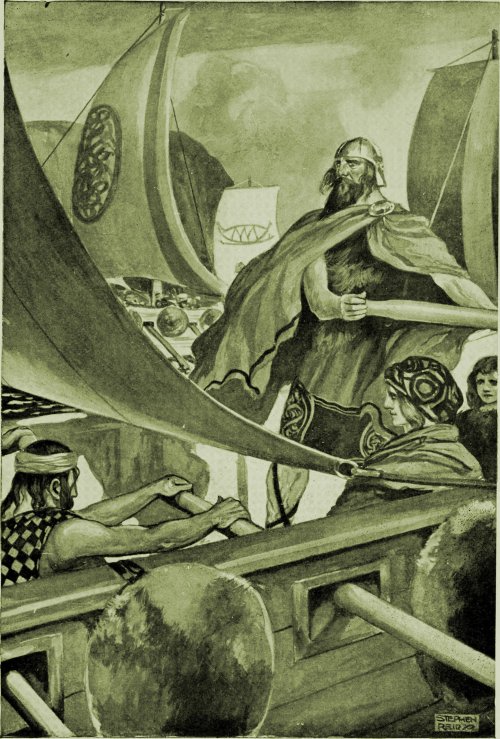
"The Coming of the Sons of Miled", illustration by J. C. Leyendecker in T. W. Rolleston's Myths & Legends of the Celtic Race, 1911
Donn was a god of the dead and the Otherworld, while Luchta, a god of the craft, helped make magical weapons for the tribe, and Ogma was a master of eloquence and language.
Two Victorious Battles Of Tuatha De Danann
The tribe is associated with two great battles of Mag Tuired. In the first of them, they fought the Fir Bolg for the ownership of Ireland, and the Tuatha de Danann won this battle. The Fir Bolg people were offered the Connacht province in Ireland, and the two sides lived peacefully.
In the Second Battle of Mag Tuired, they confronted their traditional rivals, the Fomorians, a symbol of nature's destructive or harmful powers. In this military encounter, the Tuatha were also victorious; however, it was a hard battle. The Fomorian king Balor's poisonous eye killed Nuada, the first king of the Tuatha De Danann, but his grandson, Lugh, killed Balor himself.
Balor struck down many Tuatha De Danann, and he could conquer them all, but first, he had to meet his grandson, Lugh, and confront his skills with his deadly eye. Despite being half-Fomorian, Lugh fought on the side of the Tuatha De Danann, and he played an essential role in the Fomorians' downfall.
Tuatha Dé Danann And The Milesians
For many years, the Tuatha De Danann ruled Ireland in peace until the invasion of the Milesians, a tribe of people.
The "Book of Invasions" says that the Milesians, the last mythical invaders of Ireland and the genuine Gaelic people of Ireland, arrived on Ireland's shores. The Tuatha De Danann tried to fight the invaders; they even created a magical storm to drive them away. The Milesian poet Amergin, however, calmed the sea with his invocation, and then his people landed.
The three queens of the Tuatha De Danann (Banba, Eriu, and Fódla) permitted Amergin and his people to settle in Ireland. Each of the sisters required Amergin to name the island after each.
The Milesian chief decided to call the island after Eriu, and the names of her two sisters were poetic names for Ireland. Then, the Milesians defeated the Tuatha De Danann. Amergin assigned his people to live on the ground while the Tuatha De Danann were led underground into the 'Sidhe' mounds by Manannán mac Lir.
The fairy people of Irish folklore are said to live beneath the hills and are often identified as the remnant of the ancient fabulous race of Tuatha De Danann.
The Irish myths and legends say that 'Sidhe' is the abode of immortals and fairy creatures. Mag Mell is one of such places where the Tuatha De Danann are believed to live forever.
Updated on April 6, 2024
Written by – A. Sutherland - AncientPages.com Senior Staff Writer
Copyright © AncientPages.com All rights reserved. This material may not be published, broadcast, rewritten or redistributed in whole or part without the express written permission of AncientPages.com
Expand for referencesMore From Ancient Pages
-
 Dian Cécht – Celtic Healer Who Cured Many But Killed His Own Son Of Professional Envy
-
 Ancient Recycling Technology Modern World Still Hasn’t Invented
-
 Early Expansion Of Homo sapiens: Underwater Caves Give New Clues About Sicily’s First Residents
-
 The Red Dragon Of Wales – Ancient Symbol Dating Back To Roman Times
-
 On This Day In History: ‘Principia Mathematica’ Monumental Work Published By Isaac Newton – On July 5, 1687
-
 Thor: Brave And Mighty Thunder God In Norse Mythology
-
 Ancient Cities Built By Biblical Giants – Archaeological Evidence
-
 Ukraine – A Place Where People From Different Cultures Intersected Until About 500 Years Ago
-
 Ancient Mystery Of The Unidentified Strangely Dressed Man Found In Massachusetts And His Connection To Undeciphered Rock Carvings
-
 Oldest Houses Of Nea Paphos In Cyprus – Discovered
-
 Beautiful Zeugma-Like Mosaics Unearthed In Sinop Province, Northern Turkey
-
 Nicolas Bourbaki: The Greatest Mathematician Who Never Was
-
 Unique Incense Burner Of Serapis, The Greco-Egyptian Sun God, Found In The Ancient City Of Ephesus
-
 15 Prehistoric Rock Paintings Discovered Near Ancient Armenian City Of Ani
-
 Ancient Trade Routes Between Iran And Mesopotamia – Uncovered
-
 In Ancient California Matriarchal Society, Daughters Breastfed Longer And Women Accumulated Greater Wealth
-
 Unique Well-Preserved 16th-17th Century Fabrics And Shoes Found In Toruń, Poland
-
 First Animals On Earth Could Have Evolved Much Earlier Than The Oldest Fossils Suggest
-
 Munkholmen: Island With Intriguing Yet Dark And Scary History
-
 Prehistoric Temperatures Of North America’s Oldest Archaeological Sites Shed New Light On Ancient Human Migration

