
Cornucopia – ‘Horn Of Plenty’ – Ancient Symbol And Its Almost Forgotten Meaning
A. Sutherland - AncientPages.com - A cornucopia (from Latin 'cornu copiae') - horn of plenty ) is often depicted in paintings and on friezes. It is a hollow horn-shaped container filled with abundant fruit, coins, flowers, grain, nuts, or any other desirable things.
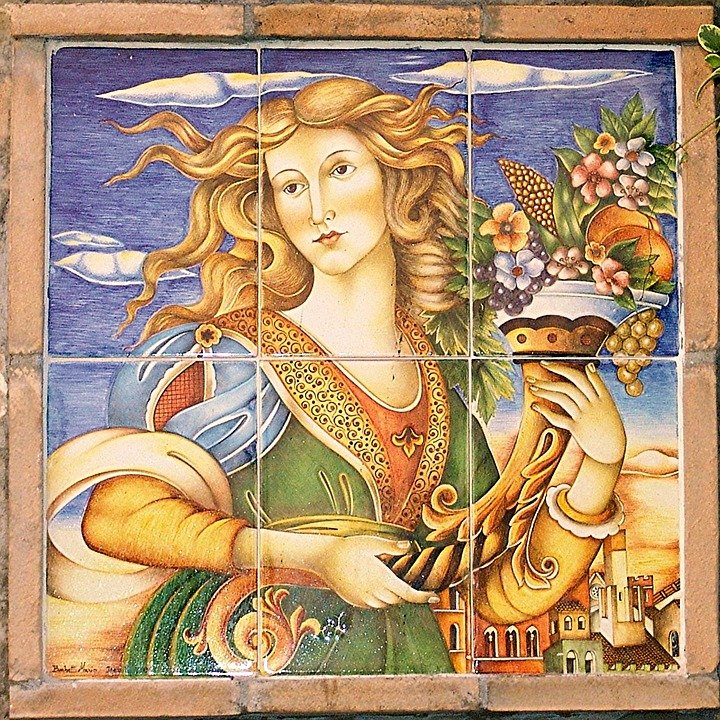 A woman holding a cornucopia. Public Domain
It is an ancient symbol of boundless abundance.
Many of us have a cornucopia at home; it can be made of plastic, wicker, metal, wood, or other materials. It can be symbolically filled with something valuable or simply beautiful.
Cornucopia – a horn of plenty – symbolizes wealth, abundance, fertility, and nourishment. It is highly respected by many ancient cultures, including the Celts, whose concept of abundance was central to their religion.
Initially, it represents a mythical symbol originating from the Mediterranean region of Europe. In North America, the cornucopia is associated with the country's great tradition of Thanksgiving, dating back to the Protestant Reformation in 16th-century Europe but the symbol of cornucopia dates back to very ancient times.
Popular Versions Of Cornucopia's Origin
Several mythological explanations suggest the origin of the cornucopia, some of which date back to the 5th century BC. Two of them are believed to be the most popular.
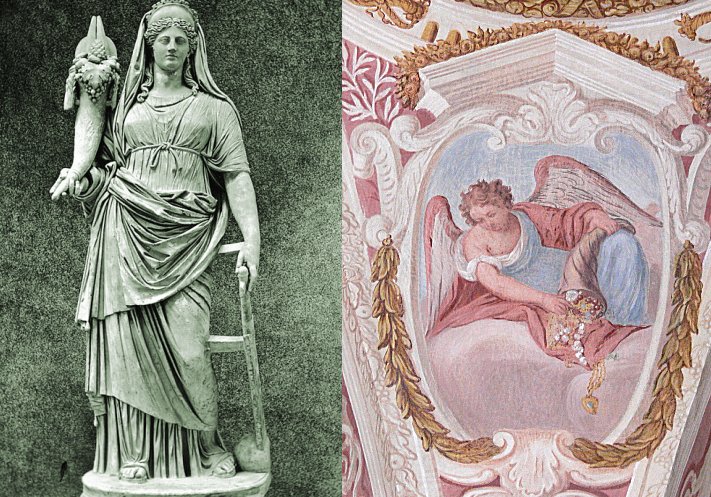
Left: Fortuna, the goddess of good luck, was given the power to bring prosperity to a human being and her attribute is a cornucopia - horn of plenty. Image credit: Vatican, Rome, Italy. Statue of Fortune. Brooklyn Museum; Right: Angel with the horn of plenty. Image credit: Wolfgang Sauber/Wikipedia
According to a version in Greek mythology, the cornucopia belonged to the goat Amalthea ("Nourishing Goddess"), who protected and raised the infant Zeus, who, even as a little boy, had enough strength to break off one of Amalthea's horns while playing. The horn then had the divine power to fill up with everything the owner wanted.
This mythological horn is known as the horn of plenty (cornucopia), and its tradition continues today.
In another myth, the cornucopia was created during one of Heracles' (Roman Hercules) missions to fight with the river god Achelous. During their encounter, Heracles broke off one of his horns.
Gods And Goddesses Were Often Depicted With Cornucopia
The cornucopia became the attribute of several Greek and Roman deities, particularly those associated with prosperity, harvest, or spiritual abundance.
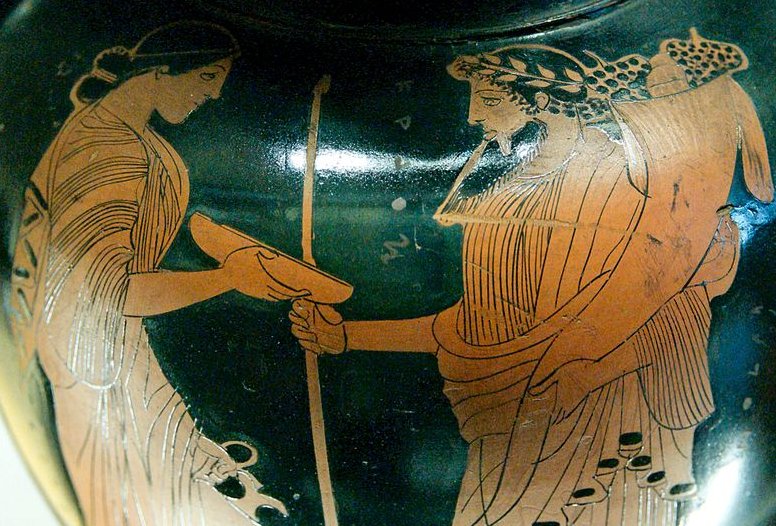
Hades (right-hand side) with a cornucopia and Persephone (left-hand side). Detail from an Attic red-figure amphora, ca. 470 BC. Image credit: Jastrow - CC BY 3.0
Erecura (Aerecura), a goddess often considered Celtic in origin, was often depicted with attributes of fertility as the cornucopia and apple baskets. Also, Epona is associated with cornucopia, Dionysus, and Hades, the god of the underworld and ruler of the dead, who, as Plouton (or Pluto), is a bringer of agricultural, mineral, and spiritual wealth.
In ancient Roman religion, Abundantia was a divine personification of prosperity and abundance. She was often depicted with a cornucopia like the Roman goddess of peace, Pax, who cared for peace (Pax Romana) and wealth and had attributes like an olive branch and a horn of plenty.
Ancient sources confirm that the cornucopia or some versions were found on seals and buildings and imprinted in Jewish coins during the Maccabean times.
A Symbol Of Cornucopia In Ancient Egypt
The cornucopia was also an important symbol for ancient Egyptians.
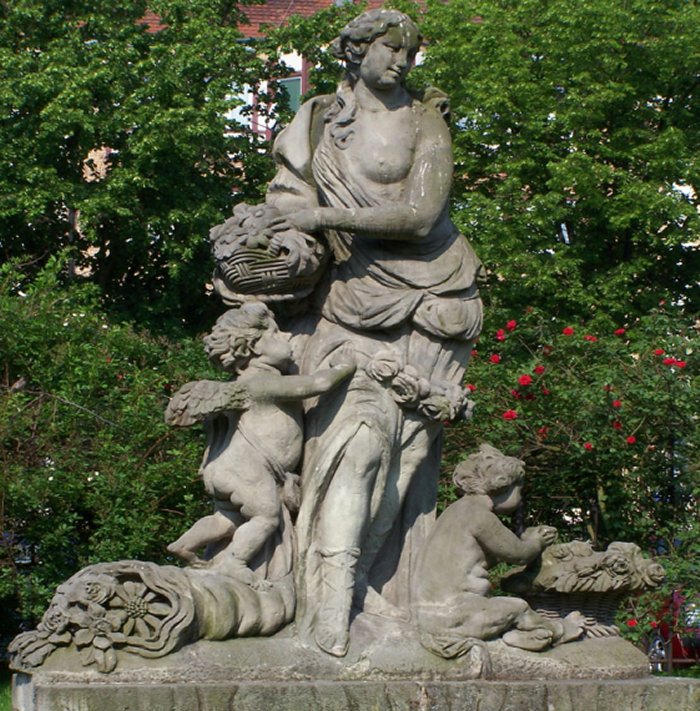 Cornucopia in the Statue of Flora in Szczecin, Poland. Image credit: Remigiusz Józefowicz - CC BY-SA 2.5 pl
"Horus the Child (the Greek Harpocrates, the god of silence and confidentiality) was one of the best-loved. In the early centuries of the Christian era, he was depicted as a child, sometimes seated in a lotus blossom, a ship, or enthroned as a follower of the sun god. Frequently he carries a cornucopia or a jar…' Lewis Spence writes in his book 'Ancient Egyptian Myths and Legends.'
The legendary Cleopatra VII, the last active ruler of the Ptolemaic Kingdom of Egypt, struck several series of silver coins at the mint in Askalon. On one side of these coins, there is her portrait, and on the reverse (back), Ptolemaic coins have exceptionally only a few motifs; one of them is particularly popular (more than 95 percent) and shows a symbol of a cornucopia (on gold coins).
The cornucopia is still a popular decorative motif, although the symbol's very ancient sacred meaning has long been forgotten.
Written by – A. Sutherland - AncientPages.com Senior Staff Writer
Updated on April 3, 2023
Copyright © AncientPages.com All rights reserved. This material may not be published, broadcast, rewritten or redistributed in whole or part without the express written permission of AncientPages.com
Expand for referencesReferences:
Harrison J. E. Themis: A Study of the Social Origins of Greek Religion
Spence L. Ancient Egyptian Myths and Legends
More From Ancient Pages
-
 On This Day In History: King Tut’s Tomb Is Unsealed And Opened – On Feb 16,1923
-
 Where Does The Expression “Pyrrhic Victory” Come From?
-
 Rainbow Was A Powerful Symbol In People’s Ancient Beliefs
-
 Has A Second Sphinx Been Found In Egypt?
-
 Ancient Icelandic Drinking Horn Reveals An Interesting Story About Saint-King Olaf
-
 Ancient Petroglyphs Of Cholpon-Ata And Mysterious Balbals Figures That Guard Grave Sites, Kyrgyzstan
-
 19 Cannons Shot From British Ships During The American Revolution Discovered In Savannah River
-
 Never Before Seen 3D Images Of Noah’s Ark Finally Revealed To The Public
-
 Shieldmaiden Hervör’s Dangerous Quest For The Cursed Tyrfing Sword
-
 Medieval Burials Discovered Under London’s Westminster Abbey
-
 Long-Lost Shipwreck Koning Willem de Tweede Filled With Treasures Discovered By Marine Archaeologists
-
 Central European Early Iron Age ‘Hascherkeller’ Reveals Its Secrets
-
 Long-Lost Mesopotamian Queen Hama Discovered By Student Just By Reading Books
-
 Extraordinary Fossils From The End Of The Age Of The Dinosaurs – Study
-
 Mysterious And Feared Underground World That No One Can Visit And Return To Tell About – Cherokee Reveal A Secret
-
 Unknown Fragments Of Two Euripides Tragedies Found In Egyptian Grave
-
 Ancient Coffin Of Priest Psamtik, Son Of Osiris And Five Replicas Of Goddess Maat Sent On Upcoming Expo
-
 More Than 2,500 Years Old Gallic Tombs Unearthed In Nîmes, Southern France
-
 Trajan’s Market Was The World’s First Known Shopping Mall
-
 Vast Paleogenetic Study Reveals Insights On Migration, Farming And Language Development Across The Southern Arc

