
Well Of Urd (Urdarbrunn): Abode Of Fate Goddesses And Powerful Symbol In Norse Beliefs
A. Sutherland - AncientPages.com - In Norse mythology, Hvergelmir (located in Niflheim) is a "bubbling boiling spring."
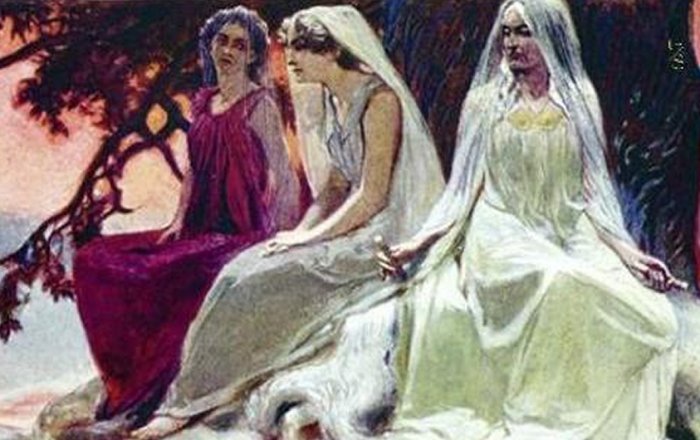
The Norns and the World-Ash. Image credit: Carl Emil Doepler, Jr. (1905) - Public Domain
According to Prose Edda, the spring is one of the three significant springs at the primary roots of the cosmic tree Yggdrasil. Ancient fairy tales in Norse mythology say that this fantastic sacred ash tree had three roots, which sucked water from three different sources.
The other two crucial sources of Yggdrasil's well-being are Mímisbrunnr (Mimir Well) and Urðarbrunnr (Well of Urd, also known as Well of Fate), inhabited by the Norns.
Mímisbrunnr (Mimir Well) keeps wisdom and understanding of the world. The well and Mimir's abode are located beneath the second root of Yggdrasil. Mimir is an enigmatic figure in Norse beliefs, and it is unclear if he is a god or one of the giants. However, he has to guard the well, drink from it daily, and gain wisdom from this source.
The Hvergelmir spring and Mimir Well are sacred, as is the 'Well of Urd' (Urdarbrunnen), a holy place at the base of the sacred ash, Ygdrassil.
The Norns Have Done Both Good And Evil In This World
The three Norns are spinning goddesses and likely live near the sacred 'Well of Urd' in a magnificent hall. They probably originate from a 'dis,' a female ghost or spirit associated with Fate who can be benevolent or hostile.
Norns and Valkyries are sometimes called the so-called 'diser' that have some connection with Fate, and mortals can never avoid it.
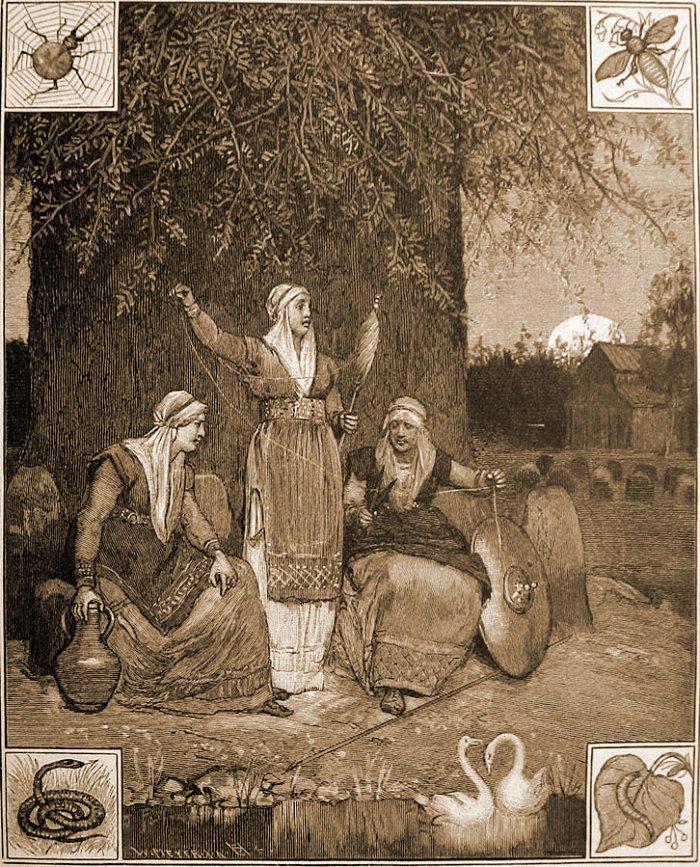
The trio of Norns at the well Urðarbrunnr is depicted in Fredrik Sander's 1893 translation of the Poetic Edda. Wood engraving by L. B. Hansen. PublicDomain
The Norns - three Fate goddesses - are Urd ('Fate'), Skuld ('Being, need/ought to be/shall be'), and Verdandi ('Necessity'), but the origin of the name 'norn' remains uncertain. However, it is reasonable to consider these goddesses in some way connected with the past, present, and future.
In Norse beliefs, they were members of the old fertility family, the Vanir. These ladies devoted all their time to spinning the threads of people's lives, and their job was to take care of people's lives. During the birth of heroes, they made gifts for them or cast curses.
The Gylfaginning (Old Norse: 'The Beguiling of Gylfi') is the first part of the 13th-century Prose Edda and deals with the creation and destruction of the world of the Æsir and many other issues of Norse mythology.
In Gylfaginning, an essential mythological source, it is said that besides the three well-known Norns, others also come to each person at birth to determine his destiny. Some of them are of the race of the gods, others of the Elves or the Dwarfs.
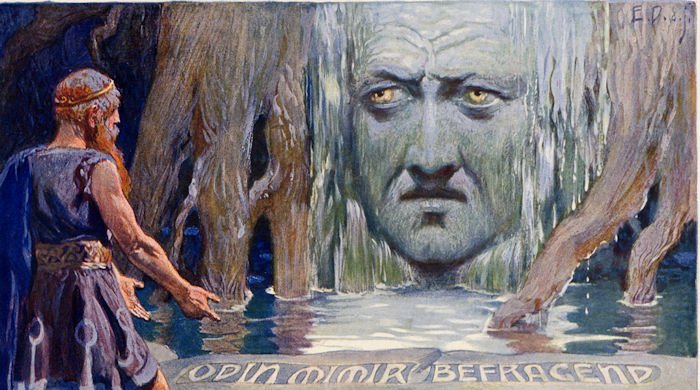
Odin Questions Mimir. Image credit: Carl Emil Doepler, Jr. (1905) - Public Domain
When it comes time for someone to die, they cut off the person's life thread. Sometimes, it gets tangled up, and problems begin in that person's life.
It is worth noting that the Norns have striking and standard features with the Greek and Roman goddesses of Destiny -- the Moirai (Moirae) and the Parcae, the female personifications of destiny who governed the lives and deaths of humans and gods.
Urd spun the thread with the spindle, closely associated with several well-known ancient goddesses, including Frigg and Freya, Egyptian Isis, Greek Artemis, and Athena.
Norse Norns worked with yarns that represented people's lives.
As Mimir's duty was to care for Yggdrasil, the three fate goddesses had to do the same. They draw water and mud from the spring of Urd daily and wet the ash tree, keeping its branches from withering. The water in the 'Well of Urd' was sacred, so everything that entered the source was white. Two swans lived in the Urd spring, and according to an ancient legend, the whole breed of birds once originated from it.
Urdarbrunn - A Powerful Symbol In Norse Mythology
Its waters flowed out at the base of one of the three great roots of the World Tree.
The well contained great powers and was named after Urd, the eldest of the Norns. Perfectly aware of the well's supernatural power, the gods rode their horses to this well each day and sat near the well of Urd, discussing judgment over the world.
The Norns - three Fate goddesses - are Urd ('Fate'), Skuld ('Being, need/ought to be/shall be'), and Verdandi ('Necessity'), but the origin of the name 'norn' remains uncertain. However, it is reasonable to consider these goddesses in some way connected with the past, present, and futur
Written by – A. Sutherland - AncientPages.com Senior Staff Writer
Updated on January 21, 2024
Copyright © AncientPages.com All rights reserved. This material may not be published, broadcast, rewritten or redistributed in whole or part without the express written permission of AncientPages.com
Expand for referencesSturluson, Snorri, Gylfaginning
Baeksted A. Nordiska gudar och hjältar
Barry B. Powell - Classical Myth
Leeming, David. The Oxford Companion to World Mythology
Nicos Walsh - Greek Mythology: Greek Gods Of Ancient Greece And Other Greek Myths
Brate E. Eddan, De nordiska guda- och hjältesångerna
More From Ancient Pages
-
 On This Day In History: Crew Of Discovery Launches Mutiny Against Captain Henry Hudson – On June 22, 1611
-
 Ancient Warming Event May Have Been Trigged By Changes In Earth’s Orbit
-
 The Ancient Giants Who Ruled America: The Missing Skeletons And The Great Smithsonian Cover-Up
-
 Chinese Writing System – Increasingly Complex Over The Course Of Its 3000-Year History
-
 Giant Bath Tub Built For Tsar Alexander I – Why Was It So Large?
-
 Pazyryk Carpet: Extraordinary Craftsmanship Of Siberian Iron Age Textile Dyers
-
 Knights Templar’s Legendary Sword In Stone In Terminillo Mysteriously Disappeared – Where Is It Hidden?
-
 Monumental King’s Grave (Bredarör) In Kivik, Sweden With Spectacular Rock Carvings
-
 Temple Of Lord Vishnu Dated To Hindu Shahi Dynasty Unearthed In Pakistan
-
 Medicine in Antiquity: From Ancient Temples To Roman Logistics
-
 The Phrase Hip Hip Hooray Has Ancient Roots
-
 Balbals – Ancient Stone Guards Of The Kazakh Steppe
-
 Rare Ancient Gold Coin Depicting Emperor Heraclius And Hill Of Golgotha Discovered In Israel
-
 Ancestors Of The Irish And Scots Came From Biblical Lands And Ancient Egypt – Myths, History And DNA
-
 Unique Viking Age Hearths Discovered In Tallinn, Estonia
-
 Bizarre Old Ring With License To Kill
-
 The Name Vatican And Etruscan Goddess Vatika Of The Underworld – What Is The Connection?
-
 Explorers Of Lost City Of The Monkey God Contract Unusual Flesh-Eating Disease
-
 Monks Mound In Ancient Cahokia Was Not What Scientists Previously Thought – New Study
-
 Rare Discovery Of 4,300-Year-Old Copper Ingots Left By Mistake In A Settlement In Oman

