
Tricksters: Mischievous Troublemakers Making Attempts To Help And Hinder In Mythologies Of Ancient Cultures
A.Sutherland - AncientPages.com - In mythologies of many ancient cultures, there is a male figure known as a trickster. Occasionally, this figure has also a nickname 'rogue', 'prankster, or 'cheater'.
His ambiguous character combined both godlike and demonic qualities, which expressed themselves in good and evil deeds.

The trickster could create a good, honest impression on people or gods. He acts as a creator, destroyer, sage, or simply prankster. His actions were often proof of his cunning and cleverness.
Ancient people also talked of trickster's wisdom, his braveness, or how he acted in a cowardly manner. The trickster could be also incredibly selfish, stubborn, and often demonstrated disrespectful behavior.
"There is a character called the Trickster who plays a crucial role in much of the world's mythology and folklore. The Trickster has many incarnations, he is, in the words of Lewis Hyde, "the adept who can move between heaven and earth, and between the living and the dead... he is sometimes the messenger of the gods and sometimes the guide of the souls, carrying the dead into the underworld or opening the tomb..." (Joseph Maurone, 'The Trickster Icon and Objectivism').
Cruelty, a weakness for women, and greed were also familiar to him. If necessary, however, he was able to save the world from monsters and evil rulers, bring gifts to people, and at the same time, provoke quarrels between them.
Sometimes he also brought quarrels between gods and people. A good example is a mischievous god Loki who is involved in many of the Norse myths. The trickster Loki often deceives the gods and creates dangerous situations and causes quarrels, then comes to the rescue of the gods, or is ready to solve troublesome situations.
As we said, trickster that could easily change his personality was a popular figure in mythologies around the world.
See also:
Nurikabe: Trickster That Manifests Itself As Invisible, Impassable Wall In Japanese Old Beliefs
Hermes – Messenger Of The Gods, Divine Trickster, Patron Of Merchants And Thieves In Greek Mythology
Pukwudgie The Trickster: Grey-Faced Humanoid Creature In Native American Beliefs
Askeladden – Little Trickster That Succeeds Where All Others Fail
Kokopelli – Popular Trickster God Of The American Southwest Brought Happiness To People
In African mythology, there are many tricksters; one is Eshu in beliefs of the Yoruba people of present-day Nigeria. He is the magician and troublemaker known for his various disguises and unpleasant mischief; another is Anansi widely known in West Africa. In Polynesian traditions, Maui is a culture hero, famous for his exploits and cleverness.
Aboriginal tricksters, on the other hand, are believed to be humorous mischief-makers and pranksters who really enjoy damaging things. These mythical individuals are known as Wurulu-Wurulu in parts of Australia.
We also must not forget Lord Krishna (one of the most important of the avatars of the god Vishnu) who has several characteristics of a trickster; however, Krishna’s trickery has an essential moral purpose that defeats wickedness.
In Greek mythology, Prometheus is a Titan, culture hero, and trickster figure who is credited with the creation of humanity from clay, and who defies the gods by stealing fire and giving it to humanity as civilization. There is also Hermes, who except for many divine characteristics, is also a trickster god who outsmarts other gods for his own satisfaction.
Trickster Was Important In African And Native American Culture
In African and Native Americans traditions, tricksters played a key role. In myths and legends, they could take the shape of an animal and be capable of using magic.
Iktomi, in Native American beliefs, was a creator figure, a shapeshifter, and a very destructive trickster, mostly to himself.
Depending on the culture and the region, he could appear as a spider, rabbit, fox, crow, raven, frog, and a coyote, which is considered a hero, immortal and trickster.
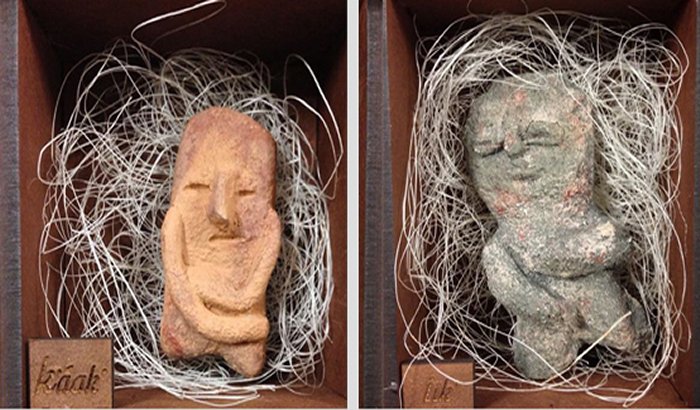
Alux is a little mythical troublemaker and guardian of corn fields in Mayan folklore. Image credit: Xenotes Oasis Maya
The coyote is the most common trickster figure in myths of the Kalapuya tribe of Native Americans, with their traditional homeland in the Willamette Valley, in Oregon. In tales of the Southwest Native Americans, the Coyote trickster is described as having human form and, occasionally, animal form.
Sometimes he helps people, but most often, his impulsive and foolish behavior causes nothing but trouble for everyone around him. Frequently killed through his recklessness, the coyote miraculously comes back to life afterward. The Coyote is credited with bringing humanity the gift of fire.
Written by – A. Sutherland - AncientPages.com Senior Staff Writer
Copyright © AncientPages.com All rights reserved. This material may not be published, broadcast, rewritten or redistributed in whole or part without the express written permission of AncientPages.com
Expand for referencesReferences:
Maurone, Joseph. "The Trickster Icon and Objectivism." The Journal of Ayn Rand Studies 3, no. 2 (2002): 229-58.
Sherman J. Storytelling: An Encyclopedia of Mythology and Folklore
Clute J. Grant J. The Encyclopedia of Fantasy
More From Ancient Pages
-
 Gigantic Viking Age Burial Ground With Artifacts And 50-Meter-Long Shipwreck Unearthed In Tvååker, Halland, Sweden
-
 Famous Runestone Is Not What We Thought And Re-Writes History Of The Vikings – Scholar Argues
-
 The 6th Century Byzantine Church Hidden Within Khirbet Tinshemet’s Woods – Discovered
-
 People Of Old Dongola Recycled And Dyed Clothes
-
 How Was A Viking King Elected And What Was Expected From Him?
-
 Effects Of The Volcanic Eruption In Alaska Rippled Through Ancient Egypt During Cleopatra’s Reign
-
 Roman Ship Cargo And Galley Equipment Discovered Underwater In The Caesarea Harbor
-
 Mysterious Ancient Spiral Structure And Buried Towers Discovered At Angkor Wat
-
 2,000-Year-Old Roman Road Discovered In Cluj-Napoca, Romania
-
 ‘Impossible’ Ancient Traces Of Humans – No, We Are Not The First
-
 African Kingdom Of Axum – Ancient Ruins Of Early Churches Unearthed
-
 Biblical Lydia ‘Woman Of Purple’ Who Run Her Own Business
-
 Omphalos – Mysterious Ancient Sacred Object And Its Meaning
-
 Ancient Skulls From Ukraine Reveal Early Modern Humans Came From The East
-
 Unique Viking Age Shipyard Discovered At Birka Challenges Maritime Activities Of The Viking Age
-
 Beautiful Mosaics Reveal Ancient Secrets Of Unknown Roman City Ucetia In France
-
 Sir William Wallace: Brave Scottish Knight And Legendary Hero
-
 On This Day In History: Battle Of Dormans Was Fought – On October 10, 1575
-
 Mictlan – Underworld Realm Of The Dead In Ancient Aztec Beliefs
-
 Giant 2,000-Year-Old Cat Geoglyph Discovered At Nazca In Peru

