AncientPages.com - How did our species, Homo sapiens, arrive in Western Europe? Published in Nature Ecology & Evolution, our new study analyzes two skull fragments dating back between 37,000 and 36,000 years to conclude that our ancestors came from Eastern Europe and migrated westwards.
These two individuals interbred with Neanderthals and with the very first European Homo sapiens, who arrived around 45,000 years ago and were thought to have become extinct following a major climatic catastrophe.

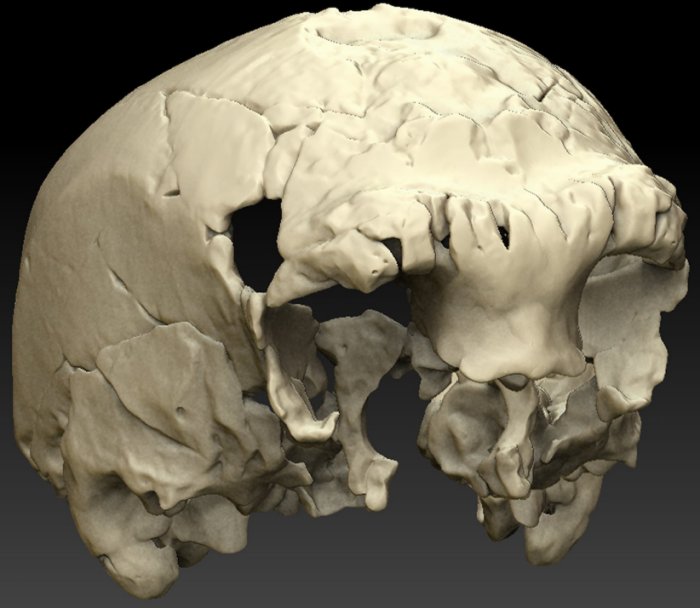
Location of the Buran Kaya III (1), Zlatý Kůň (2), Fournol (3), Serinyà (4), Krems-Wachtberg (5) and Věstonice (6) archeological sites, whose remains were were analysed in the study. Also shown are one of the analysed skull fragments and pierced beads discovered with the bone fragments from the Buran Kaya III site, as well as the Venus statuettes from Věstonice, Willendorf and the Dame de Brassempouy (from right to left). E-M. Geigl, Fourni par l'auteur
Together with lithic tools and pierced mammoth ivory beads, small skull fragments of the two skulls found in 2009 at an archaeological site in the Crimea, Buran Kaya III, bear witness to the presence of anatomically modern humans in Eastern Europe. Working with French and Ukrainian archaeologists, we were able to put in place a sampling protocol that took special precautions to prevent the fragments from being contaminated by modern human DNA and identify their ancient DNA.
The resulting analysis enabled us to generate a broad, up-to-date model of population movements, interactions and replacements as they settled in Europe during the Upper Paleolithic, the period from around 40,000 to 12,000 years ago characterized by the expansion of anatomically modern humans around the world. These individuals are the oldest representatives of Western Europeans to have established themselves permanently in Europe and to have left traces in the genomes of present-day Europeans.
It is estimated they settled in the region after the ice age that took place from 40,000 to 38,000 years ago. In addition to extremely low temperatures, the latter period was also marked by the eruption of a super-volcano in the Phlegrean Fields region near Naples, which left south-eastern and eastern Europe covered in ash. Up to this day, researchers believe that the ensuing ecological crisis wiped out both the last Neanderthal populations and the first populations of sapiens humans of the early Upper Paleolithic. The latter were the descendants of the Homo sapiens populations that came from Africa around 60,000 years ago and left archaeological remains in Europe from around 45,000 years ago, possibly even earlier.
Archaeologically, this was the period of transition between the Middle Paleolithic (250,000 to 30,000 years ago) and the Upper Paleolithic (about 50,000–40,000 years ago until about 10,000 years ago), as the lithic industry of the last Neanderthals was replaced by that of the first Homo sapiens. Their skeletal remains are rare, but the few that were found in archaeological sites in the Czech Republic, Romania and Bulgaria have had their genomes partially deciphered.
Present-day Europeans bear no trace of the genomes of these first sapiens Europeans, unlike the human populations that lived in Europe after the ecological crisis of 40,000 years ago, some of whose genomes have been sequenced.
Homo sapiens from interbreeding
Although the information obtained from the two skull fragments from the Buran Kaya III site is fragmentary, we were able to compare it against the 740,000 genetic variations shared with the genomes of other ancient individuals, a sufficient number to detect their affinities and shared ancestry.
Our paleogenomic analysis of these two fragments, which are thought to be 700 years apart from one another, revealed that these individuals were part of the second wave of European settlement by H. sapiens that occurred after the ecological crisis. Both individuals are descendants of distant interbreeding with Neanderthals. Our study also showed that the more recent individual bore traces of interbreeding with individuals from the first wave of settlement thought to have been exterminated by the -40,000 year ice age, represented by the Zlatý Kůň individual (-45,000 years). We were therefore able to conclude that the first H. sapiens were not completely replaced and some must have survived the ecological crisis.
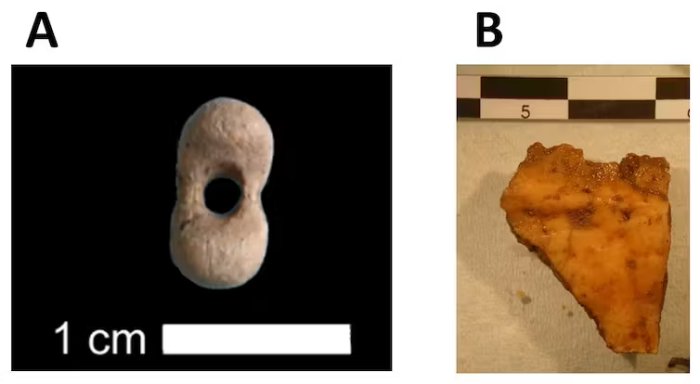
(A) Mammoth ivory pierced bead discovered in the layer of (B) bone fragment analysed in the current study. L. Crépin/E.-M. Geigl, Fourni par l'auteur
The genomes of individuals from Buran Kaya III also revealed a genetic link with contemporary and much later Caucasian populations, in line with similarities identified by archaeologists between lithic tools found in the southern Caucasus and those found at Buran Kaya III at the same period. This link indicates the direction of the migration of Buran Kaya III's ancestors in Europe: from the Middle East via the Caucasus to the territory of present-day Ukraine.
Links with fossils found in France
The strongest genetic link has been identified between the genomes of individuals from Buran Kaya III and those from south-west France (see Fournol archaeological site dating back -29,000 years BC) and north-east Spain (Serinyà, -27,000 years BC) and, to a lesser extent, those from Austria (Krems-Wachtberg, -30,500 years BC) and the Czech Republic (Dolní Věstonice, -31,000 years BC) who lived 5000 to 7000 years later.
These individuals, close to those from Buran Kaya III, were part of the population associated with the Classical Gravettian period, which produced the female ivory statuettes known as the "Gravettian Venuses" found in France, Germany, Austria and the Czech Republic. The famous Venus "Dame de Brassempouy" from the French department of Landes was sculpted at this time.
This genetic link between individuals from Buran Kaya III and those hailing from the Gravettian culture suggests the former were ancestors of the latter and were already practicing a culture that can be described as proto-Gravettian.
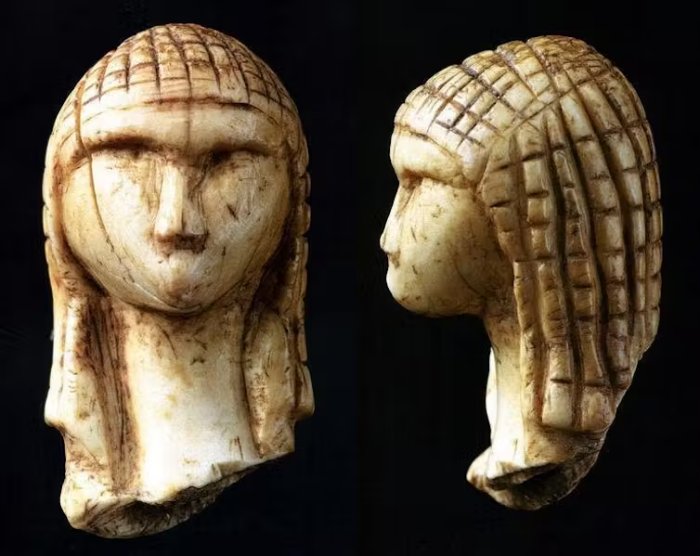
The Venus of Brassempouy, known in French as the Dame de Brassempouy_ or the Dame à la capuche). Jean-Gilles Berizzi/Wikipedia, CC BY
The genetic ties indicate that these populations spread from east to west. Moreover, the lithic tools produced by Crimean individuals have been attributed by Ukrainian archaeologists, in particular Alexandr Yanevich to the Gravettian complex, but this attribution has been rejected by other archaeologists, mainly because of their early date and their location to the east, far from the classic "Gravettian" culture that was produced in central and western Europe between -34,000 and -26,000 years ago, i.e., 5,000 to 7,000 years later and 3,000 km further east.
Our genetic results prove the Ukrainian archaeologists right: the individuals from Buran Kaya III were the ancestors of the Western Europeans, producers of the Gravettian culture and artists of the famous Gravettian Venuses.
Written by Eva-Maria Geigl, Directrice de recherche CNRS, Université Paris Cité and Thierry Grange, Directeur Scientifique Adjoint CNRS INSB Génétique Génomique Bioinformatique, Université Paris Cité
Provided by The Conversation
This article is republished from The Conversation under a Creative Commons license. Read the original article.