
Battle Of Abrittus: Roman Emperor Decius And His Troops Ambushed And Defeated By Invading Goths
A. Sutherland - AncientPages.com - The Battle of Abrittus was one of the greatest battles of the Late Antiquity.
Roman three legions were defeated, and Roman Emperor Trajan Decius (r. 249-251 AD) and his son Herennius Etruscus were killed in battle while trying to stop the barbarian invasion of the Goths.
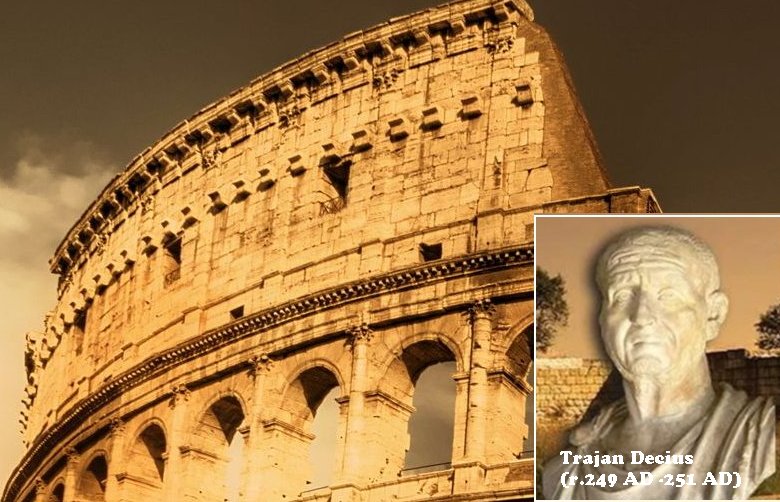
In 2016, archaeologists identified the precise site of the Battle of Abrittus in 251 AD, in the vicinity of today's city Razgrad, in Northeastern Bulgaria. At the time, Abrittus was a significant city and fortress in the Roman province of Moesia Inferior.
In 250 AD, an army of about 70,000 Goths led by chieftain Cniva, one of the Goth's most outstanding leaders, invaded the Roman Empire by crossing the Danube at Novae, one of the few great Roman legionaries along the Danube River.
At first, the Goths were halted by Emperor Trajan Decius at Nicopolis ("City of Victory"). At that time, the capital city of one of many Roman provinces, with a long history going back to 29 BC when Caesar Augustus founded it in commemoration of his victory in 31 BC over Mark Antony and Cleopatra at the Battle of Actium nearby.
Later, however, the Goths returned, attacked, and conquered several Roman cities reaching as far south as Philipopolis (today's Bulgaria's Plovdiv), a very ancient town with reach history of conquests by Thracians, Macedonians, Romans, Byzantines, Bulgarians, and Ottoman Turks.
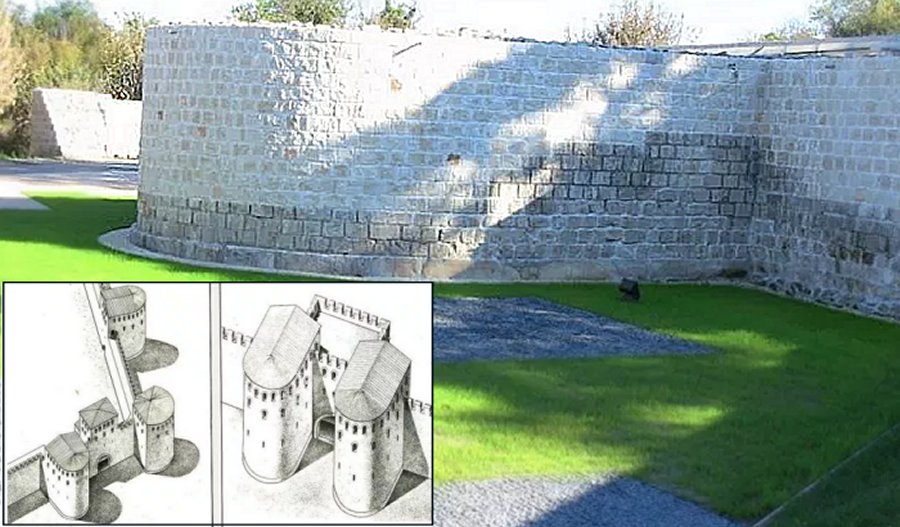 At the beginning of the 4th century AD, during the reign of Roman Emperor Constantine I the Great (r. 306-337 AD), the Romans built a large fortress in Abrittus. The city of Abritus had a fortified area of about 37 acres), four gates, and 35 fortress towers. Images: Abritus Archaeological Preserve
The Goths' ten-year-long raiding finally culminated in the Battle of Abrittus in 251 AD when they met the forces of Emperor Trajan Decius and his son (co-emperor) Herennius Etruscus (c. 227 – June 251. The Roman army was defeated, and Emperor and his son were killed.
Decius wasn't very popular, and despite his several building projects in Rome, he chiefly remained a persecutor of Christians. The latter regarded Decius' death as divine judgment.
The resting place of Decius may be located somewhere in the vicinity of the ancient Abrittus battlefield. The Roman considered flat terrains as an advantage for their legions. Therefore, Decius, his son, and their troops established there their camp.
 Roman and Goth weaponry discovered during archaeological research on the site of the 251 AD Battle of Abritus. Image credit: BNT
At first, Decius' troops surprised the Goths in the frontline, but Gothic chieftain Cniva was a clever strategist and let them take the initiative. Then, he divided his forces into smaller and more mobile units, trying to draw the Romans to the marshlands.
The Romans made the disastrous mistake of pursuing the fleeing Goths directly into the marshes. They were ambushed and routed. Decius, his son, and most of his troops had no way out. Thus, Cniva successfully managed to lure the Romans to the nearby wetland.
"He [Decius] and his son and a large number of Romans fell into the marshland; all of them perished there, none of their bodies to be found, as they were covered by the mud…" wrote Johannes (or John Zonaras), a Byzantine chronicler and theologian who lived in Constantinople.

Emperor Decius died with almost the entire army. It was the first time that not only one but two Roman two emperors perished during a battle with a foreign invader.
Abrittus first emerged as an ancient Thracian settlement established no later than the 5th century BC. It flourished as a Roman and later Byzantine city in the Late Antiquity. The ruins of Abrittus are almost probably located near the town of Razgrad in Northeast Bulgaria.
At the beginning of the 4th century AD, during the reign of Roman Emperor Constantine I the Great (r. 306-337 AD), the Romans built a large fortress in Abrittus. The city of Abritus had a fortified area of about 37 acres), four gates, and 35 fortress towers.
Regardless of the city's strong defenses, however, the Late Antiquity Roman city of Abrittus was conquered and plundered many times by barbarian tribes, including the Goths in 251 AD, and in 376-378 AD, the Huns of Attila in 447 AD, and the Avars and Slavs in 586 AD.

At the end of the 6th century AD, the city of Abrittus declined, and its residents left. So did many other Roman towns and strongholds along the Lower Danube frontier of the Empire, the region which today belongs to Bulgaria.
Today, much of the area of Abrittus remains unexplored but archaeological excavations revealed a large number of artifacts and coins among the ruins.
Apart from the coins, the artifacts found at the site include many Roman Era arms such as parts of swords, shields, spears, armors, graves, and even poles from military tents.
However, one of the most valuable archaeological finds from Abritus is the gold treasure dated to the Late Antiquity that contains 835 coins from the 5th century AD weighing 4 kilograms and dating to the reigns of ten Eastern Roman Emperors and one Western Roman Emperor.
Written by – A. Sutherland - AncientPages.com Senior Staff Writer
Copyright © AncientPages.com All rights reserved. This material may not be published, broadcast, rewritten or redistributed in whole or part without the express written permission of AncientPages.com
Expand for referencesMore From Ancient Pages
-
 7,000-Year-Old Underwater Road Discovered In Adriatic Sea Off Korcula Island
-
 Image Of The Day: The Inghirami Tomb At Volterra, Italy
-
 Caligula: The Sole Roman Emperor Associated With The Plant Hellebore And The Ancient Greek Town Of Antikyra
-
 Mysteries Of The Yellow Emperor – The ‘Son Of Heaven’ From Regulus
-
 Mysterious Hyksos People Rose To Power In Ancient Egypt Through Marriage And Not Invasion – Researchers Say
-
 Weapons Left By Barbarian Tribes Discovered In Polish Forest
-
 Astronomer Johannes Kepler Saved His Mother From Being Burned As A Witch
-
 Riddle Of The Ancient Sarcophagus And Its Strange Properties – Can Science Solve This Mystery?
-
 Beautiful Legend Of Maneki-neko – The Japanese Good Luck Charm Cat Raising A Paw
-
 Mysterious Tiny Pre-Viking Gold Foil Figures Baffle Scientists
-
 On This Day In History: Battle of Salamis Was Fought – On Sep 22, 480 BC
-
 Human Footprints Dating Back 800,000 Years Discovered In Norfolk UK
-
 On This Day In History: Charter Of The Forest Was First Issued On London – On Nov 6, 1217
-
 Mysterious And Powerful Valkyries In Norse Mythology: The Choosers Of The Slain
-
 The Great Stupa At Sanchi – Oldest Stone Structure In India
-
 New Study Reveals Rare Mortuary Treatment Of Egyptian Mummy
-
 Who Were Or Are The Ninja – Those Ancient Spies And Mercenaries?
-
 Beautiful Mosaics In Ancient City Of Germanicia
-
 Secrets Of The Lost Tomb X – Enigmatic Boxes And Unusual Samples – Part 2
-
 On This Day In History: Dante Alighieri Famous For His ‘Divine Comedy’ Born – On May 9, 1265

