
Unusual Viking Women With Elongated Heads On Gotland, Sweden
Ellen Lloyd - AncientPages.com - Archaeological evidence suggests that numerous ancient civilizations practiced artificial cranial modifications. While it is established that Vikings did undergo permanent body modifications, such as dental alterations characterized by horizontal furrows, researchers assert that there is no substantial basis to associate Vikings with the widespread tradition of altering the shape of the head.
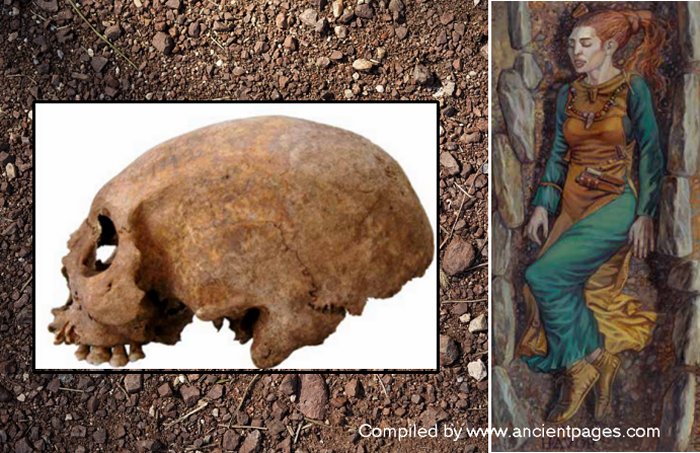
Skull image: Artificially modified skull from the female individual in grave 192 from Havor, Hablingbo parish, Gotland. © SHM/Johnny Karlsson 2008-11-05 (CC BY 2.5 SE) - Viking woman image: Drawing of the grave of the female individual with an artificially modified skull in grave 192 from Havor, Hablingbo parish, Gotland, Credit: Miroslaw Kuzma/Matthias Toplak 2019 - Image compilation AncientPages.com
However, the discovery of three Viking women with elongated heads on the island of Gotland in Sweden gives us reason to consider whether artificial cranial modification was perhaps practiced by a small number of people during the Viking Age.
Vikings And Tooth Modification
Archaeological findings have unveiled that Vikings engaged in the practice of teeth filing, though the reasons behind this remain unclear. This procedure was undoubtedly painful and required a high level of precision, suggesting an advanced understanding of dentistry for the time. Detailed examinations of Viking skulls reveal teeth that have been meticulously filed, with patterns deeply etched into the enamel. The complexity and intricacy of these patterns suggest they were likely crafted by a skilled artisan well-versed in the art of filing. Given its complexity, it is unlikely that individuals could have performed this procedure on themselves.
According to a study carried out by scientists at the University of Gothenburg, Viking did have surprisingly advanced knowledge of dentistry.
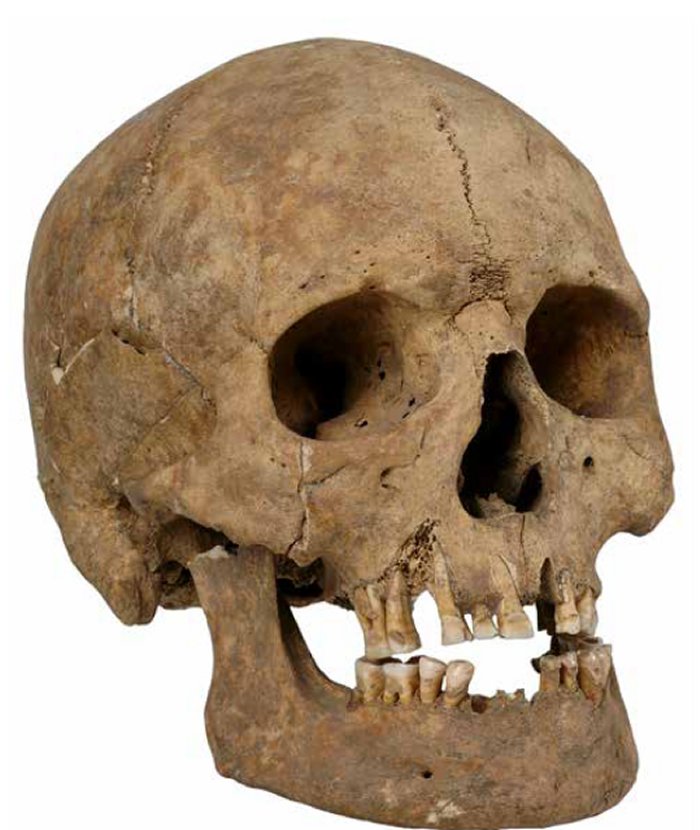
Skull of a male individual with filed teeth and healed fracture from grave 25, Slite, Othem parish, Gotland. Credit: SHM/Gabriel Hildebrand 2011-12-09 (CC BY 2.5 SE).
The research examined 3,293 teeth from 171 people belonging to the Viking Age community in Varnhem, Västergötland, Sweden. The results indicate that dental issues like caries, tooth infections, and toothaches were quite prevalent among the Vikings in Varnhem. Interestingly, though, the study also revealed examples of attempts to look after teeth in various ways.
"There were several signs that the Vikings had modified their teeth, including evidence of using toothpicks, filing front teeth, and even dental treatment of teeth with infections," says Carolina Bertilsson, a dentist and Associate Researcher, and the study's first-named and corresponding author.
Vikings And Artificial Cranial Modification
Artificial cranial deformation, alternatively referred to as cranial modification, head flattening, or head binding, is a custom of intentionally reshaping the human skull. This transformation is accomplished by exerting pressure to interfere with a child's normal skull development. This practice has been adopted by diverse cultures throughout history and geography, leading to an array of unique skull shapes. Head flattening was especially common among women.
According to scientists, the practice of altering the shape of skulls is notably recognized in regions such as Meso-America, South America, Central Europe during the Migration Period, the Caucasus, and various parts of Eurasia. A handful of these modified skulls have been discovered since the Middle Ages in Central and Southeastern Europe. Specifically, they have been found in late Viking Age Wolin in Poland, Slovakia, and predominantly Bulgaria. These findings are believed to be from between the ninth and eleventh centuries. Moreover, several Arab scholars and diplomats have reported tha the tradition of head flattening persisted in Central Asia up until the twelfth century.
Three Viking Women With Elongated Heads
Until now, scientists have only encountered three cases of artificial skull modification from the Scandinavian Viking Age.
Three women from Gotland, who lived in the latter half of the 11th century, stand out significantly from other Scandinavian discoveries due to a unique characteristic—their elongated skulls. These intriguing finds were made years ago at different burial sites scattered across this Baltic Sea island. The most recent excavation dates back to the 1930s.
One of the women was only 25-30 years old when she died, and the other one passed away when she was between 55-60 years old. The age of the third woman remains unknown.
When archaeologists examined the older woman's grave, they discovered it contained jewelry akin to those found in other female graves in Gotland. The researchers are unable to say which deities she worshipped. However, a cross pendant in her grave suggests she might have been a Christian.
DNA analysis revealed that two females were of Gotlandic origin, while the third woman came from the eastern Baltic area, possibly Lithuania.
Scientists have wondered whether the women's relatives, who were respected members of the local community, adopted the practice of skull modifications from southeastern Europe. Alternatively, could it be that foreigners who married into these women's families introduced this peculiar custom?
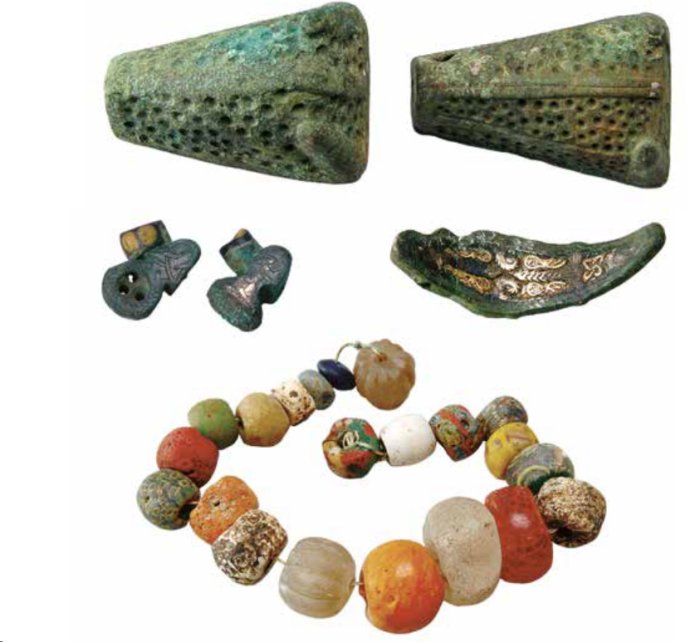
Beautiful jewelry found in one of the tombs belonging to the Viking woman buried on Gotland. Credit: SHM/Bertha Amaya/Elisabet Pettersson 2006-11-29/2006-12-04 (CC BY 2.5 SE)
According to researchers Matthias S. Toplak and Lukas Kerk, who re-examined the Viking burial on Gotland, the cranial modification was imposed on the three females during their earliest childhood to express their affiliation to a particular social group. This embodiment also expressed a form of endogenous interpersonal communication, that is, communication within a larger cultural group. On Gotland, however, this sign was probably unknown to the broader society, to the extent that it must have been interpreted as an 'alien exogenous interpersonal communication.'
Most likely, the local community perceived the three Viking women with elongated skulls as foreigners.
The researchers are inclined to think that these instances are probably unique. The local community probably viewed the three Viking women with elongated skulls as exotic or perhaps even foreigners.
Written by – Ellen Lloyd - AncientPages.com
Copyright © AncientPages.com All rights reserved. This material may not be published, broadcast, rewritten or redistributed in whole or part without the express written permission of AncientPages.com
Expand for referencesEllen Lloyd - Vikings Filed Their Teeth For Unknown Reasons – AncientPages.com
Toplak, M.S. 2015. Prone Burials and Modified Teeth at the Viking Age Cemetery of Kopparsvik: The Changing of Social Identities at the Threshold of the Christian Middle Ages. Analecta Archaeologica Ressoviensia. Vol. 10 pp. 77–97.
Toplak M.S. & Kerk Lukas Body Modification on Viking Age Gotland:Filed Teeth and Artificially Modified Skulls as Embodiment of Social Identities, The Swedish Archaeological Society, Vol. 31 2023
Toplak, M.S. 2018a. Deconstructing the Deviant Burials: Kopparsvik and the Rite of Prone Burials in Viking Age Scandinavia. META. Historiskarkeologisk tidskrift. Vol. 2018 pp. 79–109.
Toplak, M.S. 2018b. The Dead as Resource: The Utilization of Death and Burial for the Construction of Social Identity and Legitimacy in Viking Age Scandinavia. Quaestiones Medii Aevi Novae. Vol. 23 pp. 67–93.
Rodríguez-Varela, R., Moore, K.H.S., [...] Helgason, A. & Götherström, A. 2023. The Genetic History of Scandinavia From the Roman Iron Age to the Present. Cell. Vol. 186(1) pp. 32–46, doi:10.1016/j.cell.2022.11.024.
More From Ancient Pages
-
 Afterlife: Ancient Egyptian Mummification Balms Studied
-
 Clapping To Show Appreciation Is An Ancient And Widespread Behavior
-
 Wreckage of The French Steamship That Sank In Atlantic In 1856 Found Off The Coast Of Massachusetts
-
 Ancus Marcius: Semi-Legendary Fourth King Of Rome Obliged To Make War To Defend And Expend Territories
-
 Mysterious Ancient Structures Hidden Under The Sand In The Sahara Desert Could Re-Write History Of Ancient Egypt
-
 Mystery Of Marquis of Haihun: 2,000-Year-Old Royal Coffin Opened In China
-
 1,800-Year-Old Villa Of Famous Ancient Fisherman Phainos Unearthed In Turkey
-
 Mayas Utilized Market-Based Economics – New Study
-
 Mosaics Discovered In Ancient Galilean Jewish Village
-
 MUL.APIN Tablets: Babylonian Knowledge Of Astronomy And Astrology Recorded In Cuneiform Writing
-
 On This Day In History: Alexander The Great Defeats Darius III Of Persia In The Battle Of The Granicus On May 22, 334 B.C.
-
 Number Eight Powerful Symbol In Ancient Traditions Of Many Cultures
-
 Medieval Rich People Unknowingly Poisoned Themselves With Lead And Other Hazardous Heavy Metals
-
 Mysterious Anomaly In Earth’s Magnetic Field Documented On 3,000-Year-Old Mesopotamian Bricks
-
 Mysterious Watson Brake: Old Mound Complex In North America With Earthworks Raised For Unknown Purpose
-
 Magnificent 2 Meters Tall Marble Apollo Statue And Other Artifacts Found In San Casciano dei Bagni, Italy
-
 Scientists Search For North America’s ‘Atlantis’ – Submerged Landscapes In The Gulf Of Mexico Studied
-
 Reconstructed Face Of A Young Man Who Lived Some 1,300 Years Ago
-
 Ancient Sound Of Stones – Acoustics At Stonehenge Tested By Scientists
-
 Previously Uncounted Copies Of Newton’s Groundbreaking ‘Principia’ – Discovered

