
Why Are Medieval Manuscripts Full Of Doodles Of Snail Fights?
AncientPages.com - The doodles found in the margins of very old manuscripts are often just as interesting as the content of the manuscripts themselves. One such example is the frequently recurring – and extremely odd – image of knights warring against snails.
From the late 13th century through to the 15th century, images of knights fighting snails pop up in all sorts of unlikely places within the medieval literary world. And they reveal fascinating insights into what medieval people thought about the world around them.
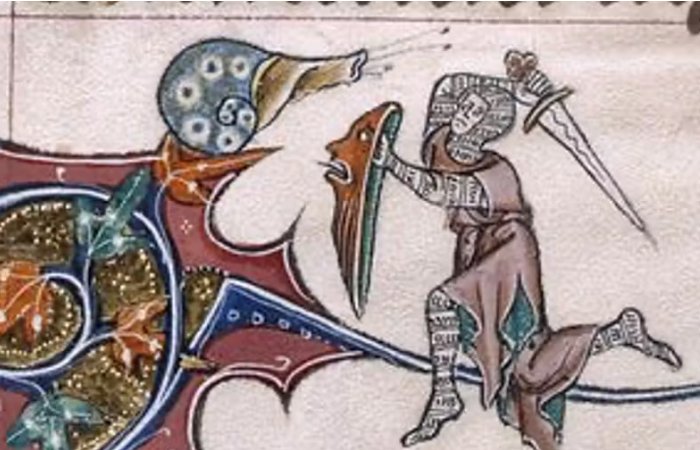
Battle in the margins from the Gorleston Psalter (1310-1324). British Library
Images of knights fighting snails first started to emerge in North French illuminated manuscripts (which are decorated with richly coloured illustrations) towards the end of the 13th century (around 1290). A few years on – although slightly less consistently – these same images started appearing in Flemish and English manuscripts.
Interestingly, in most cases these snail doodles appear to be unrelated to the adjoining illustrations of textual passages.
Often, the doodles depicted an armed knight confronting a snail whose horns were extended and pointing like arrows. In the manuscripts of the French folktale, Le Roman de Renart, the weapons that the knights were depicted with varied between sticks, maces, flails, axes, swords and even forks.
Snail assailants are almost always male knights. However, there is one known instance of a woman opposing a snail wielding a spear and shield.
As these snail combat doodles increased in popularity within manuscripts, they became an accepted element of medieval imagery. From here, they spread to other areas of medieval life.
Decorative panels carved around 1310 on the main entrance of Lyon Cathedral in France, for example, showcase a knight confronting a snail and another man threatening a dog-headed giant snail with an axe.
Despite travelling across the continent, the knights versus snails motif varied little from country to country, which suggests that it may have had a deeper meaning.
Medieval satire
Nobody knows exactly why battles between snails and knights were so popular throughout the middle ages. One theory is that these doodles added humour to texts which were otherwise quite dry and serious.
A reader could rest their eyes by taking a moment to laugh at the scene of snail combat before continuing with their reading.

Extreme jousting from Brunetto Latini’s Li Livres dou Tresor, (c. 1315-1325). Courtesy of the British Library
Many of the doodles show a knight dropping their sword or kneeling submissively before their diminutive shelled foe, which accentuates its satirical implications. There are also several representations of women pleading with knights not to attack the formidable beasts.
Other similarly lighthearted imagery includes a cat stalking a snail with the head of a mouse, as well as dogs, monkeys, dragons and even rabbits in fierce opposition with the molluscs.
The meaning of the snail motif
Snails were recognised in medieval times for their unusual strength, given that they were able to carry their home on their back. Confrontation with a snail, therefore, could represent a test of personal strength as well as mental fortitude.
Once a symbol of deceptive courage, the snail became a creature to be hunted down and destroyed in a display of strength and bravery.
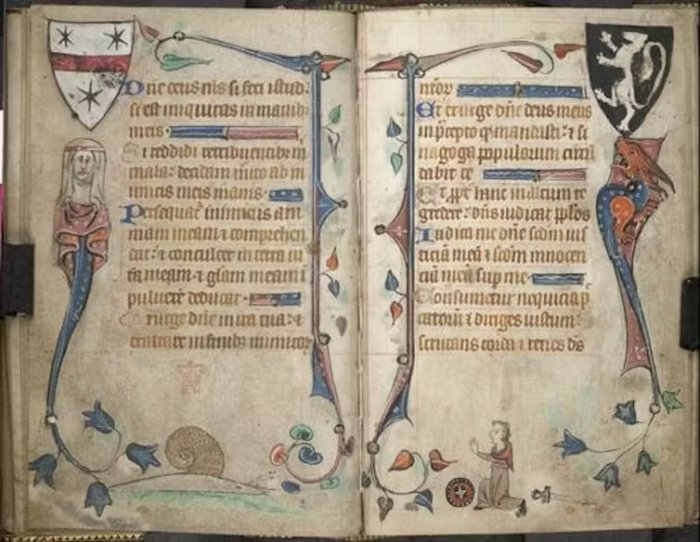
A disarmed monk faces a snail opponent, from The Book of Hours (c. 1320-1330). Courtesy of the British Library
Like many other subjects popularised in marginal illuminations of the 1300s, the snail and knight duo gradually disappeared as time wore on. They experienced a brief revival, however, in medieval manuscripts towards the end of the 15th century.
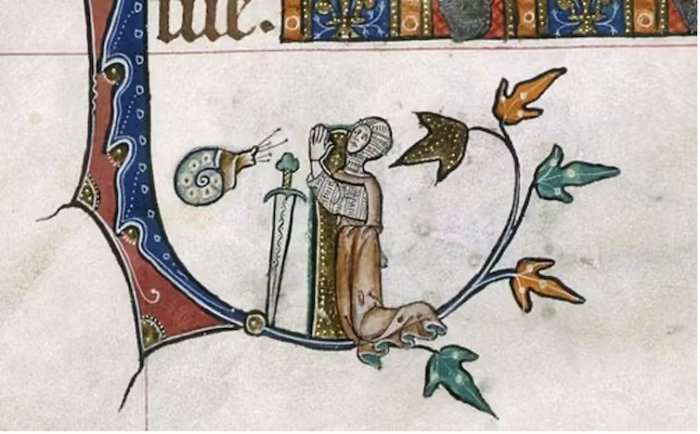
The gastropod conqueror from the Gorleston Psalter, 1310-1324. Courtesy of the British Library

A knight versus snail fight from the Smithfield Decretals ( c.1300-1340). Courtesy of the British Library
And they haven’t completely disappeared from the common imagination. Today the pairing can still be enjoyed in the nursery rhyme, Four-and-Twenty Tailors Went To Kill a Snail:
Four-and-twenty tailors went to kill a snail,
The best man amongst them durst not touch her tail;
She put out her horns like a little Kyloe cow;
Run, tailors, run, or she’ll kill you all e’en now.
Written by Madeleine S. Killacky, PhD Candidate, Medieval Literature, Bangor University
Provided by The Conversation
This article is republished from The Conversation under a Creative Commons license. Read the original article.
More From Ancient Pages
-
 Mysterious Fossilized Antarctic Forest May Offer Evidence Of The Great Flood – But Some Facts Speak Against This Theory
-
 Nazi Photo Album Made Of Human Skin Found At Polish Antiques Market
-
 Ancient City Of Prusias ad Hypium And Ruins Of City’s Theater Known As ’40 Steps’
-
 Is There An Over-Looked Ancient Secret In Sahara?- Intriguing Theory Examined
-
 Does The Shigir Idol Depict Demons And Evil Spirits?
-
 Selene – Greek Goddess Of The Moon And Myth About Love, Jealousy And Punishment
-
 Mystery Of The Bizarre Dark Figure Vanishing Into Thin Air Seen By Hotel Guests And Staff
-
 Fascinating Altamura Man – One Of The Most Complete Neanderthal Skeletons Ever Discovered
-
 Surprising Discovery Of Ancient Sarcophagus At Paris’ Notre Dame Cathedral
-
 Strange History Of Stele Of Ankh-ef-en-Khonsu – ‘Stele Of Revealing’ Gave Birth To Thelema, A New Religion
-
 Enigmatic Footprints Reveal Humans Were In Spain 200,000 Years Earlier Than Previously Thought
-
 Unique 1,000-Year-Old Medieval Golden Treasure Unearthed By Dutch Historian Using Metal Detector
-
 The Norimitsu Odachi – Giant Japanese Sword Remains An Enigma
-
 African Stonehenge – Extraordinary Stone Circles Of Senegambia – Who Were The Unknown Builders?
-
 Cuchulainn: Irish Mythical Hero And His Cruel Magical Spear Gae Bolg
-
 Mysterious Railway Car Discovered Under An Old Fortress In Antwerp, Belgium
-
 Native Americans Helped Shape The Klamath’s Forests For A Millennia Before European Colonization
-
 Ancient Circular Mound Villages Hidden In The Amazon Jungle Represent Native American Cosmos – New LIDAR Discovery
-
 Kalaripayattu – 3,000-Year-Old Indian Martial Art From Which Kung Fu And Karate Emerged
-
 One Of Egypt’s Oldest Christian Churches Discovered By Polish Archaeologists

