
Archaeologists Have Discovered A Mummy Wrapped In Gold – Here’s What It Tells Us About Ancient Egyptian Beliefs
AncientPages.com - In January 2023, a group of archaeologists excavating tombs in the ancient necropolis of Saqqara, near Cairo, discovered the mummified remains of a man named Hekashepes, who lived circa 2300BC. Found inside a limestone sarcophagus in a burial shaft, the body and its wrappings are unusually well preserved for the period.
In the 5th century BC, the Greek historian Herodotus of Halicarnassus described the elaborate way Egyptians preserved their dead. The brain was removed through the nostrils with a hook, while the inner organs were removed through a cut in the abdomen.
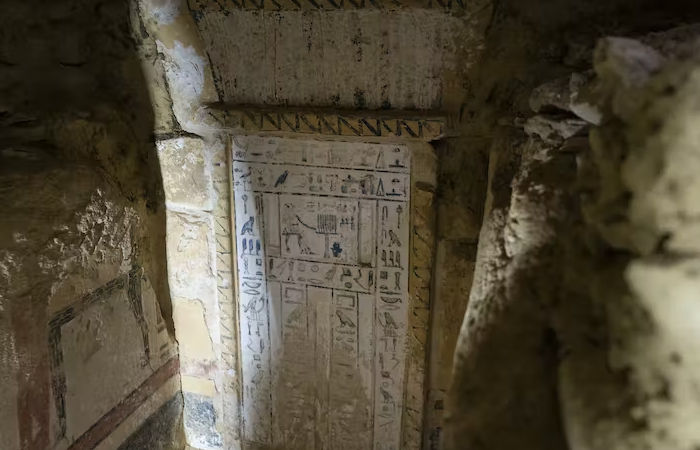
A general view inside one of the tombs recently discovered in Saqqara, including that of Hekashepes. Credit: Mohamed Hossam Eldin
The cut was then stitched up and the body rinsed with wine and spices. The body was left to dry in a natron solution (a substance harvested from dry lake beds and used to absorb moisture) for up to 70 days. After this period, it was carefully wrapped in linen bandages and finally laid to rest inside a coffin.
By the time Herodotus wrote this, Egyptians had been practising mummification for more than two millennia, gradually perfecting the technique through experimentation.
The pre-dynastic mummies of the fourth millennium BC were so well preserved by the dry desert sands – without human intervention – that their tattoos are still visible. The earliest attempts to replicate this outcome by artificial means were less effective so Hekashepes represents an early example of successful preservation.
Why did ancient Egyptians mummify their dead?
Egyptians had long observed that bodies interred in graves without direct contact with the drying sands tended to decompose and sought to prevent this for religious reasons.
Without a physical body to which it could return, they believed the Ka (soul essence) could not partake in food offerings brought to the cemetery and was instead left to roam the world of the living as a harmful spirit.
Mummification techniques were developed in order to preserve the body for the Ka. The earliest methods, which emerged no later than the time of state unification circa 3100BC, involved wrapping the body with resin-soaked linen bandages. However, as the intestines were left in place, the body eventually decomposed.
The lack of preserved human remains from this early period means that archaeologists have limited data on demographics, population health, life expectancy and diet. For this reason, the discovery of Hekashepes’ remains is highly significant.
Scientific examination of the body will provide important insight into the mummification techniques used. Scientific analysis of the skeleton and teeth might also shed light on where Hekashepes grew up, what kind of food he ate, his health, his age and the cause of his death.
How was Hekashepes preserved?
Hekashepes’ arms and legs had been individually wrapped to give the body a life-like appearance, and the head was painted with eyes, a mouth and dark hair. More striking, however, are the gold leaves that had been carefully applied to give the illusion of golden skin.
According to Egyptian beliefs, gold was the colour of the gods, and gilding the bodies of the dead expressed the idea that they acquired divine qualities in the afterlife.
As such, Hekashepes’ loved ones could take comfort in knowing that he would be reborn and rejuvenated in the afterlife, enjoying his favourite food and drink with the gods for all eternity.
What does the discovery teach us?
The archaeologists who uncovered Hekashepes’ sarcophagus also discovered, in a nearby tomb, a group of well-preserved limestone statues depicting men, women and children. These images, which only the wealthy could afford, were made to accompany burials as “reserve bodies” for the Ka to inhabit.
The beautiful statues, on which paint is still visible, depict men with athletic bodies and reddish-brown skin. The women are curvy and pale. Both sexes are depicted with luscious dark hair.
The images reflect gender roles in which men took on active roles in the public sphere, while women stayed indoors and looked after the home. Some of the statues depict women engaged in domestic tasks like grinding grain and baking bread, demonstrating the importance placed on women’s labour in the household.
The statues of married couples depict the husbands and wives affectionately linking arms. Some are shown with their children standing or kneeling by their feet.
The images of married couples and families emphasise the importance of the family as the basic social unit in ancient Egyptian society. Kinship ties were maintained in death and the living had an obligation to provide food offerings to sustain their relatives in the afterlife.
Although it is easy to get the impression that the ancient Egyptians were obsessed with death, the care with which they treated their dead reveals a love for life and a sincere hope of continued existence after death.
The discovery of Hekashepes’ body gives us hope that more well-preserved human remains from the period will come to light and increase our understanding of life in the age of the pyramids.
Written by Maiken Mosleth King, Lecturer in Ancient History, University of Bristol
Provided by The Conversation
This article is republished from The Conversation under a Creative Commons license. Read the original article.
More From Ancient Pages
-
 Mystery Of The Candelabrum: One Of The Most Enigmatic Ancient Giant Ground Drawings In The World
-
 Did Richard The Lionheart Order Assassins To Kill Conrad Of Montferrat, King Of Jerusalem?
-
 Ancient Mystery Of Giant Mounds Of Jerusalem Built For Unknown Reasons – Archaeologists Are Still Baffled
-
 1,700-Year-Old Underground Temple Of Mithras Unearthed In East Anatolia, Turkey
-
 3,000-Year-Old Silver Goblet That May Have Belonged To Mannaea Kingdom – Unearthed
-
 On This Day In History: 150 Highly-Trained Swiss Guards Entered Vatican For The First Time – On Jan 22, 1506
-
 Large Underwater Site That Was Home To 500,000 People About 14,000 Years Ago Identified Northwest Of Australia
-
 Durendal – Magical Sword Of Knight Roland That Cut Stone Boulders With A Single Strike
-
 Rare Discovery Of More Than 18,000 Inscribed Pot Sherds Document Life In Ancient Egypt
-
 Study Of Ancient Skulls Sheds Light On Human Interbreeding With Neandertals
-
 Ancient European Buildings Form A Sacred Symbol When Viewed From The Air – Scientist Reveals
-
 Image Of The Day: Chacmool – Famous Ancient Statue Of Pre-Columbian Mesoamerica
-
 Mysterious ‘Las Labradas’ Petroglyphs With Roots In The Pre-Columbian Times Of Mexico
-
 Unusual Tiny Ancient Dwellings Captivate Archaeologists – Village Of Ancient Dwarves Or Something Else?
-
 Cato The Younger – Mortal Enemy Of Julius Caesar Was A Man Who Hated Luxury, New Ideas And Was Immune To Bribes
-
 Dinosaurs Were On The Up Before Asteroid Downfall – Study Finds
-
 Sharkalishharri Cylinder Seal From The Fifth King Akkad Dynasty
-
 Ancient Mystery Of The Unknown White Bearded Rulers
-
 Two Rare Funerary Busts Rescued From Destruction In Palmyra – Restored In Italy
-
 Ancient Mystery Of The Enigmatic ‘Cat Men’ – The Arrival – Part 1

